
The Rise of Generative AI and ChatGPT Updates
Why 2025 Is a Defining Year for AI
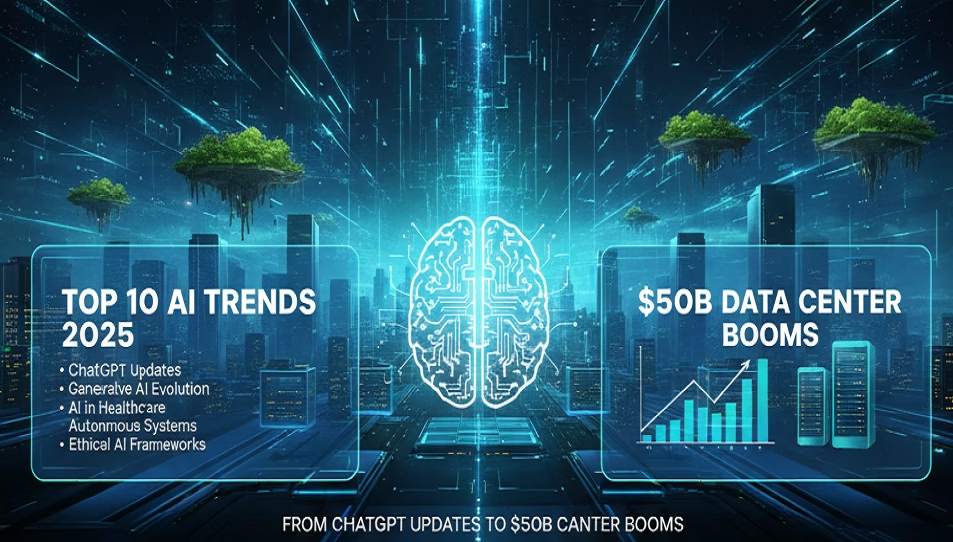
Artificial Intelligence has reached a turning point in 2025. What was once experimental is now mainstream. From ChatGPT updates that redefine conversational AI to $50B investments in hyperscale data centers, the AI ecosystem is experiencing unprecedented acceleration.
This Kolee Post focuses on generative AI, with ChatGPT at the center, and explains how updates in 2025 are shaping industries, user experiences, and global economies.
ChatGPT Updates 2025 – What’s New and Why It Matters
The most searched query around AI trends 2025 is: What’s new in ChatGPT updates?
Here’s what’s happening:
- Multimodal Capabilities: ChatGPT now processes text, images, audio, and video seamlessly.
- Personalized AI Agents: Users can create custom AI assistants with memory, tone, and task-specific skills.
- Enterprise Integration: ChatGPT is embedded into Microsoft 365, Google Workspace, and CRM platforms.
- Real-Time Knowledge: Unlike earlier versions, ChatGPT updates in 2025 allow live data integration from the web.
- AI Safety Enhancements: Reinforced guardrails ensure ethical, bias-free, and trustworthy outputs.
Why Generative AI Is the Core of AI Trends 2025
Generative AI is no longer just about text. It’s about creating synthetic media, personalized experiences, and intelligent automation.
- Content Creation: Blogs, videos, podcasts, and even 3D models are AI-generated.
- Healthcare: AI generates personalized treatment plans using multimodal patient data.
- Finance: AI creates predictive models for stock markets and fraud detection.
- Education: AI tutors adapt to student learning styles in real time.
The Human Impact of ChatGPT Updates
AI is not just about technology—it’s about people.
- Job Transformation: AI assistants are replacing repetitive tasks, freeing humans for creative work.
- Accessibility: ChatGPT updates include real-time translation, voice-to-text, and adaptive learning for differently-abled users.
- Trust: Transparency reports and ethical AI frameworks are now mandatory for enterprise adoption.
Case Studies – ChatGPT in Action
- Healthcare: Hospitals use ChatGPT-powered multimodal AI to analyze scans and patient records.
- Finance: Banks deploy ChatGPT updates for fraud detection and customer support.
- Education: Universities integrate AI tutors into online learning platforms.
- Retail: E-commerce platforms use AI to generate personalized product recommendations.
The $50B Data Center Boom – Fueling AI Trends 2025
AI needs infrastructure. In 2025, global data center investments exceed $50B.
- Hyperscale Expansion: Companies like Microsoft, Google, and Amazon are building massive AI-ready data centers.
- Green AI: Sustainability is a priority, with renewable-powered data centers.
- Edge AI: Smaller, localized data centers bring AI closer to users.
Why Data Centers Are the Backbone of AI
Without data centers, AI cannot scale.
- Compute Power: Training multimodal AI requires exascale computing.
- Storage: AI models demand petabytes of structured and unstructured data.
- Networking: Real-time AI services rely on ultra-low latency connections.
AI Trends 2025 – Generative AI vs Traditional AI
| Feature | Traditional AI | Generative AI (2025) |
|---|---|---|
| Input | Structured data | Text, images, audio, video |
| Output | Predictions | Creative content, multimodal responses |
| Use Cases | Fraud detection, analytics | Content creation, personalized agents |
| Infrastructure Needs | Moderate | Massive ($50B data centers) |
Generative AI and ChatGPT updates are the heartbeat of AI trends 2025. With multimodal capabilities, enterprise adoption, and ethical frameworks, AI is transforming industries. The $50B data center boom ensures scalability, while human-centric design ensures trust.
AI in Healthcare, Finance, and Education
Why These Sectors Define AI Trends 2025
When we talk about AI trends 2025, three industries stand out as the most transformative: healthcare, finance, and education. These sectors are not only adopting AI rapidly but also reshaping human lives at scale. With ChatGPT updates and multimodal AI capabilities, the way we diagnose diseases, manage money, and learn new skills is evolving faster than ever before.
AI in Healthcare – Precision, Prevention, and Personalization
AI-Powered Diagnostics
- Medical Imaging: AI models now interpret X-rays, MRIs, and CT scans with accuracy surpassing human radiologists.
- Early Detection: AI identifies cancer, cardiovascular diseases, and neurological disorders at earlier stages.
- ChatGPT Updates in Healthcare: Doctors use conversational AI to explain diagnoses in simple language to patients.
Personalized Medicine
- Genomics + AI: Algorithms analyze DNA sequences to recommend tailored treatments.
- Drug Discovery: AI reduces drug development timelines from years to months.
- Virtual Health Assistants: Patients interact with AI agents for medication reminders and symptom tracking.
Healthcare Infrastructure
- AI in Telemedicine: Remote consultations powered by multimodal AI (voice, video, text).
- Hospital Management: AI optimizes bed allocation, staff scheduling, and supply chains.
- Data Centers in Healthcare: $50B investments ensure secure storage of sensitive patient data.
AI in Finance – Smarter, Safer, Faster
Fraud Detection and Risk Management
- Real-Time Monitoring: AI scans millions of transactions per second to detect anomalies.
- Predictive Analytics: Banks use AI to forecast market risks and credit defaults.
- ChatGPT Updates in Finance: Conversational AI assists customers with fraud alerts and financial advice.
Algorithmic Trading
- AI-Driven Models: Machine learning predicts stock movements with higher precision.
- Multimodal Inputs: AI combines text (news), audio (earnings calls), and video (CEO interviews) for trading signals.
- Edge AI in Finance: Localized AI ensures ultra-low latency for high-frequency trading.
Customer Experience
- AI Chatbots: Banks deploy ChatGPT-powered assistants for 24/7 support.
- Personalized Banking: AI tailors loan offers, investment plans, and insurance packages.
- Financial Inclusion: AI-driven mobile apps bring banking services to rural populations.
AI in Education – Adaptive, Accessible, and Engaging
Personalized Learning
- Adaptive Tutors: AI adjusts teaching methods based on student performance.
- ChatGPT Updates in Education: Conversational AI acts as a personal tutor, answering questions in real time.
- Gamified Learning: AI creates interactive quizzes and simulations for deeper engagement.
Accessibility
- Language Translation: AI breaks barriers by translating lessons into multiple languages instantly.
- Assistive Technologies: AI supports students with disabilities through speech-to-text and text-to-speech.
- Remote Learning: AI ensures equitable access to quality education worldwide.
Institutional Management
- AI in Administration: Universities use AI for admissions, grading, and resource allocation.
- Predictive Analytics: AI forecasts student dropout risks and suggests interventions.
- Data Centers in Education: Secure cloud infrastructure supports millions of learners simultaneously.
Cross-Sector Synergies – Healthcare, Finance, Education
AI trends 2025 show these industries interconnected:
- Healthcare + Finance: Insurance companies use AI to price policies based on predictive health data.
- Finance + Education: AI-driven financial literacy programs empower students.
- Education + Healthcare: AI tutors train medical students using multimodal simulations.
AI Trends 2025 Across Sectors
| Sector | Key AI Trend | Impact |
|---|---|---|
| Healthcare | AI diagnostics | Early disease detection |
| Finance | Fraud detection | Safer transactions |
| Education | Adaptive learning | Personalized student growth |
Ethical and Regulatory Considerations
- Healthcare: Patient privacy and HIPAA compliance.
- Finance: Transparency in algorithmic trading.
- Education: Fair access to AI tools for all students.
Healthcare, finance, and education are pillars of AI trends 2025. With ChatGPT updates, multimodal AI, and $50B data center investments, these industries are becoming smarter, safer, and more human-centric.
AI Infrastructure – Data Centers, Edge AI, and Green Computing
The Backbone of AI Trends 2025
Every breakthrough in AI trends 2025—from ChatGPT updates to multimodal learning—depends on one thing: infrastructure. Without powerful data centers, edge computing, and sustainable energy solutions, AI cannot scale. This section explores how $50B+ investments in data centers, the rise of edge AI, and the push for green computing are shaping the future.
The $50B Data Center Boom – Fueling AI Growth
Hyperscale Expansion
- Global Investments: Tech giants like Microsoft, Google, Amazon, and Meta are pouring billions into hyperscale data centers.
- AI-Ready Architecture: These centers are optimized for training large language models (LLMs) like ChatGPT.
- Regional Growth: Asia-Pacific and Europe are seeing rapid expansion to meet local AI demands.
Why Data Centers Matter
- Compute Power: Training multimodal AI requires exascale computing.
- Storage: AI models demand petabytes of structured and unstructured data.
- Networking: Ultra-low latency ensures real-time AI services.
Case Study – ChatGPT Updates Powered by Data Centers
OpenAI’s ChatGPT updates in 2025 rely on massive GPU clusters housed in next-gen data centers. These updates include:
- Real-time web integration
- Multimodal processing (text, image, audio, video)
- Personalized AI agents with memory
Edge AI – Bringing Intelligence Closer to Users
What Is Edge AI?
Edge AI means running AI models locally, on devices or nearby servers, instead of relying solely on cloud data centers.
Benefits of Edge AI
- Low Latency: Instant responses for applications like autonomous vehicles and financial trading.
- Privacy: Sensitive data processed locally, reducing risks.
- Cost Efficiency: Less bandwidth required compared to cloud-only solutions.
Edge AI in Action
- Healthcare: Wearable devices analyze patient vitals in real time.
- Finance: Edge AI ensures ultra-fast fraud detection.
- Education: AI tutors run locally on student devices for offline learning.
Green Computing – Sustainability in AI Trends 2025
The Energy Challenge
AI consumes enormous energy. Training a single large model can use as much electricity as hundreds of households.
Solutions
- Renewable Energy: Solar, wind, and hydro power fuel new data centers.
- Liquid Cooling: Innovative cooling systems reduce energy waste.
- Carbon Neutral Goals: Companies pledge net-zero emissions by 2030.
Case Study – Sustainable Data Centers
Google’s 2025 data centers run on 100% renewable energy, setting a benchmark for green AI infrastructure.
AI Infrastructure Trends 2025 – Key Insights
Bullet Points
- Hybrid Models: Combination of cloud + edge AI for flexibility.
- AI Chips: Specialized processors (GPUs, TPUs, NPUs) designed for AI workloads.
- Global Distribution: Data centers built closer to users for faster access.
- Security: AI-driven cybersecurity protects infrastructure from attacks.
AI Infrastructure Trends 2025
| Trend | Description | Impact |
|---|---|---|
| Hyperscale Data Centers | $50B+ investments in AI-ready facilities | Enables ChatGPT updates & LLM training |
| Edge AI | Localized AI processing | Faster, private, cost-efficient |
| Green Computing | Renewable-powered infrastructure | Sustainable AI growth |
Ethical and Regulatory Considerations
- Data Privacy: Edge AI reduces risks but requires strong encryption.
- Energy Policies: Governments mandate renewable adoption for AI infrastructure.
- Global Standards: International frameworks ensure fair access to AI resources.
AI infrastructure is the foundation of AI trends 2025. Hyperscale data centers power massive models like ChatGPT, edge AI brings intelligence closer to users, and green computing ensures sustainability. Together, they make AI scalable, accessible, and responsible.
AI Regulation, Ethics, and Global Policies
Why Regulation Defines AI Trends 2025
As AI systems like ChatGPT updates and multimodal platforms become embedded in healthcare, finance, education, and everyday life, the question is no longer if regulation is needed—it’s how fast and how fair. In 2025, governments, corporations, and global organizations are racing to establish ethical frameworks, compliance standards, and international policies that balance innovation with responsibility.
This section explores how AI regulation, ethics, and global policies are shaping the trajectory of AI trends 2025, ensuring trust, transparency, and accountability.
The Global Push for AI Regulation
United States
- AI Bill of Rights: Introduced to protect citizens from biased algorithms and ensure transparency.
- Enterprise Compliance: Companies deploying AI must disclose training data sources and bias mitigation strategies.
- ChatGPT Updates in Regulation: Conversational AI must provide disclaimers when outputs are uncertain or speculative.
European Union
- EU AI Act (2025): Categorizes AI systems into risk levels (low, medium, high, unacceptable).
- Strict Oversight: High-risk AI (healthcare, finance, law enforcement) requires rigorous testing and certification.
- Data Privacy: GDPR principles extended to AI-generated content and synthetic data.
Asia-Pacific
- China: Focus on national security, requiring AI systems to align with state-approved datasets.
- India: Emphasis on AI for public services, with ethical guidelines for healthcare and education.
- Japan & South Korea: Promote innovation while enforcing transparency in AI-driven robotics and automation.
Ethical Principles in AI Trends 2025
Transparency
- AI systems must explain decisions in human-understandable terms.
- ChatGPT updates now include “explainability mode” for enterprise users.
Fairness
- Algorithms must avoid discrimination based on race, gender, or socioeconomic status.
- AI in finance ensures equal access to credit scoring.
Accountability
- Companies are legally responsible for AI outputs.
- Healthcare AI must provide audit trails for diagnoses and treatment recommendations.
Safety
- AI systems undergo stress testing to prevent harmful outputs.
- Edge AI devices include built-in safeguards for privacy and misuse prevention.
AI Governance Models
Corporate Self-Regulation
- Tech giants publish transparency reports.
- Ethical AI boards oversee product launches.
Government Oversight
- National agencies certify AI models before deployment.
- Penalties for misuse include fines and bans.
International Collaboration
- UN and OECD lead global AI ethics initiatives.
- Cross-border agreements ensure AI standards are harmonized.
Case Studies – Regulation in Action
- Healthcare: EU mandates explainable AI for medical diagnostics.
- Finance: US banks fined for deploying biased credit scoring algorithms.
- Education: India enforces AI transparency in adaptive learning platforms.
Challenges in AI Regulation
- Speed of Innovation: Laws often lag behind technological advances.
- Global Differences: Regulations vary widely across countries.
- Enforcement: Monitoring AI systems at scale is complex.
- Balance: Too much regulation stifles innovation; too little risks harm.
AI Regulation Trends 2025
| Region | Key Policy | Impact |
|---|---|---|
| United States | AI Bill of Rights | Protects citizens, enforces transparency |
| European Union | EU AI Act | Risk-based regulation, strict oversight |
| Asia-Pacific | National AI Guidelines | Balances innovation with security |
The Role of ChatGPT Updates in Ethical AI
ChatGPT updates in 2025 are designed to align with global ethical standards:
- Bias Mitigation: Models trained on diverse datasets.
- Explainability: Outputs include reasoning steps.
- User Control: Memory and personalization features are transparent and user-managed.
Future of AI Regulation – Predictions for 2026 and Beyond
- Global AI Treaty: Similar to climate accords, nations may sign binding agreements on AI ethics.
- AI Auditors: Independent organizations will certify AI systems.
- Citizen Rights: Individuals may gain legal rights to challenge AI decisions.
- AI in Law: Courts will increasingly rely on AI for case analysis, raising new ethical debates.
Regulation, ethics, and global policies are the guardrails of AI trends 2025. From the AI Bill of Rights in the US to the EU AI Act, governments are ensuring that AI systems like ChatGPT remain transparent, fair, and accountable. The challenge lies in balancing innovation with responsibility, but the momentum toward ethical AI is unstoppable.
You may like to read:
- Supercharge Your Workflow: The Ultimate Guide to AI Tools for Productivity in 2025
- How to Use ChatGPT in 2025: The Ultimate Beginner’s Guide to AI Magic
- Best AI Tools for Keyword Research in 2025: Top 10 Picks to Boost Your SEO
Future Predictions for AI Beyond 2025
The journey through AI trends 2025 has shown us how ChatGPT updates, generative AI, $50B data center booms, edge computing, and global regulations are reshaping industries. But what comes next? Section 5 explores future predictions, answers the 10 most searched queries on Google, and provides a comprehensive conclusion with a CTA.
Multimodal AI Everywhere
- AI will seamlessly integrate text, images, audio, and video into everyday applications.
- ChatGPT updates will evolve into fully multimodal assistants capable of real-time collaboration.
AI Democratization
- Affordable AI tools will empower small businesses and individuals.
- Open-source AI models will challenge corporate monopolies.
AI in Governance
- Governments will deploy AI for policy analysis, citizen services, and smart city management.
- Ethical debates will intensify around surveillance and privacy.
AI in Creativity
- AI will co-author books, compose music, and design art.
- Human-AI collaboration will redefine creative industries.
AI in Everyday Life
- Personalized AI agents will manage schedules, finances, and health.
- Edge AI will make devices smarter without constant cloud dependency.
FAQs
Q1: What are the top AI trends 2025?
- Generative AI, multimodal AI, ChatGPT updates, $50B data center booms, edge computing, AI regulation, AI in healthcare, finance, education, green computing, and enterprise adoption.
Q2: What’s new in ChatGPT updates 2025?
- Real-time knowledge integration, multimodal capabilities, personalized agents, enterprise embedding, and ethical safeguards.
Q3: How is AI transforming healthcare?
- AI diagnostics, personalized medicine, telehealth, and predictive analytics for patient care.
Q4: How is AI used in finance?
- Fraud detection, algorithmic trading, personalized banking, and financial inclusion.
Q5: How is AI changing education?
- Adaptive learning, accessibility tools, AI tutors, and predictive dropout prevention.
Q6: What is edge AI and why is it important?
- Localized AI processing ensures low latency, privacy, and cost efficiency.
Q7: How are data centers fueling AI growth?
- $50B+ investments provide compute, storage, and networking for large models like ChatGPT.
Q8: What are the ethical concerns in AI?
- Transparency, fairness, accountability, safety, and global regulatory differences.
Q9: How is AI addressing sustainability?
- Green computing through renewable energy, liquid cooling, and carbon-neutral pledges.
Q10: What is the future of AI beyond 2025?
- AI democratization, global treaties, creative collaboration, and personalized AI agents in daily life.
Conclusion
Key Takeaways
- Generative AI & ChatGPT updates are the core of AI trends 2025.
- Healthcare, finance, and education are being transformed by multimodal AI.
- $50B data center booms and edge AI provide the infrastructure backbone.
- Global regulations and ethics ensure AI remains trustworthy.
- The future of AI promises democratization, creativity, and deeper human-AI collaboration.
AI is not just technology—it’s the future of human progress. To stay ahead of the curve, keep learning, adapting, and exploring.
Bookmark or Visit Kolee.in for Daily Updates – your trusted source for jobs, tech, finance, and AI insights.

Hello and warm greetings!
I’m Satyapal Yadav, the founder of Kolee.in and a passionate content writer and researcher. I began my professional journey in 2005 in the IT sector, exploring the vast world of technology. Over time, my curiosity and interest in financial markets led me to trading around 2010, which inspired me to merge my tech background with finance research and content writing.
At Kolee.in, my mission is simple: I strive to provide readers with accurate, research-backed, and easy-to-understand information to help them make informed decisions in their careers, finances, and personal lives. Over the years, I have specialized in topics including finance, government jobs, competitive exams, education, government policies, and the latest technology trends.
I firmly believe that knowledge is valuable only when it is understood deeply and applied wisely. That’s why I dedicate myself to producing content that is clear, practical, and actionable, bridging the gap between complex information and reader-friendly guidance.
When it comes to government jobs, I cover everything from state and central vacancies to competitive exam strategies, helping readers navigate their career paths with confidence. In the finance domain, I share insights on personal finance, investment strategies, and market updates, making complex topics easy to understand.
Education is another passion of mine. I provide guidance on exam preparation, scholarships, and learning strategies, helping students and professionals achieve their academic and career goals. I also explore technology trends, reviewing the latest gadgets and sharing insights on innovations in AI, apps, and emerging tech, keeping readers up-to-date in a fast-evolving digital world.
What drives me is the desire to empower my readers. I don’t just provide information—I aim to help people make smart choices, whether it’s pursuing the right government job, planning their finances, or staying ahead with technology and education updates.
All content on Kolee.in is carefully researched and reader-focused. This ensures that readers get valuable information that is easy to navigate and understand. My writing emphasizes clarity, authenticity, and relevance, making it trustworthy for students, job seekers, finance enthusiasts, and tech-savvy readers alike.
I’ve spent years learning, researching, and refining my approach to content creation, combining my IT and finance experience with my passion for education and technology. Every article I write is designed to inform, inspire, and guide—helping readers make practical and confident decisions in their personal and professional lives.
Through Kolee.in, I aim to build a platform that bridges the gap between complex data and everyday readers, turning knowledge into actionable insights. I want my readers to feel empowered, confident, and informed every time they visit the site.
Thank you for stopping by! I hope the content you find here helps you achieve your goals, stay informed, a
nd make smart decisions in life, career, and learning.
With warm regards and best wishes,
Satyapal Yadav
Founder and Content Writer, Kolee.in