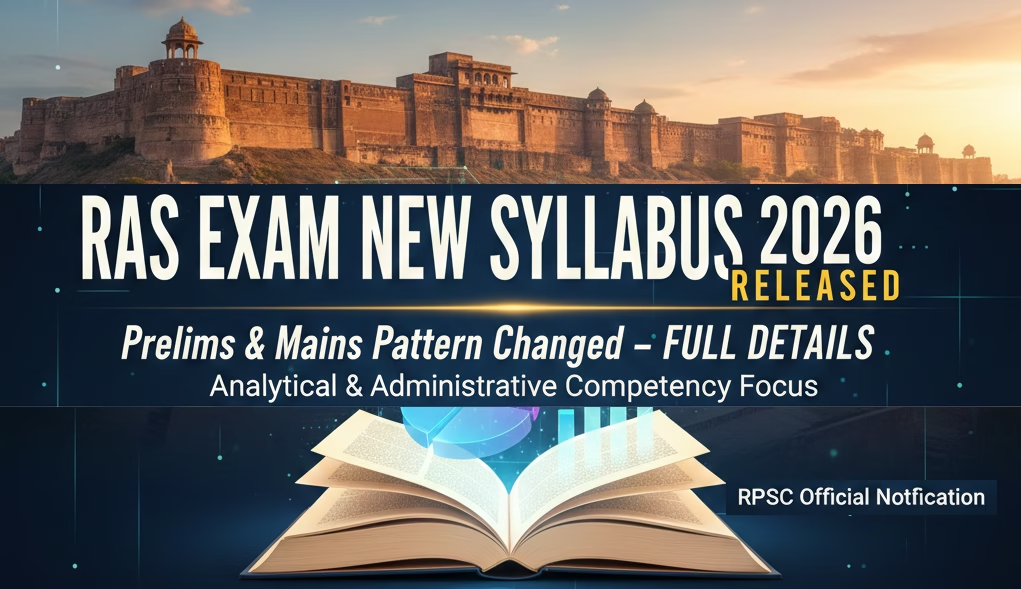
RAS Exam New Syllabus 2026 Released: Why This Change Matters More Than You Think
The release of the RAS Exam New Syllabus 2026 is not just another routine notification by the Rajasthan Public Service Commission. It marks a decisive shift in how future administrators in Rajasthan will be evaluated, filtered, and finally selected. For aspirants who have been preparing with outdated assumptions, this change redraws the entire preparation map.
Unlike earlier years, where aspirants could rely heavily on static notes, repetitive PYQs, and selective memorisation, the new RAS syllabus is deeper, more analytical, and sharply aligned with real administrative challenges. The intention is clear: RPSC wants thinkers, not crammers.
This first section explains why the syllabus was changed, what exactly has shifted at a conceptual level, and how aspirants must recalibrate their preparation immediately.
Why RPSC Introduced the RAS Exam New Syllabus 2026
Every major syllabus overhaul happens for a reason. In the case of RAS Syllabus 2026, multiple long-standing issues triggered this reform.
Declining Quality of Administrative Output
Over the past decade, Rajasthan—like many states—has faced increasing governance complexity:
Digital governance implementation
Climate-linked administrative decisions
Social justice and welfare targeting
Centre–State coordination challenges
The older RAS syllabus was content-heavy but context-light. It tested what candidates knew, not how they would apply it as officers.
Over-Reliance on Coaching-Centric Preparation
Another concern was the predictability of questions. Coaching institutes had effectively “decoded” the exam:
Repetitive prelims questions
Formula-based mains answers
Minimal originality in writing
The RAS Exam New Syllabus 2026 intentionally disrupts this predictability.
Alignment With National-Level Civil Services Thinking
RPSC has clearly moved towards a UPSC-inspired but Rajasthan-focused evaluation model:
Conceptual clarity over rote facts
Governance and ethics embedded across papers
Strong linkage between Prelims and Mains
This does not make the exam harder.
It makes the exam fairer and more relevant.
What “New” Actually Means in RAS Syllabus 2026
Many aspirants misunderstand syllabus change as “topics added or removed.”
In reality, the core transformation is structural and philosophical.
From Topic-Based to Competency-Based Assessment
Earlier:
Questions tested isolated facts
Preparation was fragmented
Now:
Topics are interconnected
Questions assess decision-making ability, awareness, and interpretation
For example:
Rajasthan economy is no longer just data
It is linked with social indicators, policy outcomes, and fiscal priorities
Clearer Prelims–Mains Continuum
One of the most important features of the RAS Exam New Syllabus 2026 is the removal of artificial separation between Prelims and Mains.
Prelims now tests:
Conceptual understanding
Application-oriented MCQs
Mains then deepens:
The same themes
With analysis, examples, and administrative perspective
This means Prelims preparation directly supports Mains, reducing duplication of effort.
Structural Overview of the RAS Exam Pattern 2026
Before diving into micro-details, aspirants must understand the macro structure.
Three-Stage Selection Process (Unchanged, But Refined)
Preliminary Examination
Objective
Screening nature
Concept-driven questions
Main Examination
Descriptive
Four papers
Strong analytical orientation
Interview / Personality Test
Administrative aptitude
Ethical clarity
Decision-making mindset
The difference lies not in stages, but in expectations from candidates at each stage.
Prelims Under the New RAS Syllabus: A Conceptual Filter
Prelims has undergone the most misunderstood transformation.
What Prelims Is Now Designed To Do
Prelims is no longer about:
Guesswork elimination
Extreme factual recall
It is designed to:
Test baseline administrative awareness
Filter candidates with sound conceptual clarity
Identify aspirants capable of analytical progression to Mains
Nature of Questions in RAS Exam New Syllabus 2026 (Prelims)
Expect:
Statement-based questions
Policy-linked current affairs
Rajasthan-specific issues with national context
Reduced emphasis on:
Random trivia
Static one-liners
This change benefits:
Serious self-study aspirants
Candidates with integrated preparation
Mains Examination: Where the Real Change Lies
The RAS Syllabus 2026 for Mains is where RPSC has made its intent unmistakable.
Writing Like an Administrator, Not a Student
Answers are no longer judged on:
Length
Number of facts
They are judged on:
Structure
Clarity of thought
Relevance to administration
For instance:
A question on governance expects solutions, not just definitions
Ethics answers must show situational judgement
Four Papers, One Unified Thought Process
Although there are four separate papers, the underlying expectation is unified:
Awareness of Rajasthan’s socio-political realities
Ability to think critically
Ethical grounding
Clear communication
This requires horizontal preparation, not paper-wise isolation.
Who Benefits From the RAS Exam New Syllabus 2026
Understanding whether the change helps or hurts you is crucial.
Aspirants Who Benefit Immediately
First-time aspirants
Candidates with strong reading habits
Those following newspapers and policy discussions
Aspirants preparing with UPSC-style thinking
These candidates are less dependent on:
Coaching predictions
“Most important questions” culture
Aspirants Who Must Rethink Strategy
Those relying only on old notes
Candidates preparing prelims and mains separately
Aspirants focusing purely on memorisation
For them, the RAS syllabus change is a warning signal.
How the RAS Exam New Syllabus 2026 Changes Your Daily Study Routine
The biggest mistake aspirants make is continuing with the old timetable.
What Must Change Immediately
Static + current affairs must be studied together
Rajasthan topics must be linked with governance outcomes
Answer writing must start early
Reading without reflection is no longer enough.
What Must Be Strengthened
Note-making from multiple perspectives
Writing short analytical summaries
Connecting issues with administration
This shift is uncomfortable initially—but powerful in the long run.
Misconceptions About RAS Syllabus 2026
Let us clear the noise.
“The syllabus has become too vast”
Reality:
The syllabus is more focused, not larger
Overlapping topics have been streamlined
“Prelims will be unpredictable”
Reality:
Prelims is now conceptually predictable
Randomness has reduced
“Only UPSC aspirants will clear RAS now”
Reality:
Rajasthan-specific depth gives state-focused aspirants an edge
Local awareness matters more than ever
Strategic Insight From the Syllabus Change
The RAS Exam New Syllabus 2026 sends a clear message:
RPSC wants officers who can understand Rajasthan, think independently, and act responsibly.
Preparation must now reflect:
Awareness
Analysis
Application
Not shortcuts.
RAS Exam New Syllabus 2026 – Complete Prelims Deep Dive (What to Study, What to Skip, How to Think)
The Preliminary Examination under the RAS Exam New Syllabus 2026 is no longer a mechanical screening test. It has been redesigned as an intellectual filter—meant to identify aspirants who possess conceptual clarity, administrative awareness, and the ability to connect ideas.
This section is a full-spectrum, aspirant-first breakdown of the RAS Prelims syllabus, explaining not just what is included, but why it is included and how questions are likely to be framed.
If your prelims preparation still revolves around static facts and random MCQs, this part will help you reset your approach completely.
Understanding the Role of Prelims in RAS Syllabus 2026
Before diving into topics, you must understand what RPSC expects from Prelims now.
Prelims Is No Longer About Elimination by Guesswork
Earlier, prelims was often described as:
Tough
Unpredictable
Highly factual
Now, under the RAS Exam New Syllabus 2026, prelims has a defined purpose:
To assess foundational understanding
To evaluate issue-based awareness
To filter aspirants capable of analytical writing in Mains
This shift changes everything about preparation.
Nature of the Prelims Paper (Conceptual Reality)
Objective-type questions
Single paper
Screening nature (marks not added to final merit)
Negative marking remains
But the thinking required has evolved.
Questions now test:
Understanding, not memory
Application, not repetition
Context, not isolation
Broad Structure of RAS Prelims Syllabus 2026
The RAS Syllabus for Prelims can be broadly understood under five interconnected domains:
General Knowledge and Current Affairs
History, Art, Culture, Literature, and Tradition
Geography (India & Rajasthan)
Indian Polity, Governance, and Constitution
Economy, Science, Technology, and Reasoning
The difference lies not in subjects—but in integration.
General Knowledge & Current Affairs: The Backbone of Prelims
This is the most misunderstood section of the RAS syllabus.
How Current Affairs Is Treated in RAS Exam New Syllabus 2026
Current affairs is no longer:
“Last 6 months news”
Random national events
It is now:
Issue-oriented
Policy-linked
Rajasthan-centric with national relevance
What to Focus On
Government schemes and outcomes
Administrative reforms
Social sector indicators
Environmental issues affecting Rajasthan
Budget priorities and policy direction
Each topic must be studied with three lenses:
What is the issue?
Why does it matter for Rajasthan?
How does administration respond?
What to Avoid
Celebrity news
International trivia without linkage
One-day events with no policy impact
Depth matters more than coverage.
History, Art, Culture & Heritage: Rajasthan at the Core
Under the RAS Exam New Syllabus 2026, this section is no longer static-history heavy.
Shift in History Preparation
Earlier:
Dynasty timelines
Battle dates
Ruler lists
Now:
Socio-cultural evolution
Administrative systems
Cultural continuity
Rajasthan history is tested as a living heritage, not a museum archive.
Art & Culture: Beyond Names and Places
Expect questions linking:
Art forms with social identity
Folk traditions with regional development
Architecture with historical context
Preparation must include:
Why an art form emerged
How it evolved
Where it stands today
This humanizes the syllabus.
Geography: Application Over Maps
Geography in RAS Syllabus 2026 is deeply application-based.
Rajasthan Geography Focus Areas
Climate challenges
Water resources
Desert ecology
Agriculture patterns
Mineral resources
Questions are framed to test:
Environmental understanding
Developmental impact
Sustainability concerns
Indian Geography: Integrated Approach
Rather than isolated facts, expect:
Interlinking of physical and human geography
Regional planning concepts
Disaster management relevance
Maps are tools—not the destination.
Indian Polity & Governance: The Administrative Lens
This section reflects the administrative nature of the RAS exam.
What Has Changed in Polity Preparation
Earlier:
Articles and amendments
Constitutional facts
Now:
Governance functioning
Institutional roles
Rights vs responsibilities
Understanding how the Constitution works in practice is critical.
Governance Is the Real Core
Focus areas include:
Transparency mechanisms
Accountability institutions
Public service delivery
Federal relations
Questions often test decision-making awareness, not legal memory.
Economy: From Numbers to Narratives
Economy has seen one of the most significant qualitative shifts.
Rajasthan Economy Under RAS Exam New Syllabus 2026
You must understand:
Sectoral contribution
Employment patterns
Welfare impact
Fiscal priorities
Data is important—but interpretation is more important.
Indian Economy: Policy-Oriented Understanding
Expect questions on:
Economic reforms
Inclusive growth
Social justice economics
Budget and planning logic
The focus is on outcomes, not formulas.
Science, Technology & Reasoning: Practical Relevance
Science & Tech: Everyday Application
This section focuses on:
Environmental science
Health and nutrition
Digital governance tools
Technological interventions in administration
Avoid deep theoretical science.
Reasoning & Mental Ability
Still present, but:
Logical thinking over puzzles
Situational judgement
Data interpretation basics
This supports administrative aptitude.
How Prelims Questions Will Be Framed Now
Understanding question design is essential.
Expect These Patterns
Multi-statement questions
Assertion-reason type
Policy-outcome linkage
Elimination-based reasoning
Blind guessing is dangerous under the new pattern.
Prelims Preparation Strategy for RAS Syllabus 2026
What to Do Daily
Read one issue deeply
Connect static and current
Revise conceptually
What to Do Weekly
Topic-wise consolidation
Concept-based MCQs
Error analysis
What to Do Monthly
Integrated revision
Simulated tests
Strategy refinement
Prelims is no longer “clear and forget.”
It builds the base for Mains.
Common Mistakes Aspirants Will Make
Studying prelims in isolation
Ignoring answer reasoning
Over-dependence on MCQs
Avoid these, and you gain a massive edge.
Strategic Insight: Why Prelims Now Decides Mains Success
The RAS Exam New Syllabus 2026 ensures that:
Weak conceptual candidates don’t reach Mains
Serious aspirants get rewarded early
This makes Prelims preparation more meaningful than ever.
RAS Syllabus 2026 – Mains GS Paper I & II Explained With Real Administrative Perspective
The Mains examination is where the RAS Exam New Syllabus 2026 reveals its true intent. Prelims filters candidates. Mains shapes future administrators. Under the revised syllabus, RPSC is no longer evaluating who knows the most—it is evaluating who thinks like an officer.
This part provides a deep, practical, and aspirant-centric analysis of General Studies Paper I and Paper II, explaining:
What RPSC actually wants to see in answers
How the syllabus wording has subtly changed expectations
How aspirants must write differently under the new framework
If your Mains answers still look like expanded notes, this section will recalibrate your entire approach.
Understanding the Philosophy Behind RAS Mains 2026
Before going paper-wise, you must understand one truth:
Every question in RAS Mains is a simulation of an administrative situation.
Under the RAS Syllabus 2026, questions are framed to assess:
Awareness of ground realities
Analytical thinking
Ethical clarity
Communication skills
Mains is not about perfection.
It is about practical reasoning.
RAS Mains General Studies Paper I: History, Culture, Society & Heritage
What GS Paper I Really Tests
On the surface, GS Paper I includes:
History
Art and culture
Literature
Tradition
But in reality, it tests:
Cultural awareness
Social sensitivity
Identity understanding
Rajasthan’s administrative challenges are deeply tied to its history and social fabric.
History: From Chronology to Context
Under the RAS Exam New Syllabus 2026, history answers must:
Explain causes, not just events
Highlight consequences
Connect past with present
For example:
A question on medieval Rajasthan is also about:
Social hierarchy
Governance patterns
Cultural integration
Avoid writing history like a textbook.
Art, Architecture & Culture: Administrative Relevance
Cultural topics are now evaluated through:
Preservation challenges
Tourism potential
Local livelihoods
Your answer must show:
Awareness of heritage management
Balance between development and conservation
This aligns directly with real officer responsibilities.
Society & Social Issues
Social topics expect:
Sensitivity
Inclusiveness
Solution-oriented thinking
Answers should reflect:
Awareness of marginalized groups
Policy interventions
Ground-level impact
Under the RAS Syllabus 2026, empathy matters.
How to Structure GS Paper I Answers
A strong answer generally includes:
Context introduction
Core explanation
Rajasthan-specific examples
Forward-looking conclusion
Short, structured, and relevant answers score better than long narratives.
RAS Mains General Studies Paper II: Governance, Constitution & Political System
GS Paper II is the administrative backbone of the exam.
What RPSC Expects From GS Paper II
This paper evaluates:
Understanding of governance structures
Constitutional application
Institutional effectiveness
It is less about articles, more about administration.
Indian Constitution: Living Document Approach
Under the RAS Exam New Syllabus 2026, the Constitution is not treated as static law.
Questions assess:
Practical implementation
Institutional challenges
Rights vs duties balance
You must demonstrate:
Constitutional values
Governance implications
Governance & Public Administration
This is one of the most scoring areas if prepared correctly.
Focus on:
Transparency mechanisms
Service delivery reforms
Accountability tools
Answers must:
Identify problems
Suggest administrative solutions
Reflect ethical governance
Role of Institutions
Expect analytical questions on:
Legislature
Executive
Judiciary
Local self-government
Explain:
Functional strengths
Operational limitations
Scope for reform
RPSC wants problem-solvers, not critics.
Writing GS Paper II Answers Under RAS Syllabus 2026
What to Avoid
Quoting articles without explanation
Over-theoretical answers
Political opinions
What to Include
Administrative practicality
Rajasthan-specific governance examples
Balanced viewpoints
Clarity beats complexity.
Common Mistakes in GS Paper I & II
Ignoring Rajasthan linkage
Writing generic UPSC answers
Lack of structure
Remember:
RAS is a state service exam, not a replica of UPSC.
How GS Paper I & II Interlink
One of the silent features of the RAS Exam New Syllabus 2026 is interlinkage.
Example:
Social history connects with governance issues
Cultural identity influences policy acceptance
Understanding these links enhances answer quality.
Preparation Strategy for GS Paper I & II
Daily Routine
Read with interpretation
Write short answers
Review model approaches
Weekly Routine
Topic-wise consolidation
Answer structuring practice
Peer or self-evaluation
Monthly Routine
Full-length answer simulation
Time management improvement
Content refinement
Consistency matters more than speed.
Why GS Paper I & II Decide Your Rank
These papers test:
Thinking depth
Administrative readiness
Communication skills
Under the RAS Syllabus 2026, high scorers are:
Clear thinkers
Structured writers
Context-aware aspirants
RAS Exam New Syllabus 2026 – GS Paper III & GS Paper IV Decoded for High Scores
If GS Paper I and II test your awareness and administrative thinking, GS Paper III and GS Paper IV decide whether you can function as a responsible, ethical, and effective officer. Under the RAS Exam New Syllabus 2026, these two papers have quietly become the most decisive scoring differentiators.
Many aspirants underestimate them.
Top rankers never do.
This section explains:
What has truly changed in GS Paper III and IV
How questions are framed under the new syllabus
How to write answers that reflect officer-level maturity
GS Paper III: Economy, Science, Technology, Environment & Security
What GS Paper III Really Evaluates
On paper, GS III looks technical.
In reality, it tests:
Administrative decision-making
Development understanding
Problem-solving ability
Under the RAS Syllabus 2026, GS III is not about academic economics or pure science. It is about applied governance.
Rajasthan Economy: The Core of GS Paper III
How Rajasthan Economy Is Now Tested
Earlier:
Static data
Sectoral definitions
Now:
Development outcomes
Employment linkage
Policy effectiveness
You must understand:
Agriculture challenges
Industrial growth limitations
Tourism and service sector role
Answers should reflect:
Ground realities
Regional disparity
Inclusive growth approach
Writing Economy Answers That Score
High-scoring answers:
Identify a problem
Explain causes
Suggest realistic solutions
Avoid:
Overuse of numbers
Generic national-level analysis
Always link back to Rajasthan-specific context.
Science & Technology: Practical Governance Focus
What to Focus On
Under the RAS Exam New Syllabus 2026, science and technology topics revolve around:
Digital governance
Health technology
Environmental technology
Agricultural innovation
Questions often ask:
How technology improves service delivery
Challenges in rural implementation
The examiner expects practical understanding, not jargon.
Environment & Ecology: Sustainability Lens
Environment has gained importance due to:
Climate stress in Rajasthan
Water scarcity
Desert ecosystem vulnerability
Topics include:
Conservation strategies
Sustainable development
Environmental governance
Answers must balance:
Development needs
Environmental protection
This reflects real administrative dilemmas.
Internal Security & Disaster Management
Security topics are framed in a state-administration context:
Disaster preparedness
Law and order challenges
Community policing
Avoid:
Military-style analysis
International security focus
Think like a district-level administrator.
GS Paper IV: Ethics, Integrity, Aptitude & Language
GS Paper IV is often misunderstood as a “soft paper.”
In reality, it is the soul of the RAS Exam New Syllabus 2026.
What Ethics Questions Really Test
Ethics questions evaluate:
Moral clarity
Decision-making ability
Administrative values
They are not philosophical essays.
How to Answer Ethics Questions
Strong answers:
Identify ethical dilemma
Mention stakeholders
Explain balanced action
Use:
Simple language
Practical reasoning
Avoid:
Idealistic extremes
Theoretical moral jargon
Case Studies: The Real Game-Changer
Case studies simulate real-life administrative challenges.
Expect situations involving:
Corruption pressure
Resource constraints
Public dissatisfaction
Your response must show:
Ethical firmness
Practical compromise
Legal awareness
This is where rank differences emerge.
Hindi & English: Communication as an Administrative Skill
Language papers are not about grammar perfection.
They assess:
Clarity of expression
Logical flow
Comprehension ability
Good language answers:
Are structured
Use simple vocabulary
Avoid unnecessary complexity
Clear writing reflects clear thinking.
Common Mistakes in GS Paper III & IV
Writing academic answers
Ignoring Rajasthan relevance
Overcomplicating ethics responses
Under the RAS Syllabus 2026, simplicity scores.
Answer Writing Framework for High Scores
Ideal Answer Structure
Context setting
Core explanation
Rajasthan-specific example
Forward-looking solution
This structure works across papers.
Time Management in Mains
Allocate time per question
Avoid over-writing
Maintain consistency
A complete paper beats a perfect half-paper.
Why GS Paper III & IV Decide Final Merit
These papers test:
Governance maturity
Ethical grounding
Communication ability
They separate:
Aspirants from officers-in-making

Hello and warm greetings!
I’m Satyapal Yadav, the founder of Kolee.in and a passionate content writer and researcher. I began my professional journey in 2005 in the IT sector, exploring the vast world of technology. Over time, my curiosity and interest in financial markets led me to trading around 2010, which inspired me to merge my tech background with finance research and content writing.
At Kolee.in, my mission is simple: I strive to provide readers with accurate, research-backed, and easy-to-understand information to help them make informed decisions in their careers, finances, and personal lives. Over the years, I have specialized in topics including finance, government jobs, competitive exams, education, government policies, and the latest technology trends.
I firmly believe that knowledge is valuable only when it is understood deeply and applied wisely. That’s why I dedicate myself to producing content that is clear, practical, and actionable, bridging the gap between complex information and reader-friendly guidance.
When it comes to government jobs, I cover everything from state and central vacancies to competitive exam strategies, helping readers navigate their career paths with confidence. In the finance domain, I share insights on personal finance, investment strategies, and market updates, making complex topics easy to understand.
Education is another passion of mine. I provide guidance on exam preparation, scholarships, and learning strategies, helping students and professionals achieve their academic and career goals. I also explore technology trends, reviewing the latest gadgets and sharing insights on innovations in AI, apps, and emerging tech, keeping readers up-to-date in a fast-evolving digital world.
What drives me is the desire to empower my readers. I don’t just provide information—I aim to help people make smart choices, whether it’s pursuing the right government job, planning their finances, or staying ahead with technology and education updates.
All content on Kolee.in is carefully researched and reader-focused. This ensures that readers get valuable information that is easy to navigate and understand. My writing emphasizes clarity, authenticity, and relevance, making it trustworthy for students, job seekers, finance enthusiasts, and tech-savvy readers alike.
I’ve spent years learning, researching, and refining my approach to content creation, combining my IT and finance experience with my passion for education and technology. Every article I write is designed to inform, inspire, and guide—helping readers make practical and confident decisions in their personal and professional lives.
Through Kolee.in, I aim to build a platform that bridges the gap between complex data and everyday readers, turning knowledge into actionable insights. I want my readers to feel empowered, confident, and informed every time they visit the site.
Thank you for stopping by! I hope the content you find here helps you achieve your goals, stay informed, a
nd make smart decisions in life, career, and learning.
With warm regards and best wishes,
Satyapal Yadav
Founder and Content Writer, Kolee.in