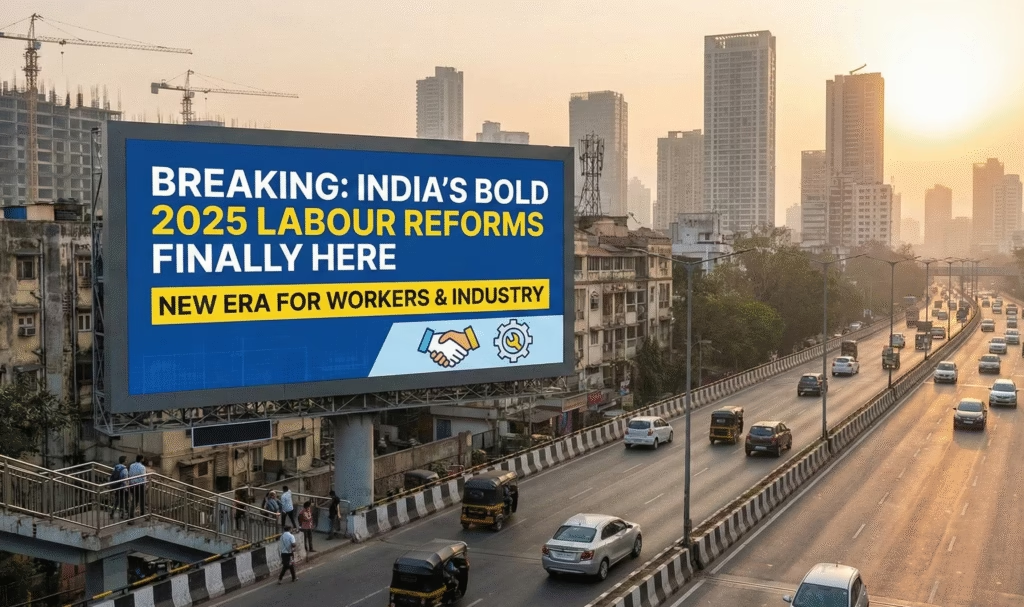
Labour Law Reforms India 2025: Overview
India’s labour law framework has been undergoing a massive transformation — one that impacts every sector, every worker, and every business operating in the country. Whether you’re a startup owner, factory supervisor, HR manager, or salaried employee, the newly operational labour law reforms in India 2025 are not just another policy shift — they mark a turning point in India’s economic, employment, and compliance environment.
For decades, India’s labour ecosystem was governed by over 40 different laws, often overlapping, outdated, and difficult to enforce consistently. Navigating compliance was exhausting for businesses, while employees struggled with inconsistent rights, payout structures, minimum wages, and workplace protection — especially across different states.
That landscape is now changing.
From January 2025 onward, most states in India have aligned with the four consolidated labour codes, replacing the previous fragmented system. These include:
Code on Wages
Occupational Safety, Health and Working Conditions (OSH) Code
Industrial Relations Code
Social Security Code
The goal is simple yet ambitious:
To make India’s labour ecosystem simpler, fairer, future-ready, and transparent.
But any major reform, especially one this wide-ranging, comes with serious questions:
What exactly changes for employers and HR departments?
Are salaries going to increase due to new wage structuring rules?
Will employees receive larger PF contributions?
Will take-home salary reduce?
How will leave policies, contract rules, and gig worker rights evolve?
What penalties now apply for non-compliance?
Which industries are most impacted?
How does this reshape staffing, hiring costs, or workforce planning?
These questions aren’t theoretical — they impact millions of working professionals.
This section will help you understand the foundation of India’s new labour codes, the real purpose behind them, and why their enforcement in 2025 is being considered one of the most significant economic reforms since GST and Insolvency Code.
Let’s break down the changes step by step — clearly, practically, and without legal jargon.
Why These Labour Reform Laws Were Necessary?
India’s workforce is one of the largest in the world. Yet, until now, the regulatory framework struggled to match:
Rapid industrial growth
Technological changes
Gig and digital economy expansion
Startup and private sector evolution
Increasing informal labour participation
The old laws were based on the realities of post-independence India, not today’s globalized, tech-driven economy.
Key challenges included:
Too many separate laws for wage regulation.
Differing rules across states, leading to confusion and litigation.
Outdated definitions of employment, wages, and workplace safety.
Lack of legal recognition for gig workers, contractual workers, and platform-based earners.
Weak or slow enforcement mechanisms.
Massive compliance paperwork burden for employers.
The result?
A system where workers lacked uniform protection, and businesses struggled with compliance ambiguity.
The labour codes aim to solve all of this, bringing India closer to global labour standards without compromising growth.
What the Labour Codes Aim to Achieve
The labour law reforms target five major improvements:
Uniformity across India so that rights and wage rules no longer vary dramatically between states.
Ease of doing business, reducing compliance friction especially for startups and MSMEs.
Better employee protection, including social security and safety.
Recognition of new-age employment models like freelancing, gig economy, hybrid, and contract work.
Digitization of compliance through centralized filings, grievance systems, and transparency.
These aren’t just policy intentions — they are being implemented through practical rules, enforcement mechanisms, and stricter penalties for violations.
Understanding the Structure of the New Labour Codes
To simplify a complex system, the government consolidated multiple earlier acts into just four major codes:
1. The Code on Wages, 2019
Replaces laws related to:
Minimum Wages Act, 1948
Payment of Wages Act, 1936
Payment of Bonus Act, 1965
Equal Remuneration Act, 1976
Core objective: Uniform rules for wage calculation and payment across all sectors.
2. Industrial Relations Code, 2020
Replaces:
The Trade Unions Act, 1926
The Industrial Employment (Standing Orders) Act, 1946
The Industrial Disputes Act, 1947
Core objective: Balance employer flexibility with employee protection in hiring, firing, and dispute resolution.
3. Social Security Code, 2020
Replaces multiple welfare laws for employees including:
EPF Act
ESI Act
Maternity Benefit Act
Gratuity Act
Building and Other Construction Workers Laws
Core objective: Expand PF, gratuity, maternity benefits, and insurance coverage to the entire workforce — including gig workers.
4. Occupational Safety, Health and Working Conditions Code (OSH), 2020
Consolidates:
Factories Act
Contract Labour Act
Inter-State Migrant Workers Act
Dock Workers Safety Act
And several others
Core objective: Create safe, regulated, and standardized workplaces across industries — factories, transport, construction, logistics, service organizations, and more.
How These Codes Benefit Employees
Employees can expect significant improvements, including:
Better defined wage rules.
Higher employer contribution toward PF and gratuity.
Clear safety and working condition standards.
Faster dispute resolution through labour tribunals.
Job security measures, especially in manufacturing and factories.
Larger social protection coverage.
How These Codes Impact Employers
Employers now experience:
Streamlined compliance under fewer laws.
Ability to hire contract and fixed-term workers more flexibly.
Centralized recordkeeping and digital compliance filings.
Clearly defined rules around layoffs, trade unions, and workforce restructuring.
Higher payroll planning due to wage definition restructuring.
In simpler terms:
These laws make compliance easier — but penalties stricter.
Industries Most Impacted by Labour Law Reforms India 2025
While all sectors are affected, the changes are especially important for:
Manufacturing and factories
Construction industry
Transport and logistics
Startups and IT companies
Gig and platform-based businesses (delivery apps, ride-sharing, freelancing platforms)
MSMEs employing contractual staff
Warehousing and ecommerce logistics
Each of these industries faces new frameworks for overtime, staffing, risk management, social security, and leave policies.
Digital Compliance: A Major Shift
One of the lesser-discussed but most impactful changes of the new labour codes is digitization.
Employers now need to maintain:
Online attendance records
Digital registers
Electronic wage slips
Online compliance reports
Unified labour return filings
Employees also benefit from:
Digital access to wage dues
Trackable PF & social security accounts
Online grievance redressal
Transparency in hiring and exit process
Why Enforcement is Finally Happening in 2025
The labour reforms were passed earlier — but implementation required:
State-level rule framing
Technology readiness
Coordination between industries and compliance regulators
Stakeholder alignment across India
By late 2024 and early 2025, most states completed rule approval, making full enforcement possible.
Current Market Response: What Employers & Workers Are Saying (2025 Trends)
Many companies have already begun restructuring appointment letters, salary components, and policy documents. HR departments are undergoing upskilling in labour compliance.
Employees are experiencing:
Higher PF deductions
Reduced take-home salary
But increased long-term retirement and social benefits
Gig workers — for the first time — are entering eligibility for formal benefits.
Contract workers are gaining more clarity regarding working hours, entitlements, and dispute processes.
Overall, experts agree that while the transition brings temporary adjustments, the long-term outcome is:
A stronger, structured, fair, and predictable labour ecosystem in India.
The 10 Most Game-Changing Labour Code Reforms in India 2025
India’s new labour codes are not minor amendments — they are historic structural reforms reshaping the employer-employee relationship across every industry. Whether you’re a salaried employee, freelancer, contract worker, HR professional, founder, or MSME owner, these changes will influence work culture, financial planning, hiring, workforce structure, and long-term employee benefits.
This section explains the 10 most impactful labour law reforms India 2025 in a clear, practical, and example-based manner, rather than legal language.
These reforms include:
New Universal Wage Structure (Definition of Wages and Salary Breakup Rules)
Changes in PF (Provident Fund) Contribution Structure
Gratuity Eligibility Expansion
Fixed-Term Employment with Full Benefits
Gig and Platform Worker Social Security Inclusion
New Working Hours, Shift Rules & Overtime Regulations
Stricter Compliance and Penalty Framework
Ease of Hiring and Layoffs (Industrial Relations Code Changes)
Standardized Leave and Working Condition Requirements
Digitization of Labour Compliance and Employer Filings
Let’s break them down one-by-one.
1. New Universal Wage Structure: What Changes in Salary Breakdown?
Under the Code on Wages, the government has introduced a uniform wage definition across all employment categories in India. This rule is designed to eliminate confusion and manipulation of salary structuring.
Before the Reform
Companies often structured salaries creatively — keeping basic salary low and allowances high — to:
Reduce PF contribution
Reduce gratuity obligation
Reduce bonus eligibility
This resulted in lower long-term payouts for employees.
After the 2025 Reform
The new rule states:
Basic salary + dearness allowance + retaining allowance must be at least 50% of the total CTC.
This means allowances cannot exceed 50% of wages.
Example Comparison
| Component | Earlier System | New Labour Code System |
|---|---|---|
| Basic Salary | 25-35% of CTC | Must be 50% of CTC |
| PF Contribution | Lower (due to lower basic) | Higher (due to higher basic) |
| Take-Home Salary | Higher | Slightly Reduced |
| Retirement Benefits | Lower | Higher |
Impact on Employees
Long-term savings and protection improve.
PF & gratuity increase.
Salary becomes transparent and predictable.
Impact on Employers
HR must restructure payroll for compliance.
Budgeting and payroll cost forecasting now changes permanently.
This reform alone is one of the most powerful shifts in wage governance in India.
2. PF Contribution: Bigger Retirement Corpus, Lower Immediate Take-Home
With the wage definition rule affecting salary structure, PF contributions automatically increase.
What the New Law Says
PF must be based on the revised wage definition, not arbitrary employer-chosen basic pay.
Estimated Impact Example
Assume a CTC of ₹50,000/month.
| Breakdown | Earlier Rule (Approx.) | New Rule (Approx.) |
|---|---|---|
| Basic Salary | ₹13,000 | ₹25,000 |
| PF Contribution (Employee) | ₹1,560 (12%) | ₹3,000 (12%) |
| Take-Home | Higher | Reduced |
| Retirement Value (10 yrs) | Lower | Significantly Higher |
Long-Term Difference
An employee earning ₹6 lakh/year could see PF corpus increase by ₹4–7 lakh more over 10 years.
Over 25–30 years, PF maturity value increases dramatically.
Gig Workers & PF
For the first time, gig workers may receive contributory social security benefits through:
Aggregators (e.g., Zomato, Swiggy, Ola, Uber)
Government welfare boards
3. Gratuity Eligibility Expanded — Even for Contract and Gig Workers
Previously, gratuity was available only after 5 years of continuous service to permanent employees.
New Rules Include:
Fixed-term employees
Contractual workers
Gig/platform workers
Short-term workers (pro-rata gratuity)
Pro-Rata Gratuity Formula Example
If someone works 1 year on contract, they are eligible for proportional gratuity, instead of needing a 5-year minimum.
This benefits workers in industries like:
IT & startups
Service sector
Logistics & gig workforce
Construction
MSMEs using contract hiring
4. Fixed-Term Employment: Permanent Benefits Without Permanent Hiring
Earlier, contract workers received fewer rights than permanent employees.
Under the Industrial Relations Code, fixed-term employees now:
Get same benefits as permanent workers.
Receive pro-rata gratuity even for less than 5 years.
Know the exact employment tenure from day one.
This helps:
Employers during seasonal demand cycles.
Employees avoid exploitation under “contractor middlemen.”
India’s economy now formally recognizes flexible workforce models.
5. Gig & Platform Workers Enter the Legal Framework for the First Time
Under the Social Security Code, India now legally recognizes:
Gig workers
Platform-based workers
Freelancers
App-based earners
Delivery partners
Ride-sharing drivers
Content creators earning digitally
What Benefits They Will Receive
Accident insurance
Social security contributions
Pension scheme access
Health and maternity benefits
Digital worker registry
Unified ID-linked service records
Major platforms must now contribute to a Social Security Fund, ensuring welfare even without fixed employer-employee relationships.
This is a landmark reform aligning with India’s growing digital workforce economy.
6. Working Hours, Shift Rules, and Overtime (Major Changes)
New labour codes define:
48-hour weekly cap
Flexible working models (4-day work week allowed, if agreed)
Daily work shift can be 12 hours, but weekly total cannot exceed 48 hours.
Overtime Rules Strengthened
Overtime must be paid at twice the regular wage rate, monitored digitally.
Mandatory Rest Requirements
1 day weekly off
Minimum 30 minutes break after every 5 hours of work
Rules applicable to both factory and white-collar jobs
This reform protects workers from excessive hours while enabling flexible workweek models.
7. Penalties for Non-Compliance Are Now Stricter
The new compliance regime comes with:
Higher fines
Criminal penalties for repeated violations
Digital enforcement
Surprise inspections and automated compliance tracking
Fines may now scale based on:
Number of impacted workers
Type of violation
Duration of non-compliance
This pushes employers to stay compliant rather than risk penalties.
8. Ease of Hiring and Layoffs (Industrial Relations Code)
One of the most debated changes:
Companies with 300 employees (earlier 100) can hire/lay off without prior government permission.
Employee Safeguards Still Exist
Reskilling funds
Notice periods
Tribunal-based dispute resolution
Expanded social security protections
India now follows global employment models balancing flexibility and rights.
9. Standardized Leave, Safety, and Working Conditions
The OSH Code enforces uniform rules across states and sectors for:
Rest days
Working conditions
Leave entitlement
Safety audits
Maternity and health benefits
Mandatory HR grievance processes
Migrant worker registry
It prioritizes worker dignity and safe workplace environments.
10. The Compliance System Goes Fully Digital
The new digital labour ecosystem includes:
Single annual return
Centralized labour compliance dashboard
Digital salary slips
Aadhaar-linked worker ID
Standardized employment register
This eliminates paperwork burden and prevents compliance disputes.
Real-World Impact of India’s New Labour Codes on Different Worker and Employer Categories (With Salary Scenarios, Case Studies & Practical Examples)
Major reforms always raise one fundamental question:
“How does this affect me?”
India’s new labour codes 2025 are not theoretical — they directly reshape salary structure, employer compliance, leave policies, onboarding, offboarding, workplace safety, social security coverage, gig economy stability, and long-term financial wellbeing.
However, the impact is not uniform.
Different workers and industries experience these reforms differently — based on salary level, employment type, sector, and company size.
This section breaks down the effects with comparisons, tables, salary examples, and industry case studies for:
Salaried Employees (Private Sector)
Government & PSU Staff
Startup and IT Workforce
Contract Employees
Fixed-Term Employees
MSMEs and Small Enterprises
Gig & Platform Workers
Freelancers and Remote Workforce
Manufacturing and Industrial Workers
HR Teams and Business Owners
The goal is to simplify how the labour law reforms India 2025 translate into real-world changes.
1. Impact on Salaried Private Sector Employees
Most employees will notice two major shifts:
Higher PF contribution
Lower monthly take-home salary
Why?
Because the new wage code mandates that Basic Salary must form at least 50% of total compensation.
Example Salary Change
Assume an employee with a ₹60,000 monthly CTC.
| Component | Old System | New Labour Code System |
|---|---|---|
| Basic Salary | ₹18,000 | ₹30,000 |
| PF (Employee 12%) | ₹2,160 | ₹3,600 |
| Gratuity | Lower | Higher |
| In-Hand Salary | Higher | Slightly Lower |
| Retirement Benefit | Moderate | High |
Key Outcome
Employees lose a little now but gain more later through:
Higher PF buildup
Better gratuity
Improved long-term security
For younger workers — especially under 30 — this shift is financially beneficial in the long run.
2. Impact on Government Employees and PSU Workforce
Government employees already follow structured pay systems where:
Basic pay is high
Allowances are regulated
Retirement and social benefits are mandatory
Therefore, the labour codes have minimal structural salary impact on them.
However, two things change:
Standardization of working hours
Digitization of compliance & attendance
PSU contract workers, however, now receive:
Pro-rata gratuity
PF coverage
Clear hiring & exit rights
This closes loopholes previously exploited through long-term “temporary” contracts.
3. Impact on Startup & IT Industry Workforce
This category sees mixed outcomes.
Positive:
Flexibility in 4-day work week implementation
Clear framework for remote work, hybrid teams, and digital workers
Streamlined compliance for HR systems and payroll automation
Challenging:
Increased hiring cost due to PF, gratuity, benefits on higher basic salary
Contract and gig-based hiring now requires social security deposits
Work Schedule Change Example
| Previous Practice | New Allowed Model |
|---|---|
| 5–6 day week standard | Optional 4-day work week |
| 8–9 hours/day | Up to 12 hours/day (48-hour max/week) |
| Mixed compliance interpretations | Uniform regulation |
Startups must now plan compensation strategically — balancing cost control and compliance.
4. Impact on Contract Workers and Temporary Staff
Under old laws, contract workers often received:
No paid leave
No gratuity
No PF
No exit protections
Under the labour codes, contract workers now gain:
Same working hours safeguards
Social security access
Overtime protection
Pro-rata gratuity (even under one-year service)
PF and ESI coverage based on contract agreement
Transparent wage structure
This improves fairness in industries like:
Manufacturing
Construction
Retail
Food and hospitality
Logistics
Security services
5. Impact on Fixed-Term Employees
Fixed-term workers now enjoy nearly the same rights as permanent employees, except:
Their employment automatically ends after the contract duration.
They receive:
Full PF benefits
Leave entitlement
ESI/insurance protections
Pro-rata gratuity
Real contract clarity
This prevents misuse of short-term contracts and reduces workforce exploitation.
6. Impact on MSMEs & Small Businesses
MSMEs represent the largest employment segment in India — and many previously struggled with:
Compliance burden
Paperwork
Overlapping laws
Under the new system:
Benefits for MSMEs:
One simplified annual return
Digitized compliance platform
Reduced inspection harassment
More hiring flexibility
Challenges:
Higher wage compliance cost
Mandatory digital attendance and payroll records
Penalties for non-compliance
MSMEs now require:
HR restructuring
Updated appointment letters
Standardized employee documentation
7. Gig Workers and Platform Workforce Impact (Major Milestone)
This category includes:
Swiggy, Zomato, Blinkit, Rapido delivery staff
Ola, Uber and bike taxi drivers
Online freelancers and platform-based creators
Online tutors and remote digital workers
Earlier, they existed in a legal grey zone.
Now, gig workers receive:
Social security contributions from platforms
Insurance benefits
Digital worker identity database
Occupational safety protocols
Example:
A Zomato delivery partner may now receive:
| Benefit Type | Old System | New Labour Codes |
|---|---|---|
| Insurance | Limited | Mandatory |
| PF or Pension | None | Partially funded |
| Social Security | None | Supported by employer + govt |
| Legal Rights | Minimal | Recognised as a labour category |
This is one of the biggest global-level policy evolutions in the platform economy.
8. Impact on Freelancers and Remote Workers
Freelancers are now formally recognized for:
National digital ID registry
Access to voluntary contribution pension system
Eligibility for government worker welfare schemes
This recognition bridges the gap between traditional and digital economic systems.
9. Impact on Manufacturing, Factory, Construction, and Industrial Workers
These sectors experience the biggest impact due to:
Working hours restructuring
Safety audits
Labour tribunals for dispute resolution
Stricter overtime enforcement
Minimum wage standardization across states
Employers must now maintain:
Safety protocols
Digital attendance
Verified working hour records
Mandatory rest periods
Factories can adopt flexible workforce models, but cannot compromise on safety.
10. Impact on HR Teams and Business Owners
HR teams now handle:
Updated salary structures
PF/gratuity recalculations
Revised appointment templates
Digital compliance reporting
Updated employee handbooks
Occupational safety alignment
Labour codes introduce clarity, but transition requires:
Training
Documentation restructuring
Internal process alignment
Who Benefits the Most from Labour Law Reforms India 2025?
| Category | Benefit Level | Why |
|---|---|---|
| Gig Workers | Very High | First-time legal recognition |
| Fixed Term Staff | High | Same rights as permanent staff |
| Contract Workers | High | Social security + wage rights |
| Young Salaried Employees | High | Higher PF + retirement value |
| Employers/Startups | Medium | Compliance clarity |
| Government Employees | Low | Already regulated |
Implementation Challenges, Salary Restructuring Models, Compliance Roadmap, and Myths vs. Facts About India’s New Labour Codes 2025
The transition to the new labour law reforms India 2025 is one of the most significant workforce and compliance shifts the country has seen in decades. While the laws are intended to simplify and modernize India’s employment ecosystem, implementation is not without challenges — especially for HR teams, employers, finance departments, startups, MSMEs, gig platforms, and contractual workforce systems.
This section focuses on four crucial aspects:
Implementation Challenges Across India
Salary Restructuring Models Employers Are Adopting
Compliance Roadmap and Employer Toolkit
Common Myths vs. Verified Facts About Labour Codes (2025 Edition)
By the end of this section, both employees and employers will understand how to adapt smoothly, what to expect, and what changes are mandatory vs. optional.
1. Implementation Challenges Across India
Although the labour codes are officially in force, implementation is complex because:
India has 28 states and 8 Union Territories.
Each state must draft and notify supporting rules.
Digital compliance platforms are still scaling.
Companies must revise long-standing HR and payroll processes.
Below are the major real-world challenges currently being observed (as of Nov–Dec 2025):
A. State-Level Variations
While labour codes aim for uniformity, certain rules still allow state-specific interpretation.
For example:
Minimum wages
Occupational safety requirements
Inspector-cum-facilitator working models
Industry-specific compliance standards
This means companies operating across multiple states — such as Amazon, Tata, Flipkart, Infosys, Zomato — must manage central + state compliance alignment.
B. Salary Restructuring Confusion
Many employers are unsure whether:
Existing employees require complete restructuring
Only new hires should be aligned
PF should be capped or unlimited based on wage rules
Allowances such as HRA, conveyance, travel, and variable pay fall under capped or uncapped wage categories
This confusion has led to delays in salary policy restructuring.
C. HR and Payroll Technology Readiness
Large companies are upgrading:
ERP systems
Payroll software
Leave and shift automation tools
Digital attendance systems
Compliance reporting dashboards
However, MSMEs and traditional-sector businesses are still transitioning from manual payroll and registers to digital systems.
D. Gig Worker Registration Complexity
Gig platforms must:
Register workers across platforms
Contribute to the social security fund
Track working hours and engagements across multiple company ecosystems
This requires cross-platform data coordination, which is new and logistically complex.
E. Lack of Awareness Among Workers
A large portion of the workforce still does not fully understand:
PF benefits
Gratuity eligibility
Gig worker rights
Working hour protections
Social security contributions
Without awareness, rights cannot be fully exercised.
2. Salary Restructuring Models Employers Are Adopting
To comply with the 50% Basic Pay rule, companies are using various restructuring strategies depending on manpower cost, business model, and workforce type.
Here are the three most commonly implemented models:
Model 1: Full Compliance Model
Basic salary set to 50% of CTC
PF, gratuity, ESI, and bonus revised accordingly
Benefits fully aligned with labour codes
Used by:
MNCs
Government-linked companies
Global IT firms
Top corporate employers
Impact:
Lower take-home salary
Higher job and financial security
Model 2: Marginal Adjustment Model
Basic salary adjusted to just above 50% threshold
Allowances carefully defined to prevent reclassification
PF capped for employees opting out of higher deductions
Used by:
Startups
MSMEs
Cost-sensitive sectors
Impact:
Minimal change in take-home pay
Moderate long-term benefits
Model 3: Variable Compensation Redistribution Model
Higher performance-linked pay introduced
Flexi-benefit policies used to retain salary structure balance
PF benefits capped or voluntary above statutory minimum
Used by:
Sales-based companies
Logistics and gig-connected sectors
Consumer electronics and retail hiring models
Impact:
Employees feel empowered through performance-based earnings
Reduces employer payroll liability while maintaining compliance
3. Compliance Roadmap and Employer Toolkit (2025 Edition)
To comply effectively with the labour codes, employers must adopt a structured implementation roadmap.
Step-by-Step Compliance Checklist
| Step | Employer Action |
|---|---|
| 1 | Audit existing employee documentation and payroll structure |
| 2 | Restructure wages according to new wage definition |
| 3 | Update employment contracts and offer letters |
| 4 | Digitize attendance, wage slips, and compliance records |
| 5 | Ensure social security enrollment for all eligible workers |
| 6 | Register gig and contract workers where applicable |
| 7 | Train HR, payroll staff, and team leaders |
| 8 | File unified labour compliance return |
| 9 | Implement workplace safety and working-hour rules |
| 10 | Conduct periodic compliance audits |
Employer Compliance Tools Required
Aadhaar-based worker registry
Digital salary slip software
Shift tracking and overtime calculation system
Grievance redressal platform
Unified statutory compliance register (digital)
Optional AI-based time and attendance systems
4. Myths vs. Facts About India’s Labour Codes
There is widespread misunderstanding about certain provisions. This comparison clarifies them:
| Common Myth | Verified Fact |
|---|---|
| Take-home salary will reduce for everyone. | Only salaries with low basic structure change significantly; impact varies. |
| Employees will be forced to contribute more PF. | Employees can voluntarily opt for capped or increased PF based on employer policy. |
| Gig workers are now considered full-time employees. | Gig workers are recognized legally but remain independent—only social security applies. |
| The 4-day work week is mandatory. | It is optional — only allowed if weekly hours remain within 48 hours. |
| All companies must immediately restructure payroll. | Implementation is phased but required within compliance deadlines. |
| Overtime is discretionary. | Overtime at 2x wage rate is now a legal requirement. |
| Gratuity is still only for 5+ years’ service. | Pro-rata gratuity now applies to fixed-term and gig workers. |
What This Means in Practical Terms
Employees gain more rights and retirement benefits.
Employers gain simplified rules — but enforcement is stricter.
The labour market moves toward formalization, fairness, and future-readiness.
India is shifting from a wage-first employment framework to a rights + security + digital compliance ecosystem.
Labour Law Reforms India 2025 – Critical Industry Impact, Case Scenarios, Compliance Blueprints & Real-World Readiness Framework
India’s 2025 labour law reforms are not just technical statutory updates—they represent a complete reorganizing of how employers and employees function, negotiate, document, and fulfil compliance under India’s unified labour codes.
This section explores the real industry impact, practical adaptation strategies, case-based examples, and compliance execution blueprints designed for HR heads, small business owners, compliance officers, labour law consultants, and workers seeking clarity.
This is the most actionable part of the guide, focusing entirely on:
Industry-wise effects
Implementation barriers
Compliance timelines and frameworks
Policy design templates
Audit checklists
Penalty avoidance strategies
Future of labour governance in India
Why Implementation Still Challenges Businesses in 2025
Even though the labour codes provide simplification, the migration from old laws to new digital-first compliance has been the biggest challenge.
Common implementation hurdles:
Lack of state-wise harmonization
Poor employee awareness
HR software incompatibility with new wage structure
Confusion around ESIC/EPF applicability under expanded thresholds
Contract workforce transition complexities
Penalty enforcement in digital audit environments
Businesses must adapt structurally—not just legally.
Industry-Wise Impact Study (2025)
The impact of labour law reforms is not uniform across sectors. The following breakdown helps employers prepare and employees understand rights in context.
1. IT & ITES Sector
The IT sector experiences strong effects due to:
New rules on standing orders
Compulsory notice pay rules
Termination rules connected with employment category
Overtime tracking in WFH/hybrid models.
Key Takeaways:
| Parameter | Old System | Under New Labour Codes |
|---|---|---|
| Working Hours | Flexible/Undefined | Fixed 8 hrs/day, 48 hrs/week |
| Overtime | Rarely documented | Compulsory compensation |
| Leave Policy | Company defined | Standardized compliance-based |
Outcome: Employee rights strengthen while HR operations become heavily standardized.
2. Manufacturing & Industrial Units
Manufacturing gets the most radical transformation due to OSHWC (Occupational Safety, Health & Working Conditions Code).
Key changes include:
Compulsory safety audits
Mandatory accident reporting
Digital registers over manual filings
Welfare provisions for migrant and contract workers
It will push companies toward ISO-aligned compliance culture.
3. Startups and MSMEs
Startups gain flexibility under:
Self-certification
Reduced reporting burden
Startup grievance redressal mechanism
Simplified contract workforce model
But enforcement on wage structure compliance and PF applicability now applies irrespective of funding stage.
Many startups will need payroll restructuring to avoid legal risks.
4. Gig Economy, Platform Work & Creator Economy
With Social Security Code 2025 enforcement, India becomes one of the first countries to legally define and protect platform labourers including:
Delivery partners
Cab drivers
Freelancers
Content creators
Digital task workers
Mandatory provisions include:
Pension pool contribution
Insurance and accidental coverage
Dispute resolution framework outside traditional employment
This will formalize a previously informal workforce.
5. Retail, Hospitality & Service Sector
This sector sees:
Higher cost of compliance
Regulated shift scheduling
Employee protection in temp, seasonal, or flexible hiring
Digital attendance and overtime tracking become legally binding.
Employee Experience & HR Transformation Under Labour Codes
Labour reforms move HR from a record-maintenance function to a governance, compliance, and employee-rights protection system.
HR Must Now Manage:
Digital registers + AI-backed audits
Standardized wage rule structures
Employee grievance handling protocol
Statutory training & documentation requirements
Employee experience will now revolve around transparency, accessibility, and institutional justice.
Practical Case Scenarios (Real-World Examples)
These examples help interpret legal language into real situations.
Case 1 — Salary Structure Dispute
Scenario: Employee receives ₹28,000/month salary. Employer structures 70% as allowances to avoid PF and bonus.
Under Labour Codes:
Basic + Allowances must follow 50% wage rule.
Outcome:
Employer must:
Restructure salary
Recalculate PF
Pay statutory bonus if eligible
Risk penalty if non-compliant
Case 2 — Termination Without Notice
Employee working for 2 years is terminated instantly for “performance mismatch.”
Under Industrial Relations Code:
Written notice required
Full final settlement must occur within 2 working days
Employee may seek compensation
Penalty applies for violation.
Case 3 — Gig Worker Health Emergency
A delivery driver meets with an accident during a delivery route.
Under Social Security Code:
Platform must provide:
Insurance coverage
Compensation
Medical support
Gig worker protections apply even without a traditional employment contract.
Compliance Blueprint 2025 (For Employers)
A practical framework to adopt labour codes efficiently:
Step-by-Step Implementation Roadmap:
Policy Mapping: Compare existing employment documents with new labour code requirements
Payroll Reform: Apply 50% wage rule and ESIC/EPF eligibility
Work-Hour Standardization: Adjust shifts, holidays, overtime rules
Digital Register Setup: Move from paper-based compliance to digital systems
State Notifications Review: Ensure state-aligned compliance
Employee Training: Internal awareness, handbook rollout
Quarterly Compliance Audit: Avoid penalty and litigation risk
Mandatory Registers Checklist (Digital Format Accepted)
Employee register
Contract worker register
Wage and deduction register
Overtime log
Accident and safety compliance register
Maternity benefits record
Social security compliance record
Predicting India’s Labour Future — Beyond 2025
India is moving toward:
Digital labour identity
National unified compliance database
AI-based inspection models
Predictive governance to prevent violation before occurrence
This positions India to compete globally in compliance-driven economies.
Frequently Asked Questions
Q1. Are India’s new labour codes fully implemented in 2025?
Yes, as of November 2025, labour codes are implemented in phased enforcement across most states, with digital compliance requirements active.
Q2. Are employees entitled to overtime under new labour laws?
Yes. Work beyond 8 hours/day or 48 hours/week requires mandatory overtime compensation.
Q3. Will employee in-hand salary reduce due to labour codes?
Some employees may see reduced in-hand salary because PF, ESIC, and bonus calculations now follow the 50% wage definition rule, increasing statutory contributions.
Q4. Do gig workers now get benefits?
Yes. Platform and gig workers are legally protected under the Social Security Code including insurance, pension, and health benefits.
Q5. Are casual or contract workers covered under labour codes?
Yes. The codes protect permanent, contract, gig, temporary, migrant, and platform workers.
Q6. What is the penalty for non-compliance?
Penalties include ₹50,000–₹1,00,00,000 fines and legal action in case of repeat offenses.
Q7. Is digital compliance mandatory?
Yes. Registers, wage records, agreements, safety reports, and inspections are now digitally manageable.
Q8. Can women work night shifts?
Yes, but only if the employer provides safety, transport, and policy compliance.
Q9. Are startups exempt from labour laws?
No, they must comply, but some flexible provisions apply for fixed-term employment and onboarding.
Q10. Can an employee be terminated without notice?
No. Wrongful termination without required notice and settlement violates labour codes.
Conclusion
India’s New Labour Laws 2025 are transforming the nation’s working model from fragmented, outdated regulation to a modern, transparent, rights-focused and compliance-driven employee ecosystem.
Whether you’re an employer planning payroll restructuring, an HR leader drafting new policy documents, a gig worker seeking clarity on entitlements, or an employee understanding your rights — this reform marks the beginning of India’s future-ready labour framework.
To stay compliant, organizations must shift mindset from paperwork to continuous compliance culture.
Employees must stay informed — rights only work when understood.
Bookmark or Visit Kolee.in for Daily Updates.

Hello and warm greetings!
I’m Satyapal Yadav, the founder of Kolee.in and a passionate content writer and researcher. I began my professional journey in 2005 in the IT sector, exploring the vast world of technology. Over time, my curiosity and interest in financial markets led me to trading around 2010, which inspired me to merge my tech background with finance research and content writing.
At Kolee.in, my mission is simple: I strive to provide readers with accurate, research-backed, and easy-to-understand information to help them make informed decisions in their careers, finances, and personal lives. Over the years, I have specialized in topics including finance, government jobs, competitive exams, education, government policies, and the latest technology trends.
I firmly believe that knowledge is valuable only when it is understood deeply and applied wisely. That’s why I dedicate myself to producing content that is clear, practical, and actionable, bridging the gap between complex information and reader-friendly guidance.
When it comes to government jobs, I cover everything from state and central vacancies to competitive exam strategies, helping readers navigate their career paths with confidence. In the finance domain, I share insights on personal finance, investment strategies, and market updates, making complex topics easy to understand.
Education is another passion of mine. I provide guidance on exam preparation, scholarships, and learning strategies, helping students and professionals achieve their academic and career goals. I also explore technology trends, reviewing the latest gadgets and sharing insights on innovations in AI, apps, and emerging tech, keeping readers up-to-date in a fast-evolving digital world.
What drives me is the desire to empower my readers. I don’t just provide information—I aim to help people make smart choices, whether it’s pursuing the right government job, planning their finances, or staying ahead with technology and education updates.
All content on Kolee.in is carefully researched and reader-focused. This ensures that readers get valuable information that is easy to navigate and understand. My writing emphasizes clarity, authenticity, and relevance, making it trustworthy for students, job seekers, finance enthusiasts, and tech-savvy readers alike.
I’ve spent years learning, researching, and refining my approach to content creation, combining my IT and finance experience with my passion for education and technology. Every article I write is designed to inform, inspire, and guide—helping readers make practical and confident decisions in their personal and professional lives.
Through Kolee.in, I aim to build a platform that bridges the gap between complex data and everyday readers, turning knowledge into actionable insights. I want my readers to feel empowered, confident, and informed every time they visit the site.
Thank you for stopping by! I hope the content you find here helps you achieve your goals, stay informed, a
nd make smart decisions in life, career, and learning.
With warm regards and best wishes,
Satyapal Yadav
Founder and Content Writer, Kolee.in