Introduction
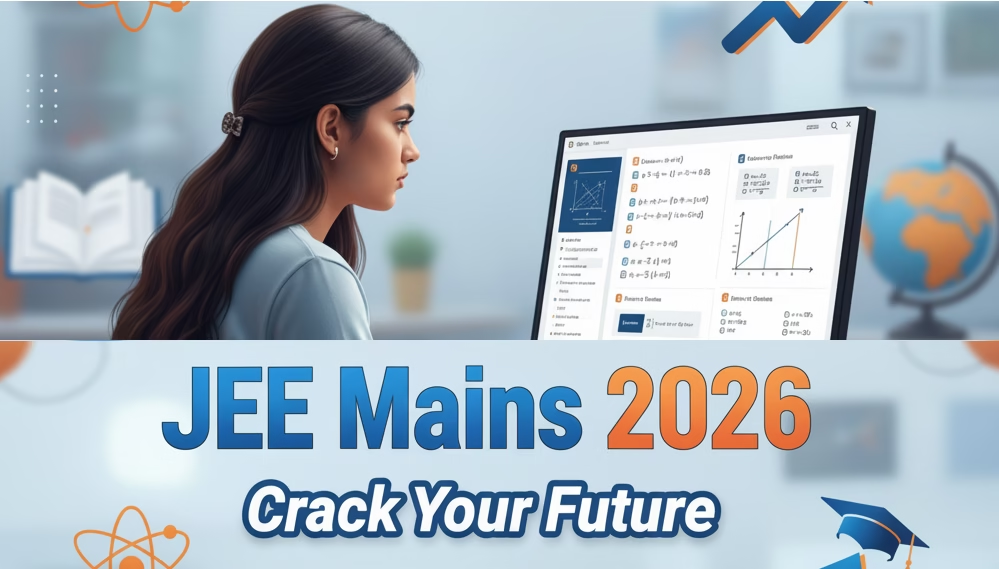
The JEE Main 2026 is more than just an exam — it is the gateway to some of India’s most prestigious engineering institutes. Every year, lakhs of aspirants compete to secure seats in IITs, NITs, IIITs, and other top technical institutions. The stakes are high, competition is fierce, and preparation requires both strategy and perseverance.
Why JEE Main 2026 Matters
Acts as a qualifying exam for JEE Advanced, which leads to IIT admissions.
Determines eligibility for NITs, IIITs, and GFTIs.
Provides multiple opportunities through two sessions per year.
Challenges Students Face
Vast syllabus covering Physics, Chemistry, and Mathematics.
Time management during preparation and the exam.
High competition with over 10 lakh aspirants every year.
Psychological pressure, stress, and maintaining consistency.
Promise of This Guide
This blog will serve as your ultimate roadmap for JEE Main 2026. By the end, you will:
Know all confirmed and expected dates.
Understand eligibility, registration, and syllabus details.
Learn subject-wise preparation strategies.
Discover time management, mock test strategies, and tips to crack JEE Main 2026.
Get guidance on colleges, cut-offs, and branch selection.
Overview of JEE Main 2026
The Joint Entrance Examination (JEE) Mains is conducted by the National Testing Agency (NTA). It is a computer-based test (CBT) and is held in two sessions per year, allowing candidates multiple chances to improve scores.
Key Features
Conducted twice a year: January and April sessions.
Covers Physics, Chemistry, and Mathematics.
Required for admission to undergraduate engineering programs.
Serves as a qualifying exam for JEE Advanced (for IIT admissions).
Applicable for both Indian and foreign nationals.
JEE Main 2026 Exam Dates (as of 25-10-2025)
| Event | Tentative/Confirmed Dates 2026 |
|---|---|
| Session 1 Registration Start | 25th October 2025 (Confirmed) |
| Session 1 Registration End | 15th November 2025 (Expected) |
| Admit Card Release | 5th January 2026 (Expected) |
| Exam Dates (Session 1) | 21st–30th January 2026 (Confirmed) |
| Session 2 Registration Start | Last week of January 2026 (Expected) |
| Session 2 Exam Dates | 1st–10th April 2026 (Confirmed) |
| Result Declaration | 15th May 2026 (Expected) |
These dates allow students to plan preparation strategically and manage mock tests and revision effectively.
Eligibility Criteria & Registration Process
Eligibility Criteria
To appear in JEE Main 2026, candidates must satisfy the following conditions:
Age Limit
Candidates must be born on or after 1st October 2001.
No age limit for foreign nationals.
Educational Qualification
Passed 12th class or equivalent from a recognized board.
Must have studied Physics, Chemistry, and Mathematics as compulsory subjects.
Number of Attempts
Maximum of three consecutive years.
Year of Passing
Class 12 passed in 2024, 2025, or appearing in 2026.
Registration Process
Step-by-Step Guide
Visit Official NTA Website
Go to jeemain.nta.nic.in.
Create Login Credentials
Use a valid email and mobile number.
Fill Personal and Academic Details
Carefully enter name, date of birth, educational details, and category.
Upload Documents
Scanned photograph, signature, and other required certificates.
Pay Application Fee
Fee ranges from ₹650–₹1300 depending on category.
Submit Form and Print Confirmation
Save the confirmation page for future reference.
Registration Tips
Keep documents ready in the specified format.
Avoid mistakes in personal details as corrections may not be allowed.
Ensure payment is successful before submission.
JEE Main 2026 – Syllabus Breakdown
The JEE Main syllabus covers Physics, Chemistry, and Mathematics based on NCERT Class 11 and 12.
Physics (Class 11 & 12)
Class 11
Kinematics
Laws of Motion
Work, Energy & Power
Gravitation
Thermodynamics
Oscillations & Waves
Class 12
Electrostatics & Current Electricity
Magnetic Effects of Current
Electromagnetic Induction
Optics
Modern Physics
Tips for Physics Preparation:
Focus on conceptual understanding.
Practice numerical problems daily.
Maintain a formula sheet for quick revision.
Chemistry (Class 11 & 12)
Physical Chemistry
Atomic Structure
Chemical Bonding
Thermodynamics
Equilibrium
Electrochemistry
Organic Chemistry
Hydrocarbons
Alcohols, Phenols & Ethers
Carbonyl Compounds
Biomolecules
Inorganic Chemistry
Periodic Table
Coordination Compounds
Chemical Nomenclature
Preparation Tips:
Memorize reaction mechanisms and periodic trends.
Practice numerical problems in Physical Chemistry.
Revise NCERT Inorganic Chemistry thoroughly.
Mathematics (Class 11 & 12)
Key Topics
Algebra: Sets, Relations, Functions, Complex Numbers
Calculus: Differentiation, Integration, Limits, Continuity
Coordinate Geometry: Lines, Circles, Conics
Trigonometry: Identities, Equations
Probability & Statistics
Preparation Tips:
Daily practice of problem sets is crucial.
Focus on shortcuts and formulae.
Solve previous year questions to identify high-weightage topics.
JEE Main 2026 Exam Pattern & Marking Scheme
| Feature | Details |
|---|---|
| Mode | Computer-Based Test (CBT) |
| Duration | 3 Hours |
| Papers | Paper 1: B.E./B.Tech, Paper 2: B.Arch/B.Planning |
| Question Type | MCQs + Numerical Value Questions |
| Total Marks | 300 |
| Negative Marking | 1 mark deduction for wrong MCQ answers |
| Sessions | 2 per year (January & April) |
Tips for Exam Day:
Attempt easier sections first to save time.
Avoid guesswork to minimize negative marking.
No on-screen calculator will be available. ( Download New Update)
Preparation Strategy
Long-Term Preparation (6–12 Months)
Divide syllabus into weekly topics.
Alternate Physics, Chemistry, and Maths daily.
Solve mock tests monthly.
Analyze performance and weak areas.
Short-Term Preparation (1–2 Months)
Focus on high-weightage chapters.
Take full-length mock exams weekly.
Revise formula sheets and reaction mechanisms.
Maintain healthy study routine.
Daily Routine
| Time | Activity |
|---|---|
| 5:30–7:30 AM | Mathematics Practice |
| 8:00–10:00 AM | Physics Problem Solving |
| 10:30–12:00 PM | Chemistry Revision |
| 2:00–4:00 PM | Mock Test / Previous Year Questions |
| 4:30–6:00 PM | Weak Topics Practice |
| 6:30–8:00 PM | Formula & Concept Revision |
Subject-Wise Tips
Physics: Focus on numerical accuracy and understanding laws.
Chemistry: Emphasize NCERT and reaction mechanisms.
Mathematics: Prioritize problem-solving speed and accuracy.
Mock Test Strategy
Attempt 2–3 full-length mock tests per week.
Analyze mistakes and avoid repeating them.
Time management is key — try to finish 75% of paper in 2 hours and revise in last hour.
Previous Year Trends & Analysis
Physics: Mechanics, Electricity, and Modern Physics are high-weightage topics.
Chemistry: Physical Chemistry numericals and Organic Chemistry reactions are frequently asked.
Mathematics: Calculus, Algebra, and Coordinate Geometry have maximum questions.
Strategy: Prioritize topics that appear every year and practice numerical-heavy chapters.
College & Admission Guidance
Top Colleges Through JEE Main 2026
NITs: National Institutes of Technology (across India)
IIITs: Indian Institutes of Information Technology
GFTIs: Government Funded Technical Institutes
Private Engineering Colleges: Selective based on cut-offs
Cut-Off Trends (Expected 2026)
| Category | Percentile Cut-Off |
|---|---|
| General | 90–95 |
| OBC | 70–75 |
| SC | 50–55 |
| ST | 40–45 |
| PwD | 40 |
Branch Selection Tips
Consider personal interest, career scope, and future opportunities.
Computer Science, Electronics, and Mechanical branches are highly sought after.
Check college-specific cut-offs before finalizing choices.
Frequently Asked Questions (FAQs)
Q1: Can I attempt JEE Main 2026 after 12th?
Yes, candidates appearing or passed Class 12 in 2026 can apply.
Q2: How many sessions are there in JEE Main 2026?
Two sessions: January and April.
Q3: Is JEE Main 2026 online or offline?
It is completely computer-based (online).
Q4: Are calculators allowed?
NO,calculators are not allowed.
Q5: How is percentile calculated?
Percentile is based on relative performance of all candidates in the session.
Q6: Can I improve my score by attempting both sessions?
Yes, your best score among the sessions will be considered for ranking.
Q7: What is the best strategy for last-month preparation?
Focus on revision, mock tests, and weak areas, avoiding learning new topics.
Motivation, Success Tips & Conclusion
Motivational Tips
Stay consistent with daily study routines.
Maintain a balanced lifestyle with exercise and sleep.
Visualize success and set achievable targets.
Key Success Factors
Consistency: Daily practice and revision.
Time Management: During preparation and exam.
Mock Tests: Regular practice builds confidence.
Conceptual Clarity: Focus on understanding, not rote memorization.
Final Checklist for JEE Main 2026
Confirm eligibility and registration.
Prepare all subjects systematically.
Keep formula sheets, notes, and important topics ready.
Practice previous year papers and mock tests.
Stay calm and confident on exam day.
Important Notifications and advisories
Direct Link : Latest clarification on availability and use of calculator
Direct Link: Updated Information Bulettin
Direct link : Advisory for JEE(Main) – 2026 Aspirants
Bookmark or Visit Kolee.in for Daily Updates to stay ahead with the latest notifications, preparation tips, and exam insights for JEE Main 2026.

Hello and warm greetings!
I’m Satyapal Yadav, the founder of Kolee.in and a passionate content writer and researcher. I began my professional journey in 2005 in the IT sector, exploring the vast world of technology. Over time, my curiosity and interest in financial markets led me to trading around 2010, which inspired me to merge my tech background with finance research and content writing.
At Kolee.in, my mission is simple: I strive to provide readers with accurate, research-backed, and easy-to-understand information to help them make informed decisions in their careers, finances, and personal lives. Over the years, I have specialized in topics including finance, government jobs, competitive exams, education, government policies, and the latest technology trends.
I firmly believe that knowledge is valuable only when it is understood deeply and applied wisely. That’s why I dedicate myself to producing content that is clear, practical, and actionable, bridging the gap between complex information and reader-friendly guidance.
When it comes to government jobs, I cover everything from state and central vacancies to competitive exam strategies, helping readers navigate their career paths with confidence. In the finance domain, I share insights on personal finance, investment strategies, and market updates, making complex topics easy to understand.
Education is another passion of mine. I provide guidance on exam preparation, scholarships, and learning strategies, helping students and professionals achieve their academic and career goals. I also explore technology trends, reviewing the latest gadgets and sharing insights on innovations in AI, apps, and emerging tech, keeping readers up-to-date in a fast-evolving digital world.
What drives me is the desire to empower my readers. I don’t just provide information—I aim to help people make smart choices, whether it’s pursuing the right government job, planning their finances, or staying ahead with technology and education updates.
All content on Kolee.in is carefully researched and reader-focused. This ensures that readers get valuable information that is easy to navigate and understand. My writing emphasizes clarity, authenticity, and relevance, making it trustworthy for students, job seekers, finance enthusiasts, and tech-savvy readers alike.
I’ve spent years learning, researching, and refining my approach to content creation, combining my IT and finance experience with my passion for education and technology. Every article I write is designed to inform, inspire, and guide—helping readers make practical and confident decisions in their personal and professional lives.
Through Kolee.in, I aim to build a platform that bridges the gap between complex data and everyday readers, turning knowledge into actionable insights. I want my readers to feel empowered, confident, and informed every time they visit the site.
Thank you for stopping by! I hope the content you find here helps you achieve your goals, stay informed, a
nd make smart decisions in life, career, and learning.
With warm regards and best wishes,
Satyapal Yadav
Founder and Content Writer, Kolee.in