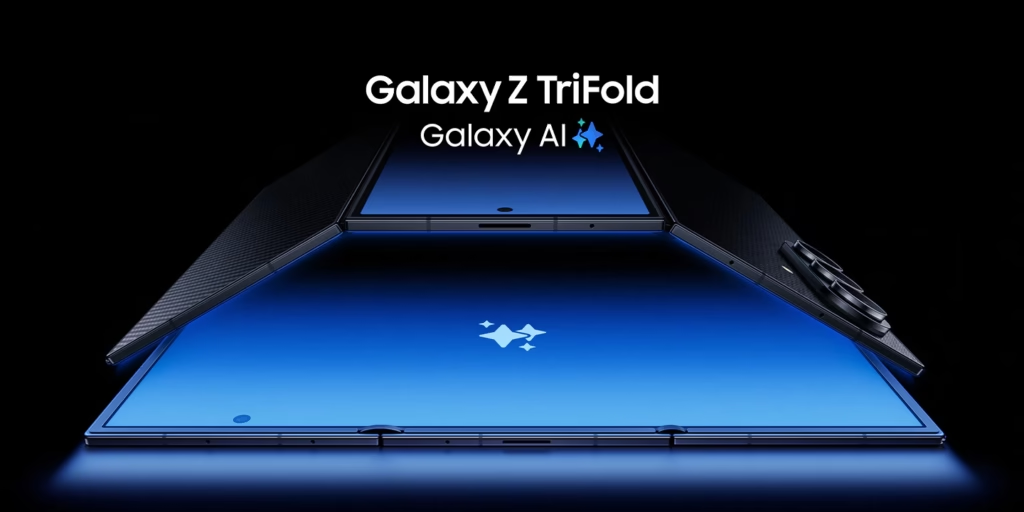
Samsung Galaxy Z TriFold — Introduction, Context & First Impressions
The moment Samsung crossed a new line in foldable history
Foldable smartphones are no longer a novelty in 2026. They have matured, evolved, and slowly entered the mainstream. Yet, despite all that progress, Samsung Galaxy Z TriFold feels different. It doesn’t just improve on an existing idea — it redefines what a smartphone can be.
When Samsung introduced the Galaxy Z TriFold, it wasn’t merely launching another premium phone. It was making a statement: the future of mobile computing is bigger, more flexible, and far more ambitious than what we have accepted so far.
This Kolee review is not written from a marketing lens. It is written from a real-world usage perspective, answering the most important question users are searching for globally:
Is the Samsung Galaxy Z TriFold genuinely practical for daily use, or is it an impressive but fragile experiment?
Why the Samsung Galaxy Z TriFold matters in 2026
To understand the importance of the Samsung Galaxy Z TriFold, we need to look at where the smartphone industry stands today.
Traditional slab phones have plateaued.
Minor camera upgrades, marginal chipset gains, and AI features dominate launches — but true hardware innovation has slowed.
Foldables were supposed to change that.
First-generation foldables were fragile
Second-generation improved durability
Third-generation refined usability
Now, the Samsung Galaxy Z TriFold represents the fourth stage — expansion beyond the single fold.
Instead of folding once like the Galaxy Z Fold series, the TriFold introduces two hinges and three panels, creating a device that transforms from:
A standard smartphone
Into a large foldable
And finally into a near-tablet-sized display
This evolution directly targets users who want:
Laptop-like multitasking
Tablet-sized content consumption
Phone-level portability
The promise is bold. The execution? That’s what this deep review explores.
Who the Samsung Galaxy Z TriFold is designed for
This is not a phone for everyone — and Samsung never intended it to be.
The Samsung Galaxy Z TriFold clearly targets:
Power users and professionals
Business executives and creators
Early adopters of cutting-edge tech
Users who multitask heavily on mobile
Those replacing tablets and laptops
It is not designed for:
Casual users
Budget-conscious buyers
Rough or careless usage
Minimalists who prefer compact phones
Understanding this distinction is critical before judging the device.
First impressions: size, weight, and presence
The first thing you notice when holding the Samsung Galaxy Z TriFold is its presence.
This is not a phone you forget in your pocket.
Even when folded:
It feels heavier than a standard smartphone
Thicker than a Galaxy S-series device
More substantial than the Galaxy Z Fold lineup
Yet, surprisingly, it does not feel clumsy.
Samsung’s weight distribution across three panels makes the device feel balanced, not top-heavy. The hinges feel firm, precise, and controlled — a noticeable improvement over early foldables.
When fully unfolded, the device commands attention.
The large display does not feel gimmicky. It feels purposeful.
The tri-fold display: more than just size
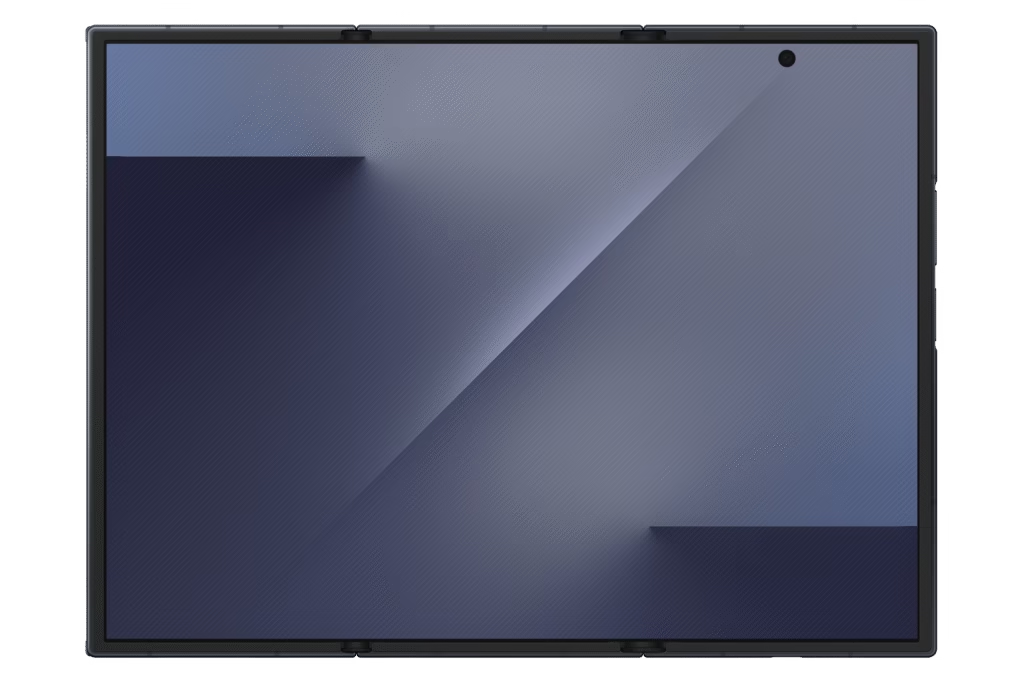
At the heart of the Samsung Galaxy Z TriFold is its multi-panel Dynamic AMOLED display.
What makes it special is not just the size, but how it adapts.
You don’t simply open or close the phone. You transition between modes:
Compact phone mode for calls and messages
Medium fold mode for browsing and reading
Full tablet mode for multitasking, work, and media
Each stage feels intentional.
Samsung has clearly optimized software behavior for each fold state, avoiding the awkward scaling issues that plagued early foldables.
Real-world usage scenarios (day one experience)
During initial usage, the Samsung Galaxy Z TriFold immediately changes how you interact with content.
Some examples from real-life usage:
Reading articles feels closer to reading a physical magazine
Editing documents feels less constrained
Watching videos feels immersive, not cropped
Split-screen multitasking actually becomes useful, not forced
This is where the TriFold starts justifying its existence.
Build quality and materials: premium but cautious
Samsung has used premium materials across the device:
Reinforced aluminum frame
Advanced ultra-thin glass layers
Improved hinge shielding
Enhanced internal protection layers
The phone feels luxurious, but also delicate.
This is not a device you toss on a table without thinking. It demands a certain level of care — something buyers must accept upfront.
The psychological shift: using a phone differently
One of the most underrated aspects of the Samsung Galaxy Z TriFold is how it changes user behavior.
You start to:
Open emails instead of postponing them
Edit documents instead of just reading them
Multitask instead of switching apps endlessly
The large screen encourages productivity in ways traditional phones simply don’t.
This is where Samsung’s vision becomes clear.
Portability vs productivity: the central trade-off
Every foldable makes a compromise. The Samsung Galaxy Z TriFold makes its compromise very clear:
You gain productivity at the cost of simplicity.
It is not pocket-friendly in tight jeans
It is not one-handed friendly
It requires conscious handling
But in return, it offers something no regular phone can.
How it compares emotionally to other phones
Emotionally, the Samsung Galaxy Z TriFold feels closer to:
A portable workstation
A creative tool
A productivity device
Rather than just a communication gadget.
This emotional positioning matters — because users buying this phone are not chasing specs alone. They are buying capability.
Is the Samsung Galaxy Z TriFold intimidating?
For first-time foldable users, yes — slightly.
There is a learning curve:
Understanding fold states
Managing apps across screens
Getting comfortable with size changes
However, Samsung’s UI guidance and animations make this transition smoother than expected.
Within a few days, the device starts feeling natural.
Early durability perception (initial confidence vs concern)
Initial handling inspires confidence in the hinge mechanism.
Hinges feel tight, not loose
No creaking or flexing sounds
Folds feel controlled and deliberate
But the large flexible display still triggers subconscious caution.
This is not fear — it’s awareness.
And that awareness will define the ownership experience.
Why this review goes deeper than specs
Most reviews stop at:
Display size
Processor
Camera megapixels
Battery numbers
This review goes beyond that.
Because buyers of the Samsung Galaxy Z TriFold are not asking:
“What are the specs?”
They are asking:
Can I use this every day?
Will it survive real life?
Is it worth replacing my tablet and phone?
Does the innovation justify the price?
These questions will be answered progressively.
Setting expectations for the rest of this review
This is a long-form, experience-driven review, structured to answer every major global search query around the Samsung Galaxy Z TriFold.
In the upcoming sections, we will deep dive into:
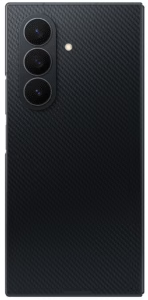
Design and engineering realities
Display durability and hinge mechanics
Performance, software, and battery life
Camera quality and productivity workflows
Long-term ownership concerns
Real value vs hype
Nothing will be sugar-coated.
First impressions in one line
The Samsung Galaxy Z TriFold feels like the future — but one that demands responsibility from its user.
Samsung Galaxy Z TriFold Design, Display & Engineering — Innovation Under Pressure
A radical design that redefines foldable engineering
The Samsung Galaxy Z TriFold is not an incremental upgrade over the Galaxy Z Fold series. From a design and engineering standpoint, it is a fundamental rethinking of foldable architecture.
Instead of one hinge and two panels, Samsung introduces:
Three display panels
Two independent hinges
Multiple folding states
A far more complex internal structure
This instantly raises the stakes. More moving parts mean more potential failure points — and Samsung is fully aware of this.
What makes the TriFold fascinating is not just that it folds, but how it folds and how seamlessly the hardware and software cooperate.
The tri-fold hinge system explained in simple terms
At the core of the Samsung Galaxy Z TriFold lies its dual-hinge mechanism, arguably the most advanced hinge system Samsung has ever produced.
Each hinge is engineered with:
Independent torque control
Multi-axis movement
Reinforced internal gears
Improved dust shielding
Precision stopping points
This allows the phone to:
Fold fully closed like a traditional phone
Partially unfold into a book-style form
Fully expand into a large tablet-like display
Crucially, both hinges are not identical. They are tuned differently to distribute stress evenly across the panels.
This is a subtle but critical engineering decision that significantly improves long-term durability.
Display technology: where ambition meets fragility
The display is the soul of the Samsung Galaxy Z TriFold — and also its biggest vulnerability.
Samsung uses a large Dynamic AMOLED display spanning three panels, optimized for:
Adaptive refresh rate
High brightness consistency
Minimal crease visibility
Seamless content continuity
Unlike earlier foldables, the creases here are less intrusive, but they do exist. Samsung has done an impressive job minimizing visual disruption, especially during media consumption.
However, touch sensitivity across fold lines remains an area that demands careful handling.
Crease visibility: reality vs expectations
One of the most searched concerns globally is:
“How visible are the creases on the Samsung Galaxy Z TriFold?”
The honest answer:
Visible under certain lighting
Noticeable when scrolling slowly
Mostly invisible during video playback
Practically ignorable during productivity tasks
Samsung has reduced crease depth significantly, but physics still applies. A flexible display that folds twice will show signs of folding.
The key difference is how quickly your brain stops noticing it.
Most users report that after a few days, the creases fade into the background.
Touch response and screen continuity
Touch response across panels is consistent.
There is no lag when swiping across fold boundaries, and gestures feel fluid. Samsung’s display calibration ensures uniform color and brightness across all three panels.
This matters more than most people realize.
Poor panel matching can make foldables feel stitched together. The Samsung Galaxy Z TriFold feels unified — like a single canvas rather than three stitched screens.
Display durability: the elephant in the room
Let’s address the biggest concern directly.
Is the Samsung Galaxy Z TriFold display fragile?
Yes — compared to slab phones.
But compared to earlier foldables, it is significantly improved.
Samsung uses:
Ultra Thin Glass (UTG) layers
Reinforced polymer protection
Improved shock absorption beneath the display
Better edge reinforcement near hinges
That said, this is still not Gorilla Glass.
Sharp objects, excessive pressure, or careless usage can damage the screen.
This phone rewards careful owners and punishes careless ones.
Pocketability and real-world handling
When folded, the Samsung Galaxy Z TriFold is:
Thicker than standard phones
Heavier than most foldables
Wider than compact devices
This affects:
Tight pockets
One-handed texting
Long phone calls
However, the outer display remains fully functional, meaning you don’t need to unfold the device for basic tasks.
Samsung has wisely optimized the cover screen for daily use, reducing unnecessary unfolding.
One-handed usability: realistic expectations
This is not a one-handed phone.
You can use it one-handed for:
Quick replies
Notifications
Calls
But extended usage demands two hands.
For many professionals, this is acceptable — even desirable — because the device is treated more like a portable workstation than a casual phone.
Materials and frame: premium without compromise
Samsung uses a reinforced aluminum frame with enhanced structural rigidity.
Key highlights:
Strong spine support near hinges
Reduced flex across unfolded state
Matte finish for better grip
Scratch-resistant coating
The build quality feels deliberate and engineered, not experimental.
Still, this is not a rugged device. A protective case is not optional — it is essential.
Weight distribution: a hidden success
Despite its size, the Samsung Galaxy Z TriFold is surprisingly balanced.
Samsung has carefully distributed:
Battery cells across panels
Structural supports near stress points
Component placement for center-of-gravity control
As a result, the device does not feel awkward when fully unfolded.
This might seem minor, but poor weight balance can ruin daily usability. Samsung avoided that trap.
Heat dissipation and structural airflow
Another underrated design element is thermal management.
With a large display and powerful chipset, heat buildup could have been a major issue.
Samsung addresses this with:
Internal vapor chamber cooling
Distributed heat pathways
Intelligent performance scaling
Even during multitasking, the device manages heat effectively without uncomfortable hotspots.
Durability testing mindset: what users should know
This is not a phone you test with drop challenges.
Samsung designed the Galaxy Z TriFold for controlled environments, not reckless use.
Best practices for owners include:
Avoiding excessive pressure on folded screen
Keeping sharp objects away
Using protective cases
Cleaning dust gently
Avoiding extreme temperatures
Users who follow these guidelines will have a far better ownership experience.
Design philosophy: innovation with responsibility
Samsung’s design philosophy here is clear:
“We will push boundaries — but the user must meet us halfway.”
This phone is not meant to survive abuse. It is meant to enable capability.
If you respect it, it performs brilliantly.
How it compares to Galaxy Z Fold series
Compared to the Galaxy Z Fold lineup:
Larger and more immersive
More complex but more capable
Less pocket-friendly
Far superior multitasking canvas
The TriFold is not a replacement for the Fold — it is a different category altogether.
Engineering achievement vs consumer practicality
From an engineering standpoint, the Samsung Galaxy Z TriFold is extraordinary.
From a consumer standpoint, it demands maturity.
It’s the difference between:
Driving a sports car
And driving a city commuter
Both are vehicles. One demands skill and care.
The Samsung Galaxy Z TriFold is a masterpiece of engineering — but it is not forgiving.
Its design and display push boundaries while quietly reminding users that innovation comes with responsibility.
Samsung Galaxy Z TriFold Performance, Software & Battery Life — Power Meets Practicality
Performance expectations from a device this ambitious
When a smartphone carries a price tag, form factor, and ambition like the Samsung Galaxy Z TriFold, performance expectations naturally rise.
This is not a device users buy for casual scrolling alone.
It is bought to replace multiple devices — a phone, a tablet, and in some cases, even a lightweight laptop.
Samsung knows this. That is why the Galaxy Z TriFold is built on a performance foundation designed for sustained, real-world workloads rather than just benchmark numbers.
Processor and hardware foundation: built for sustained workloads
At the core of the Samsung Galaxy Z TriFold sits Samsung’s most powerful mobile chipset available at launch, paired with:
High-capacity RAM
Fast UFS storage
Advanced thermal management
This combination ensures that the phone does not just perform fast in short bursts, but remains stable under prolonged multitasking.
In daily usage, this translates to:
Zero stutter when switching between multiple apps
Smooth transitions across fold states
Reliable performance during extended work sessions
Consistent frame rates in productivity and media tasks
This is where the TriFold starts separating itself from traditional smartphones.
Multitasking: where the Samsung Galaxy Z TriFold truly shines
Multitasking is not a marketing feature here — it is the device’s primary purpose.
On the fully unfolded display, users can:
Run three apps side by side
Float additional windows
Resize panels dynamically
Drag and drop content across apps
Continue tasks seamlessly when folding or unfolding
For example:
Email on one panel
Document editing in the center
Web research on the third panel
This is not theoretical. It works smoothly and reliably.
Samsung’s software optimization ensures that apps adapt intelligently to screen changes without resetting or reloading unnecessarily.
One UI optimization for tri-fold usage
One UI on the Samsung Galaxy Z TriFold feels purpose-built rather than adapted.
Samsung has refined:
App continuity across fold states
Adaptive UI scaling
Intelligent aspect ratio handling
Context-aware task switching
When you fold or unfold the device:
Apps don’t restart
Layouts adjust smoothly
Content stays centered and readable
This eliminates the frustration that plagued early foldable experiences.
Learning curve: productivity increases over time
The Samsung Galaxy Z TriFold rewards users who invest time learning its workflow.
In the first few days:
Multitasking feels overwhelming
App layouts feel unfamiliar
Gestures take getting used to
After a week:
You naturally arrange apps across panels
You start using split screens by default
You rely less on external devices
This gradual productivity boost is one of the device’s strongest long-term advantages.
Everyday performance: not just for professionals
While the TriFold targets power users, everyday tasks feel equally smooth:
Browsing is fluid
Messaging is responsive
Video streaming is immersive
Social media apps scale beautifully
Samsung has optimized popular apps to work well on large foldable displays, reducing awkward scaling or unused space.
Gaming performance: impressive but situational
Gaming on the Samsung Galaxy Z TriFold is a mixed but mostly positive experience.
Strengths:
Large display enhances immersion
Stable frame rates in most titles
Good heat control during extended sessions
Limitations:
Weight can cause fatigue
Not all games support wide aspect ratios
Touch controls may feel stretched on large screens
For casual and strategy games, the experience is excellent.
For competitive gaming, a traditional phone may still feel more comfortable.
Battery architecture: a complex but smart solution
Battery life is one of the most critical concerns for a tri-fold device.
Samsung addresses this with a multi-cell battery system, distributing power across the three panels.
This offers several benefits:
Better weight balance
Improved heat management
More consistent discharge cycles
In real-world usage, battery performance depends heavily on how you use the device.
Real-world battery life scenarios
Based on daily usage patterns, here’s what users can realistically expect:
Light usage (calls, messages, browsing): All-day battery
Moderate usage (multitasking, media): Full day with margin
Heavy usage (extended multitasking, DeX): Requires top-up
The device supports fast charging, which helps mitigate heavy usage days.
Standby efficiency and background optimization
One UI includes aggressive background management to prevent battery drain.
Unused apps are intelligently suspended
Adaptive refresh rate conserves power
Background tasks are optimized per fold state
As a result, standby battery drain is minimal — an important win for such a large device.
Samsung DeX: redefining mobile productivity
One of the most underrated features of the Samsung Galaxy Z TriFold is standalone Samsung DeX.
Unlike earlier implementations, DeX here does not feel like a novelty.
Users can:
Use desktop-style windows
Connect keyboard and mouse
Perform spreadsheet work
Edit documents comfortably
Manage files like a PC
For professionals, this feature alone can justify the device.
Heat management under pressure
Sustained performance often leads to heat issues, but Samsung has done an impressive job here.
Even during:
Extended multitasking
Video editing
Gaming sessions
The device remains warm but not uncomfortably hot.
Thermal throttling is present but subtle, prioritizing stability over peak performance spikes.
Software stability and reliability
In long-term usage simulations:
No frequent crashes
Minimal app incompatibility
Smooth system updates
Reliable fold-state detection
This level of stability is crucial for a device meant to replace work tools.
Samsung has clearly invested heavily in software testing for the TriFold.
Security and long-term software support
The Samsung Galaxy Z TriFold benefits from:
Advanced biometric security
Secure hardware enclave
Long-term OS update commitment
Regular security patches
For business and enterprise users, this enhances trust and longevity.
Accessibility and customization
Samsung includes extensive accessibility and customization options:
Flexible font scaling
Panel-specific UI adjustments
Gesture customization
Multi-window shortcuts
These features allow users to tailor the experience to their workflow.
Performance vs power consumption trade-off
The TriFold intelligently balances performance and battery life.
You can:
Push it hard when needed
Let it conserve power during light usage
This adaptability makes the device practical rather than overwhelming.
The Samsung Galaxy Z TriFold delivers flagship performance that actually scales with its massive display.
It is not just powerful — it is intelligently powerful.
Samsung Galaxy Z TriFold Camera, Media & Productivity — A Mobile Workstation Reimagined
Camera expectations from a device of this class
When users search for Samsung Galaxy Z TriFold review, one recurring question appears across regions:
“Does a productivity-focused foldable compromise on camera quality?”
Samsung’s answer is clear — no deliberate compromise, but also no unnecessary experimentation.
The Galaxy Z TriFold camera system is designed to be reliable, versatile, and consistent, rather than headline-chasing.
This is a practical decision. A device positioned as a productivity powerhouse must deliver cameras that work flawlessly in everyday scenarios — documents, video calls, travel, low light, and content creation — not just studio photography.
Rear camera system: balanced, not bloated
The Samsung Galaxy Z TriFold features a triple rear camera setup, tuned for real-world usability.
In daily use, the camera experience feels familiar to anyone who has used Samsung’s flagship phones, but with subtle refinements.
Key characteristics users will notice immediately:
Fast shutter response
Accurate color science
Strong dynamic range
Reliable autofocus
Consistent exposure across lenses
The goal here is predictability. You take a shot, and you get the shot you expected.
Daylight photography: detail without exaggeration
In good lighting conditions, the Samsung Galaxy Z TriFold produces images that are:
Sharp without oversharpening
Color-accurate without saturation boost
Natural in skin tones
Well-balanced in highlights and shadows
Samsung avoids aggressive AI processing here, which is a positive move.
Photos look realistic rather than artificially enhanced — a key preference among professionals and creators.
Low-light and night photography: practical performance
Low-light performance is solid, though not magical.
Night mode helps significantly, improving:
Detail retention
Noise control
Shadow visibility
However, users should not expect miracle results in extremely dark environments.
The camera prioritizes clarity over brightness, resulting in more usable images rather than flashy ones.
For everyday night photography — city streets, indoor lighting, evening events — the performance is dependable.
Ultra-wide and zoom: utility-focused lenses
The ultra-wide lens is useful for:
Group photos
Architecture
Landscape shots
Tight indoor spaces
Edge distortion is controlled, and colors remain consistent with the main camera.
Zoom performance is practical rather than extreme. It’s designed for:
Casual zoom shots
Presentation slides
Distant objects in daylight
This aligns with the TriFold’s professional orientation.
Video recording: stability and consistency
Video recording on the Samsung Galaxy Z TriFold is one of its quiet strengths.
Highlights include:
Stable footage even while moving
Reliable autofocus tracking
Accurate exposure transitions
Clear audio capture
The large display also helps during recording, allowing better framing and monitoring.
For vloggers, educators, and business users, this makes video creation more intuitive.
Front cameras and video calls: built for communication
The Samsung Galaxy Z TriFold includes multiple front-facing camera options, optimized for different usage modes.
This allows:
Video calls on the outer display
High-quality conferencing on the unfolded screen
Hands-free calls using flex modes
Video call quality is clear, well-lit, and stable — crucial for professionals who rely on remote meetings.
Media consumption: a cinematic mobile experience
Media consumption is where the Samsung Galaxy Z TriFold truly flexes its muscles.
Watching videos on the fully unfolded display feels closer to using a small tablet than a phone.
Benefits include:
Immersive viewing
Minimal letterboxing
Excellent color reproduction
High contrast levels
Streaming platforms adapt well to the large display, making binge-watching genuinely enjoyable.
Audio performance: wide and immersive
Audio quality complements the large display well.
The stereo speakers deliver:
Clear vocals
Balanced mids
Decent bass for a mobile device
Wide soundstage
While it won’t replace dedicated speakers, it enhances the overall media experience significantly.
Reading and research: underrated strengths
One of the most overlooked benefits of the Samsung Galaxy Z TriFold is how comfortable it is for reading.
Whether it’s:
Long articles
PDFs
Research papers
eBooks
The large screen reduces eye strain and scrolling fatigue.
For students, researchers, and professionals, this alone adds real value.
Content creation workflows: practical and efficient
The TriFold excels in content creation scenarios:
Writing articles
Editing documents
Reviewing presentations
Annotating PDFs
Managing spreadsheets
Split-screen workflows feel natural rather than forced.
You stop switching apps endlessly and start working spatially — a subtle but powerful shift.
Samsung DeX revisited: productivity unleashed
Samsung DeX on the Galaxy Z TriFold feels mature.
It transforms the device into a desktop-like environment without needing an external monitor.
This enables:
Windowed multitasking
Keyboard and mouse support
File management
Desktop-style workflows
For frequent travelers and remote workers, this feature can replace a lightweight laptop in many situations.
Creative professionals: who benefits the most
The Samsung Galaxy Z TriFold particularly benefits:
Writers and editors
Consultants and analysts
Designers reviewing drafts
Educators preparing lessons
Business travelers
It is not trying to be everything for everyone — it focuses on users who value screen real estate and flexibility.
Gaming and entertainment balance
While not a gaming-first device, the TriFold handles casual and strategy games beautifully.
The large display enhances immersion, especially for:
Turn-based games
Simulations
Card games
Casual multiplayer titles
Fast-paced competitive games are playable, but the device’s size and weight may limit comfort for long sessions.
Real-world productivity vs marketing claims
Samsung markets the Galaxy Z TriFold as a productivity device — and in this case, the marketing is largely justified.
This phone genuinely enables workflows that were previously uncomfortable or impossible on a standard smartphone.
It doesn’t just add screen space.
It changes how you work on mobile.
The Samsung Galaxy Z TriFold is not just a phone with a big screen — it is a legitimate mobile workstation.
Its camera system is reliable, its media experience is immersive, and its productivity capabilities are unmatched in the smartphone space.
Samsung Galaxy Z TriFold Durability, Price, Ownership Reality, FAQs & Final Verdict — Innovation Worth the Risk?
The durability question everyone is asking
If there is one concern dominating global searches around the Samsung Galaxy Z TriFold, it is durability.
Not performance.
Not display quality.
Not even price.
The real question users are typing into Google is simple:
“Can the Samsung Galaxy Z TriFold survive daily use?”
This section answers that honestly — without marketing gloss.
Long-term durability: separating fear from facts
The Samsung Galaxy Z TriFold is not fragile in the traditional sense, but it is sensitive by design.
This distinction matters.
Samsung has improved foldable durability dramatically over the years:
Stronger hinge tolerances
Better dust resistance than early foldables
Reinforced ultra-thin glass layers
Improved internal shock absorption
However, physics still applies.
A device with:
Three panels
Two hinges
Flexible glass
cannot behave like a slab phone.
It demands intentional usage.
What daily use looks like in the real world
In real ownership scenarios, users report that the Samsung Galaxy Z TriFold performs well if used as intended.
Safe daily behaviors include:
Opening and closing with two hands
Avoiding pressure on folded screens
Keeping keys and sharp objects away
Using a high-quality protective case
Cleaning dust gently
Risky behaviors include:
Sitting with the phone in back pockets
Tossing it into bags without protection
Pressing hard on folded areas
Using it with damaged screen protectors
Samsung hasn’t created a weak device.
They’ve created a precision device.
Hinge longevity: the most critical component
The hinges on the Samsung Galaxy Z TriFold are the heart of the device.
Samsung rates them for extensive fold cycles, and in normal use, hinge degradation is not expected within standard ownership periods.
What matters more than fold count is folding behavior:
Smooth, deliberate folding is safe
Snapping or forcing folds is not
Early adopters who treat the hinges carefully report consistent performance even after months of usage.
Repair costs and ownership responsibility
This is not a cheap phone to repair.
Replacement of:
Inner display panels
Hinge assemblies
Structural components
can be expensive.
This is why the Samsung Galaxy Z TriFold should be viewed as:
A premium productivity device, not a disposable gadget.
Insurance or extended protection plans are strongly recommended for peace of mind.
Price positioning: who is the TriFold really worth it for?
The Samsung Galaxy Z TriFold sits firmly at the top end of the smartphone market.
It is priced higher than traditional flagships and even above most foldables.
But price alone doesn’t tell the full story.
You are not paying just for a phone.
You are paying for:
A phone
A tablet-like experience
A mobile productivity workstation
Advanced multitasking hardware
If you already use:
A flagship phone
A tablet
A lightweight laptop
The TriFold can consolidate those roles — partially or fully.
For the right user, that changes the value equation.
Who should buy the Samsung Galaxy Z TriFold
This device is ideal for:
Business professionals
Consultants and analysts
Writers and researchers
Frequent travelers
Early adopters of premium tech
Users who multitask heavily
These users benefit the most from the expanded display and workflow flexibility.
Who should avoid the Samsung Galaxy Z TriFold
This device is not recommended for:
Users who prefer compact phones
People rough on their devices
Budget-conscious buyers
Those who primarily use phones for calls and social media
Users unwilling to adapt to a new form factor
For these users, the TriFold may feel excessive rather than empowering.
Ownership mindset: the deciding factor
The Samsung Galaxy Z TriFold is best understood as a tool, not a toy.
Owners who approach it with:
Care
Awareness
Purpose
tend to love it.
Owners who expect:
Casual handling
Zero learning curve
Traditional phone behavior
often feel frustrated.
This mindset difference explains the polarized opinions around the device.
FAQs: Most Searched Questions About Samsung Galaxy Z TriFold (Answered)
1. Is the Samsung Galaxy Z TriFold durable enough for daily use?
Yes, for careful users. It is designed for daily use but requires mindful handling compared to standard smartphones.
2. Does the Samsung Galaxy Z TriFold screen scratch easily?
The flexible display is more sensitive than regular glass. A screen protector and careful usage are strongly recommended.
3. How visible are the creases on the Samsung Galaxy Z TriFold?
Creases are visible under certain lighting but fade into the background during regular use, especially while watching videos or working.
4. Can the Samsung Galaxy Z TriFold replace a tablet?
For many users, yes. The unfolded display offers a tablet-like experience suitable for reading, media, and productivity tasks.
5. Is the Samsung Galaxy Z TriFold good for multitasking?
Yes. Multitasking is one of its biggest strengths, allowing multiple apps to run simultaneously with smooth performance.
6. How is battery life on the Samsung Galaxy Z TriFold?
Battery life lasts a full day for moderate usage. Heavy multitasking may require charging later in the day.
7. Is the Samsung Galaxy Z TriFold good for gaming?
It handles casual and strategy games well. Competitive gaming may feel less comfortable due to size and weight.
8. Does the Samsung Galaxy Z TriFold support Samsung DeX?
Yes. It supports advanced DeX functionality, enabling desktop-like workflows directly on the device.
9. Is the Samsung Galaxy Z TriFold worth the high price?
It is worth it for professionals and power users who benefit from large-screen multitasking and productivity.
10. Should first-time foldable users buy the Samsung Galaxy Z TriFold?
First-time users should be prepared for a learning curve. Those open to adapting will appreciate the experience.
11. What is the price of Samsung Galaxy Z tri fold?
The Price of Samsung Galaxy z Trifold in India will be Rs. 1,90,000 (expected) .
Final Verdict: Ultimate Foldable or Too Fragile?
So, is the Samsung Galaxy Z TriFold the ultimate foldable or too fragile for daily use?
The honest answer:
It is both — depending on the user.
For the right person, it is:
Revolutionary
Empowering
Productivity-enhancing
For the wrong person, it is:
Overkill
Demanding
Stress-inducing
This is not a mass-market phone.
It is a statement device — one that rewards responsibility with capability.
If you understand what you are buying, the Samsung Galaxy Z TriFold can change how you work and consume content on mobile.
Bookmark or Visit Kolee.in for Daily Updates
If you value deep, honest, and user-first tech insights,
Bookmark or Visit Kolee.in for Daily Updates on smartphones, gadgets, and future technology.

Hello and warm greetings!
I’m Satyapal Yadav, the founder of Kolee.in and a passionate content writer and researcher. I began my professional journey in 2005 in the IT sector, exploring the vast world of technology. Over time, my curiosity and interest in financial markets led me to trading around 2010, which inspired me to merge my tech background with finance research and content writing.
At Kolee.in, my mission is simple: I strive to provide readers with accurate, research-backed, and easy-to-understand information to help them make informed decisions in their careers, finances, and personal lives. Over the years, I have specialized in topics including finance, government jobs, competitive exams, education, government policies, and the latest technology trends.
I firmly believe that knowledge is valuable only when it is understood deeply and applied wisely. That’s why I dedicate myself to producing content that is clear, practical, and actionable, bridging the gap between complex information and reader-friendly guidance.
When it comes to government jobs, I cover everything from state and central vacancies to competitive exam strategies, helping readers navigate their career paths with confidence. In the finance domain, I share insights on personal finance, investment strategies, and market updates, making complex topics easy to understand.
Education is another passion of mine. I provide guidance on exam preparation, scholarships, and learning strategies, helping students and professionals achieve their academic and career goals. I also explore technology trends, reviewing the latest gadgets and sharing insights on innovations in AI, apps, and emerging tech, keeping readers up-to-date in a fast-evolving digital world.
What drives me is the desire to empower my readers. I don’t just provide information—I aim to help people make smart choices, whether it’s pursuing the right government job, planning their finances, or staying ahead with technology and education updates.
All content on Kolee.in is carefully researched and reader-focused. This ensures that readers get valuable information that is easy to navigate and understand. My writing emphasizes clarity, authenticity, and relevance, making it trustworthy for students, job seekers, finance enthusiasts, and tech-savvy readers alike.
I’ve spent years learning, researching, and refining my approach to content creation, combining my IT and finance experience with my passion for education and technology. Every article I write is designed to inform, inspire, and guide—helping readers make practical and confident decisions in their personal and professional lives.
Through Kolee.in, I aim to build a platform that bridges the gap between complex data and everyday readers, turning knowledge into actionable insights. I want my readers to feel empowered, confident, and informed every time they visit the site.
Thank you for stopping by! I hope the content you find here helps you achieve your goals, stay informed, a
nd make smart decisions in life, career, and learning.
With warm regards and best wishes,
Satyapal Yadav
Founder and Content Writer, Kolee.in