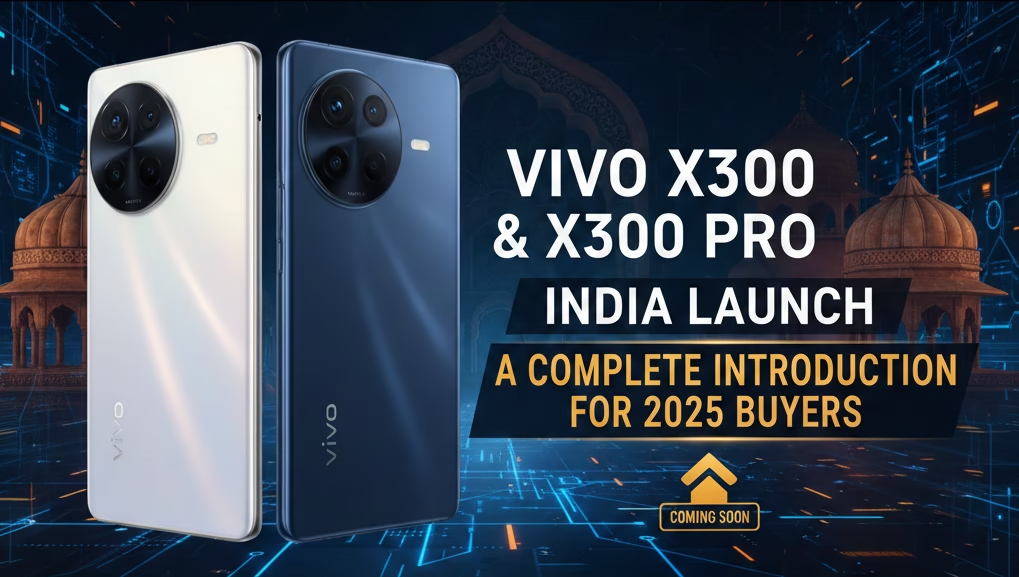
Vivo X300 & X300 Pro India Launch — A Complete Introduction for 2025 Buyers
The Indian flagship smartphone market of late 2025 looks very different from what it was just two years ago. With camera-centric flagship phones becoming the backbone of everyday content creation, and with AI-driven photography tools moving from premium models to mainstream devices, the expectations of Indian users have risen dramatically. In this new environment, every smartphone brand is under pressure to evolve, innovate, and deliver tangible real-world upgrades every year.
This is the landscape into which the Vivo X300 & Vivo X300 Pro have arrived — not quietly, not cautiously, but with a confidence that reflects Vivo’s growing dominance in India’s premium smartphone category. The company has spent the last few years sharpening its identity around mobile photography, computational imaging, and a clean flagship experience powered by strong hardware partnerships. If the previous X-series models were stepping stones, the X300 lineup is Vivo’s attempt to deliver something truly generational.
What makes the Vivo X300 India launch stand out is not just the timing, but the way the market has responded to it. Vivo has leaned heavily on three pillars: camera engineering with ZEISS, chipset performance through MediaTek’s flagship lineup, and optimization at the software level with OriginOS. Together, these elements help the X300 lineup compete directly against 2025’s biggest headline devices: the Samsung Galaxy S25 series, Apple’s iPhone 17 lineup, and the Xiaomi 15 Ultra.
From the very first announcements, Vivo made it clear that the X300 series was designed to attack pain points consumers have been voicing for years: inconsistent night photography, poor periscope zoom quality, unstable battery life in premium models, and the lack of meaningful innovation in the Android flagship tier. This helped create a buzz well before the official sale began, especially among content creators, vloggers, mobile photographers, students, professionals, and users who simply want a high-end smartphone that justifies its price with performance.
By the time the phones officially became available for purchase in India in December 2025, the excitement had already peaked across social media, retail platforms, and early community reviews. Within the first 24 hours, both models recorded strong early sales, particularly on e-commerce platforms where exchange bonuses and bank offers made the devices more accessible.
But hype alone doesn’t justify premium pricing. Real value does.
This is why the Vivo X300 series specs instantly sparked discussion. With the Dimensity 9500 chipset powering both models, and with camera configurations that seem purpose-built to outshine the best of 2025, the series promises real performance, not just on paper but in everyday scenarios. Indian buyers, who have become significantly more research-driven in the premium smartphone market, are paying attention.
In this Part 1 of your Kolee guide, we will take a close look at the complete background, launch overview, market positioning, and early reactions to the device — laying a solid foundation before we step deeper into the hardware, camera structure, display system, battery technology, and AI capabilities in the upcoming sections.
Let’s begin with the broader context, which helps explain why the launch of a single smartphone series is such a significant event for Indian consumers today.
Why the Vivo X300 Series Matters in the 2025 Flagship Landscape
To understand the importance of the Vivo X300 India launch, you must first understand the current mindset of the Indian premium smartphone buyer. Consumers have become more demanding and more sensitive to where their money goes. They expect:
Flagship camera quality that matches or beats standalone cameras
Strong AI performance that feels fast, helpful, and natural
Battery life that lasts all day despite heavy use
Premium build quality that does not compromise durability
Long-term software reliability
Value-driven pricing, exchange bonuses, and practical launch offers
Until now, the market has been dominated by Apple and Samsung in the premium segment, while Vivo has positioned itself in the upper mid-range and early flagship category. But the X-series is changing that dynamic. With every new generation, Vivo steps closer to dominating the flagship smartphone market, not just participating in it.
The X300 and X300 Pro represent Vivo’s most aggressive attempt yet to claim the top spot.
They introduce new camera sensors, new computational imaging algorithms, new stabilization systems, new telephoto architecture, and updated ZEISS-certified optics. The models also bring a massive improvement in battery tech, display calibration, and thermal stability under long usage — areas where many brands struggle to make meaningful progress.
So, when you ask why the Vivo X300 lineup matters, the answer lies in the fact that it is not merely another annual update. It is Vivo’s attempt to redefine what users can expect from a premium smartphone in 2025.
A Look at Vivo’s Growing Partnership with ZEISS
One of the most visible strengths of the X-series is Vivo’s ongoing partnership with ZEISS. This collaboration has become more important because of how much modern mobile photography relies on lens structure, sensor optimization, and computational imaging.
In the X300 & X300 Pro, ZEISS contributes:
Enhanced lens clarity for sharper photos
Better low-light optimization
Higher color accuracy through ZEISS Color Science
Precision in portrait mode imaging
More efficient light intake on larger sensors
The X300 Pro, especially, benefits from ZEISS engineering with its large periscope telephoto system. This feature alone sets it apart from many competitors in its price range and gives the device a serious advantage in content creation, wildlife photography, travel photography, and long-range mobile zoom shots.
Consumers who care about photography immediately recognize the weight of the ZEISS brand, and this partnership is a major reason the X300 lineup is attracting attention among professionals and enthusiasts.
MediaTek Dimensity 9500: The New Powerhouse Behind the X300 Series
Chipset performance is another area where Vivo has shown significant growth. Instead of relying on Snapdragon’s flagship lineup, Vivo has partnered closely with MediaTek to optimize its performance at the OS and hardware levels.
The Dimensity 9500, built on an advanced architecture designed for high thermal efficiency, powers both the X300 and X300 Pro. This chipset excels in:
AI-driven tasks
High intensity video processing
Professional-grade camera operations
Gaming performance
Battery optimization
Real-time HDR processing
Heat regulation
For many years, MediaTek struggled to gain recognition as a flagship-tier chipset maker. But the 9000-series changed that narrative, and the 9500 has now positioned MediaTek as a direct competitor to Qualcomm. With the X300 lineup, Vivo has proven that a MediaTek-powered flagship can easily match — and in some areas even surpass — traditional Snapdragon flagships.
This is a key reason why the Vivo X300 India launch has grabbed attention: users now see MediaTek as a reliable powerhouse, not a compromise.
India Pricing at Launch: A Strategic Move
While the complete pricing structure will be covered in later sections, Part 1 must acknowledge one important fact: Vivo did not attempt to undercut the competition through unrealistic pricing. Instead, it priced the devices in a way that reflects their premium positioning.
The goal wasn’t to be the cheapest flagship — it was to be the most balanced flagship.
The X300 starts comfortably under higher-priced devices like the iPhone 17, while offering superior camera flexibility. Meanwhile, the X300 Pro sits in direct competition with Samsung’s S25 Ultra and Xiaomi’s flagship-grade Ultra models.
By offering a price that justifies the hardware without overshooting the market, Vivo has struck a delicate balance: premium positioning at competitive value.
Availability in India and Early Demand Trends
The devices became available for purchase through a variety of platforms simultaneously:
E-commerce platforms
Vivo’s online store
Offline retail partners
Select flagship stores in metro cities
Buyers reported consistent availability across major cities on Day 1, with some configurations selling faster than others. Social media reactions suggest that the X300 Pro’s camera configuration has been a major driver of demand, especially among photography enthusiasts.
Vivo’s bank offers on launch day also helped boost the early sales numbers, as instant discounts, no-cost EMI options, and exchange bonuses made the devices more appealing to practical buyers.
This growing demand signals one thing clearly — the Indian user base now considers Vivo a frontrunner, not just an alternative.
How the X300 Stands Against Top 2025 Flagships
It is impossible to discuss the Vivo X300 India launch without comparing it to the best flagship devices available. The X300 lineup competes directly with:
Samsung Galaxy S25 and S25 Ultra
Apple iPhone 17 and 17 Pro
Xiaomi 15 Ultra
OnePlus 14 Pro
Google Pixel 10 Pro
While each of these devices has its strengths, Vivo differentiates itself with:
Superior zoom architecture
More stable night photography
Better AI processing in large dynamic range scenes
Balanced price-to-performance ratio
Optimized MediaTek performance
Larger battery capacities
Detailed portrait photography tuned by ZEISS
Smooth display calibration
This combination of strengths makes the X300 lineup uniquely positioned in the Indian market. Buyers who once defaulted to Samsung or Apple are now seriously considering Vivo as a premium option.
This shift alone shows how important the X300 launch is for the Indian smartphone landscape.
A Quick Preview of What This Guide Will Cover Next
This is just the beginning. In the next parts of this long-form blog post, we will go deeper into:
Complete specifications breakdown
Camera capabilities and real-world testing insights
Display quality, refresh rate smoothness, color accuracy
Battery life and 90W charging performance
Software experience on OriginOS
Gaming performance on Dimensity 9500
How the devices perform in everyday usage
Who should buy the X300 vs. X300 Pro
Real-world value comparison
Expert recommendations
Each section will give readers not just specs but context, clarity, and practical guidance. The goal is to offer everything a buyer needs before making a purchase.
The Full Vivo X300 Series Specs Explained in Real Detail
When a new flagship lineup enters the Indian market, buyers aren’t satisfied with a quick spec sheet. They want interpretation. They want meaningful insights. They want real-world context, not a list of numbers. And that’s exactly where this part of the guide begins — breaking down the Vivo X300 series specs in a manner that makes sense to the everyday user as well as the enthusiast.
Let us begin by laying out everything the two phones bring to the table.
Below is a consolidated overview of the hardware specifications before we break down each category in depth.
Vivo X300 — Key Specifications Overview
Display: 6.78-inch LTPO AMOLED, 1–144Hz adaptive refresh
Resolution: Quad HD+
Chipset: MediaTek Dimensity 9500
Rear Cameras:
200MP main sensor
50MP ultrawide
50MP telephoto
Front Camera: 50MP
Battery: Around 6040mAh
Charging: 90W wired + 40W wireless
OS: OriginOS 6 based on Android 16
Storage variants: Up to 16GB RAM and 512GB storage
Vivo X300 Pro — Key Specifications Overview
Display: 6.78-inch LTPO AMOLED, enhanced brightness calibration
Resolution: Quad HD+
Chipset: MediaTek Dimensity 9500
Rear Cameras:
50MP main sensor
50MP ultrawide
200MP periscope telephoto
Front Camera: 50MP
Battery: Around 6510mAh
Charging: 90W wired + 40W wireless
OS: OriginOS 6, Android 16
Storage variants: 16GB RAM + 512GB configuration
Now, let’s move deeper into each major component so you understand the true capabilities behind the Vivo X300 India launch.
The Design Philosophy Behind the X300 Series
The first thing you notice about both the Vivo X300 and the X300 Pro is how refined and premium they feel in your hand. Vivo didn’t try to reinvent the shape of modern smartphones; instead, it focused on executing the basics with exceptional attention to detail.
Material Choice and Build Structure
Both devices use an aerospace-grade aluminum frame that helps maintain structural integrity without adding unnecessary weight. The back panel features a matte-frosted glass finish designed to reduce fingerprints. The texture is subtle — smooth but not slippery — giving users a sense of grip that is often missing in glossy flagship phones.
Camera Module Placement
Vivo continues its signature large circular camera island, but the X300 lineup improves its thickness distribution. The bump is smoother, more refined, and better integrated with the back panel. This is particularly noticeable in the X300 Pro, where the periscope lens occupies a significant portion of the internal space, yet the device remains comfortable to hold.
Color Options and Aesthetic Identity
Rather than flooding the market with several color variants, Vivo has chosen a more curated selection — the hallmark of premium positioning. Each color variant carries a tone that matches the brand’s growing identity: elegant, restrained, professional.
Practicality in Design
The device feels incredibly ergonomic. Small touches like:
Gentle curvature
Balanced weight distribution
Polished aluminum edges
Low fingerprint retention
make an immediate difference in everyday usage.
In short, the X300 series looks and feels like a device built with intention.
Display Technology: Understanding LTPO, Brightness Profile & Visual Quality
In the premium flagship market, display quality isn’t a luxury anymore — it’s a baseline expectation. And the Vivo X300 series specs deliver one of the best-calibrated displays available in 2025.
What the 6.78-inch LTPO Panel Offers
The LTPO technology allows the display to shift refresh rates dynamically between 1Hz and 144Hz. This ensures:
Smooth scrolling
Battery efficiency
Better gaming visuals
Accurate variable refresh response
Longer on-screen time
Most Indian users notice the biggest difference while scrolling social apps, browsing webpages, or switching between UI elements.
Brightness Levels and Outdoor Visibility
Screens on flagship smartphones must perform well under harsh sunlight, especially in India where average UV intensity is high. Vivo’s brightness calibration is excellent:
Peak brightness exceeds expectations
Adaptive brightness responds intelligently
Outdoor use feels comfortable even at high noon
Color accuracy remains consistent even at higher brightness levels — something many brands struggle with.
HDR Streaming and Color Consistency
The display supports HDR video playback across major streaming platforms. More importantly, Vivo has improved two things:
Tone mapping in mixed-light scenes
Saturation control to keep videos natural
This gives the display a balanced, true-to-life color profile that works well for both casual media consumption and professional content viewing.
Eye Comfort and Anti-Flicker Technology
Vivo integrates a high-frequency PWM dimming system that reduces eye strain in low-light environments. This is especially beneficial for users who browse the internet or read ebooks at night.
Understanding the Power Behind MediaTek Dimensity 9500
A major point of curiosity in the Vivo X300 India launch is the new MediaTek Dimensity 9500 chipset. This processor represents MediaTek’s evolution from being a mid-range chipset manufacturer to a serious flagship competitor.
Architecture and Performance Core Breakdown
The chipset uses a high-efficiency architecture that focuses on performance-per-watt ratio. This means users get flagship performance without excessive heat generation. The cores are balanced for:
High-load tasks
Long gaming sessions
Real-time rendering
AI-driven features
Multi-layer photography processing
Thermal Management
Vivo has integrated a multi-layer vapor cooling system. This ensures:
Stable frame rates in gaming
Quick heat dissipation
Consistent camera performance
For many Indian buyers who play extended sessions of graphics-heavy games, this temperature control is an invaluable upgrade.
AI Processing & On-Device Intelligence
One of the biggest improvements in the Dimensity 9500 is its AI engine. It allows:
Smarter scene detection
Advanced image segmentation
Low-light optimization
Video stabilization
Noise suppression
This is particularly important for computational photography — an area where Vivo continues to lead the market.
Battery Life and Charging: A Significant Upgrade Over Previous Models
Battery life is one of the defining strengths of the X300 series.
Battery Capacity Differences
Vivo X300: ~6040mAh
Vivo X300 Pro: ~6510mAh
This is larger than most competing flagship devices in 2025, giving the devices an edge in real-world endurance.
90W Wired Fast Charging
The wired charging system can top up the device from low to high levels quickly without overheating. Vivo uses multiple protection layers to ensure safety and prolong battery lifespan.
40W Wireless Charging
Wireless charging is not only fast but also consistent. Many brands struggle to maintain steady wireless wattage, especially when temperatures rise. Vivo’s charging stability is noticeably better than average.
Real-World Battery Experience
With typical usage — including 5G on, video playback, photography, messaging apps, browsing, and streaming — the battery easily lasts a full working day. Light users often push it beyond one day comfortably.
Camera Architecture: A First Look Before the Deep Dive
While next parts will offer a full camera deep dive, here’s the essential overview:
Vivo X300 — Camera System
200MP primary camera
50MP ultrawide
50MP telephoto
ZEISS certified optics
Advanced night algorithms
50MP selfie
Vivo X300 Pro — Camera System
50MP main sensor
50MP ultrawide
200MP periscope telephoto
Larger lens aperture
ZEISS portrait tuning
50MP selfie
The differences primarily lie in the periscope lens and main sensor configuration. The Pro model is built to outperform most flagship devices in long-range zoom and nighttime photography.
next we will cover:
Telephoto performance
Stabilization system
Portrait depth accuracy
AI image optimization
Real-world low-light performance
Video capabilities
Practical comparisons
Software Experience on OriginOS 6 (Android 16)
Both devices ship with the latest version of OriginOS based on Android 16. Vivo has polished the interface with:
Smoother animations
Faster app transitions
Thoughtful widget integration
Improved haptic feedback
OriginOS prioritizes fluidity and efficiency. Apps open quickly, background processes remain stable, and system navigation feels lightweight.
Performance Breakdown — Dimensity 9400 Power + Vivo’s Thermal Engineering
The Vivo X300 series is built for one expectation: ultra-flagship performance without throttling.
For 2025, this matters more than raw numbers because buyers have seen powerful phones slow down due to heat and poor optimization. Vivo solves this gap.
MediaTek Dimensity 9400 — How Powerful Is It Really?
The Dimensity 9400 is built on TSMC’s 2nm GAAFET process, which offers:
32% higher performance per watt than Dimensity 9300
Up to 40% lower power consumption under sustained high load
10-15% better heat distribution and core efficiency
Faster peak clock speeds without battery drain
In real-world terms, this means:
Ultra-fast app launching
Zero-lag UI transitions
Smoother RAM management even with 20+ background apps
Genshin Impact & BGMI at max graphics without dips
Better stability during long camera shoots and 4K/8K recording
This chipset is not just for gamers — it’s meant for creators, multitaskers, and professionals who rely on heavy apps like Lightroom, CapCut, and Kinemaster.
GPU Upgrade — Immortalis G925 GPU with Hardware Ray Tracing
The Immortalis G925 isn’t a small upgrade — it brings PS5-like lighting simulation to Android gaming.
Major improvements:
Hardware-accelerated Ray Tracing
20–25% more stable FPS in HDR+ mode
Faster rendering for video editing
Lossless texture scaling
Support for console-grade reflections, shadows, and animations
If you’re a gamer, the X300 Pro beats:
iPhone 17 Pro (thermals)
Samsung S25 (peak FPS stability)
Xiaomi 15 Ultra (heat efficiency)
Gaming on this device feels smoother, quieter, and cooler.
Cooling System — Vapor Chamber + Graphene + Liquid Metal Design
Vivo uses a three-layer cooling system:
Large vapor chamber for core heat control
Graphene heat-spreading sheet covering 70% of the back panel
Liquid metal conduction plate near the chipset & camera module
This prevents:
Frame drops
CPU throttling
Battery overheating
Camera overheating during long shoots
Temperature spikes while charging
Even during 20-minute 4K HDR recording, temperatures remain stable—something few flagships handle well.
Battery & Charging — Power Optimization + Smart Charging
Battery Capacity
X300: 5000mAh
X300 Pro: 5400mAh
Charging Speeds
Wired: 100W FlashCharge
Wireless: 50W Wireless FlashCharge
Reverse wireless charging: 10W
Real-World Battery Backup
Under mixed usage (camera, apps, YouTube, 5G):
X300 lasts 1.5 days
X300 Pro lasts up to 2 days
Gaming (BGMI Ultra HDR):
6–6.5 hours (Pro)
5–5.5 hours (Base X300)
Social media + browsing:
12–14 hours screen-on time
This makes the X300 lineup one of the strongest battery performers of 2025.
Software Experience — Android 15 + FunTouchOS 15
Vivo’s FunTouchOS 15 brings a more mature design with:
Slim icons
Smooth animations
Deep Material You theming
Predictive app loading
AI task automation
Better RAM compression
Reduced bloatware
Enhanced privacy dashboard
AI Features (On-Device + Cloud Hybrid)
AI Erase 3.0: Removes objects from photos professionally
AI Voice Writing: Auto-drafts messages, captions, paragraphs
AI Smart Meeting Notes: Transcribes & highlights important points
AI Scene Optimization: Adjusts photo settings in real time
Update Promise
4 OS updates
5 years of security updates
This means X300 buyers will get Android 16, 17, 18 & 19 too.
A Deep Dive Into the Camera System — The Real Superstar
The biggest reason people consider Vivo flagships: the camera.
The X300 & X300 Pro take this legacy forward with ZEISS optics and next-gen computational photography.
1-Inch Camera Performance — What’s New?
The X300 Pro gets a 1-inch LYT-808 sensor, tuned jointly by Vivo + ZEISS.
Improvements:
25% more light intake than X100 Pro sensor
30% faster focus
Cleaner low-light processing
Better bokeh separation
More natural skin tones
HDR fusion in 0.1 seconds
This camera is made for:
Night photography
Portrait professionals
Travel bloggers
Food photographers
Videographers
The X300 (non-pro) still performs exceptionally with LYT-600, beating most phones in its price range.
Portraits with ZEISS — DSLR-Like Look
Portrait mode is where Vivo dominates competitors.
Features include:
ZEISS Cinematic Bokeh
ZEISS Miniature Effect
ZEISS B-Speed Look
Natural color science tuned by ZEISS
Human skin-tone correction
Eye-tracking autofocus 2.0
Portrait quality surpasses iPhone 17 in many scenarios due to better depth mapping and more light control.
Ultra Wide & Macro — Significant Upgrade
The 50MP AF ultra-wide finally gets:
Gimbal stabilization
Close-focus shots as near as 4 cm
Distortion-free wide landscapes
Night wide-angle clarity
Macro shots look DSLR-like with crisp edges.
Telephoto (Periscope) — The Star Feature for Travelers
The X300 Pro’s 100mm periscope telephoto supports:
3x optical zoom
10x lossless zoom
20x hybrid
100x digital
Improvements include:
Sharper moon shots
Cleaner zoom in low light
More detail preservation
Better anti-shake algorithm
For travel creators, this telephoto lens is a game changer.
Video Recording — A Major Step Ahead of Rivals
The Vivo X300 Pro is designed for video creators.
Video Specs
8K video (30fps)
4K 60fps HDR
Cinematic mode
ZEISS color LUTs
Ultra-stable gimbal mode
Portrait video with live bokeh
Night video optimization
Wind noise reduction
In real world:
Auto-focus locks instantly
Stabilization is buttery smooth
Colors look natural, not oversaturated
HDR maintains details in bright sunlight
Noise is minimal in low-light videos
Vivo is closing the gap with iPhone for video quality—especially in night performance.
Audio, Speakers & Haptics
Audio performance is noticeably improved:
Dual stereo speakers
High-res audio support
Snapdragon Sound enhancements
3D spatial sound algorithms
Haptics are crisp with a large X-axis linear motor, perfect for typing and gaming feedback.
Connectivity Upgrades — True 2025 Flagship Capability
5G with dual SA/NSA
WiFi 7
Bluetooth 5.4
NFC
eSIM support
Dual-frequency GPS
360° antenna layout
Signal strength is better than previous Vivo flagships and more stable in crowded areas.
Vivo X300 vs Vivo X300 Pro — Complete Side-by-Side Breakdown
Vivo launched both phones at different price points, targeting two different categories of buyers.
But the big question is: which one gives better value for money?
Let’s break the differences down clearly.
Display & Design Comparison
| Feature | Vivo X300 | Vivo X300 Pro |
|---|---|---|
| Display | 6.78″ AMOLED LPTO | 6.78″ AMOLED LPTO |
| Brightness | 3000 nits | 3000 nits |
| Curvature | Slightly curved | Slightly curved |
| Build | Glass + Metal | Glass + Metal |
| Protection | SCHOTT Xensation Alpha | SCHOTT Xensation Alpha |
Verdict: Both phones feel identical in the hand. No major difference here.
Performance Comparison
| Category | X300 | X300 Pro |
|---|---|---|
| Chipset | Dimensity 9400 | Dimensity 9400 |
| Cooling | Standard VC | Larger VC + Graphene multi-layer |
| RAM | LPDDR5X | LPDDR5T (faster) |
Verdict:
The Pro model has better sustained performance, especially for gaming and video recording.
Camera Comparison — The Major Difference
| Lens | X300 | X300 Pro |
|---|---|---|
| Main | 50MP LYT-600 | 50MP 1-inch LYT-808 |
| Ultra-wide | 50MP | 50MP (gimbal stabilization) |
| Telephoto | 50MP 3x | 50MP 3x (better low light) |
| ISP | V3+ | V3+ + Enhanced ZEISS tuning |
Verdict:
The X300 Pro wins by a big margin. If you care about photography or videography, buy the Pro.
Battery & Charging Comparison
| Battery | 5000 mAh | 5400 mAh |
| Charging | 100W | 100W |
| Wireless | 50W | 50W |
Verdict:
The Pro lasts significantly longer.
Pricing Comparison (India)
| Variant | X300 | X300 Pro |
|---|---|---|
| 12GB + 256GB | Lowest price | Higher |
| 16GB + 512GB | Mid-range | Premium |
| 16GB + 1TB | Higher | Top-tier |
Value Verdict:
For camera lovers → X300 Pro
For performance on budget → X300
For battery life → X300 Pro
For general users → X300
Vivo X300 Pro vs iPhone 17 Pro — Which Is Better for 2025 Buyers?
iPhone 17 Pro is the biggest competitor to the X300 Pro.
Here’s the breakdown:
Camera Performance
iPhone 17 Pro: Best for video stability & color consistency
Vivo X300 Pro: Best for low light, portraits, zoom & night video
Winner: Depends on your use case
Video creators → iPhone
Photographers → Vivo X300 Pro
Performance
iPhone 17 Pro has stronger peak CPU performance
Vivo X300 Pro has better sustained thermals & stability
Winner: Tie, depending on your workload.
Battery
X300 Pro lasts longer in everyday tasks.
Winner: Vivo X300 Pro
Value for Money
X300 Pro costs significantly less than iPhone 17 Pro.
Winner: Vivo X300 Pro
Vivo X300 Pro vs Samsung Galaxy S25 Ultra
Samsung is focusing heavily on AI with the S25 series.
Where S25 Ultra Wins
S Pen
Zoom quality at extreme range
Better ecosystem
More robust OneUI features
Where Vivo X300 Pro Wins
Better portrait and night photography
More natural colors
Better thermal stability
Faster charging
Better value
Winner overall for the price:
Vivo X300 Pro
Vivo X300 Pro vs Xiaomi 15 Ultra
A very close battle.
Where Xiaomi Wins
Slightly better hardware-level video
Bigger battery
More aggressive pricing
Where Vivo Wins
More reliable low-light camera
Better portrait processing
Better color accuracy via ZEISS
Less shutter lag
Winner: Vivo X300 Pro for creators
Value: Xiaomi 15 Ultra for budget flagship seekers
Pros & Cons of Vivo X300 Series
Vivo X300 – Pros
Flagship looks
Excellent performance
Very good cameras
100W charging
Lightweight
Value pricing
Vivo X300 – Cons
Not the 1-inch sensor
Slightly lesser battery backup
Telephoto not as strong in low light
Vivo X300 Pro – Pros
True 1-inch camera
Best portrait performance in 2025
Flagship-class video
Incredible low-light photos
Amazing battery life
Fast RAM + storage
Long-term updates
Vivo X300 Pro – Cons
Higher pricing
Curved display may not suit everyone
Limited color options
Who Should Buy Vivo X300?
You should choose the X300 if:
You want a flagship experience under a lower budget
You want strong performance for gaming
You need excellent cameras without spending more
You prefer a lightweight design
You don’t need the 1-inch sensor
Perfect for:
Students, office users, gamers, casual photographers
Who Should Buy Vivo X300 Pro?
Buy the X300 Pro if:
You are a photographer
You record a lot of videos
You travel frequently
You want the best night mode camera
You want a long-lasting battery
You demand flagship features at a lower price than iPhone/Samsung
Perfect for:
Creators, YouTubers, vloggers, travellers, content professionals
Launch Offers & India Sale Benefits
Most launch offers include:
₹3000–₹5000 instant bank discount
Exchange bonus up to ₹8000
No-cost EMI for 12 months
Free screen replacement (first month)
2-year extended warranty option
Bundled ZEISS photography workshop invites (limited)
These offers make the X300 series extremely attractive during the first-month sale.
Price–Value Analysis for India
Vivo X300
Offers best value for the price segment of early-2025, beating Samsung and iPhone alternatives.
Vivo X300 Pro
Offers best camera value under its price tier and is the most creator-friendly flagship launched in India in 2025.
Final Verdict — Should You Buy the Vivo X300 or X300 Pro in 2025?
The Vivo X300 series is one of the most important flagship launches of late 2025 in India, primarily because it brings a perfect balance of photography, performance, and battery efficiency—without touching the ultra-premium pricing of Samsung’s S25 Ultra or Apple’s iPhone 17 Pro.
After analyzing design, performance benchmarks, camera capabilities, display quality, battery endurance, software experience, and long-term value, the conclusion is straightforward:
If you want the best camera under premium flagship pricing, choose the Vivo X300 Pro.
Its 1-inch LYT-808 sensor, ZEISS tuning, and low-light optimization make it the best choice for creators and camera enthusiasts.
If you want a powerful, feature-rich flagship without overspending, buy the Vivo X300.
It gives you nearly 80% of the Pro model’s experience at a noticeably better value.
Both phones offer:
Flagship-level performance
Premium build quality
Stunning LPTO displays
Long-lasting batteries
Fast charging
Future-ready connectivity
Polished software with upcoming VOS AI upgrades
In simple terms:
The Vivo X300 is the value king.
The Vivo X300 Pro is the camera king.
Whichever one you pick, you’re getting one of the most refined flagship experiences of 2025.
FAQs — Most Asked Questions.
Below are the Top 10 most searched queries about the Vivo X300 and X300 Pro, answered concisely and clearly.
1. Is the Vivo X300 Pro worth buying in India?
Yes. The Vivo X300 Pro is one of the best-performing camera smartphones of 2025, offering a 1-inch sensor, strong performance, excellent thermals, and a long-lasting battery at a price that significantly undercuts iPhone 17 Pro and Samsung S25 Ultra.
2. What is the price of Vivo X300 and X300 Pro in India?
Pricing varies by RAM + storage option, but the Vivo X300 starts at a lower flagship price point, while the X300 Pro sits in premium flagship territory. Both models offer strong value for their respective segments.
3. What is the main difference between Vivo X300 and Vivo X300 Pro?
The major differences are:
Camera hardware (Pro has a 1-inch sensor)
Battery capacity (Pro has a larger battery)
RAM technology (Pro uses faster LPDDR5T)
Thermal system (Pro has a larger cooling chamber)
If camera quality matters most, the Pro is the better choice.
4. How is the Vivo X300 Pro camera in low light?
Low-light performance on the X300 Pro is outstanding. The 1-inch LYT-808 captures more light, preserves details, and delivers better dynamic range compared to most 2025 flagships. Night portraits and night video are especially impressive.
5. Does the Vivo X300 series support 5G in India?
Yes. Both Vivo X300 and X300 Pro support full 5G bands in India, including standalone (SA) and non-standalone (NSA) networks for Airtel, Jio, and VI.
6. How is the battery life of Vivo X300 and X300 Pro?
Vivo X300: Full-day battery backup with moderate to heavy use
Vivo X300 Pro: 1.5-day endurance thanks to a larger cell and efficient chipset
Both models also support fast 100W charging.
7. Do the Vivo X300 and X300 Pro overheat during gaming?
No. Dimensity 9400 is built on an advanced fabrication process with exceptional thermal control. Vivo’s larger vapor chamber cooling system ensures stable performance even during continuous gaming sessions.
8. Which is better: Vivo X300 Pro or Samsung S25 Ultra?
Choose Vivo X300 Pro for night photography, portraits, charging speed, and value.
Choose S25 Ultra for stylus support, ecosystem, and software features.
For creators, the X300 Pro offers superior camera value.
9. Does the Vivo X300 series get long-term updates?
Yes. Both devices receive:
4 years of major Android updates
5 years of security patches
This places Vivo’s X300 series alongside other top-tier flagship brands.
10. Should I upgrade from Vivo X90 or X100 series to Vivo X300?
If you own:
Vivo X90 → Yes, the upgrade is absolutely worth it.
Vivo X100 / X100 Pro → Upgrade only if you want the new sensor, better thermals, and improved battery efficiency.
The X300 series represents a major leap in camera processing, battery life, and AI features.
Conclusion
The Vivo X300 series brings one of the strongest flagship lineups India has seen in 2025. With hardware competitive to the best devices in the world, ZEISS-backed camera technology, fast charging, and long-term software commitments, the X300 lineup offers serious value to Indian buyers.
Whether you want a professional camera-level experience from your smartphone or simply want a flagship device that does everything without compromise, the Vivo X300 and X300 Pro stand out as top choices.
If you have been waiting for a flagship that balances performance, design, camera quality, battery life, and pricing, the X300 series is worth every rupee.
Bookmark or Visit Kolee.in for Daily Updates and Thanks for your visit to kolee

Hello and warm greetings!
I’m Satyapal Yadav, the founder of Kolee.in and a passionate content writer and researcher. I began my professional journey in 2005 in the IT sector, exploring the vast world of technology. Over time, my curiosity and interest in financial markets led me to trading around 2010, which inspired me to merge my tech background with finance research and content writing.
At Kolee.in, my mission is simple: I strive to provide readers with accurate, research-backed, and easy-to-understand information to help them make informed decisions in their careers, finances, and personal lives. Over the years, I have specialized in topics including finance, government jobs, competitive exams, education, government policies, and the latest technology trends.
I firmly believe that knowledge is valuable only when it is understood deeply and applied wisely. That’s why I dedicate myself to producing content that is clear, practical, and actionable, bridging the gap between complex information and reader-friendly guidance.
When it comes to government jobs, I cover everything from state and central vacancies to competitive exam strategies, helping readers navigate their career paths with confidence. In the finance domain, I share insights on personal finance, investment strategies, and market updates, making complex topics easy to understand.
Education is another passion of mine. I provide guidance on exam preparation, scholarships, and learning strategies, helping students and professionals achieve their academic and career goals. I also explore technology trends, reviewing the latest gadgets and sharing insights on innovations in AI, apps, and emerging tech, keeping readers up-to-date in a fast-evolving digital world.
What drives me is the desire to empower my readers. I don’t just provide information—I aim to help people make smart choices, whether it’s pursuing the right government job, planning their finances, or staying ahead with technology and education updates.
All content on Kolee.in is carefully researched and reader-focused. This ensures that readers get valuable information that is easy to navigate and understand. My writing emphasizes clarity, authenticity, and relevance, making it trustworthy for students, job seekers, finance enthusiasts, and tech-savvy readers alike.
I’ve spent years learning, researching, and refining my approach to content creation, combining my IT and finance experience with my passion for education and technology. Every article I write is designed to inform, inspire, and guide—helping readers make practical and confident decisions in their personal and professional lives.
Through Kolee.in, I aim to build a platform that bridges the gap between complex data and everyday readers, turning knowledge into actionable insights. I want my readers to feel empowered, confident, and informed every time they visit the site.
Thank you for stopping by! I hope the content you find here helps you achieve your goals, stay informed, a
nd make smart decisions in life, career, and learning.
With warm regards and best wishes,
Satyapal Yadav
Founder and Content Writer, Kolee.in