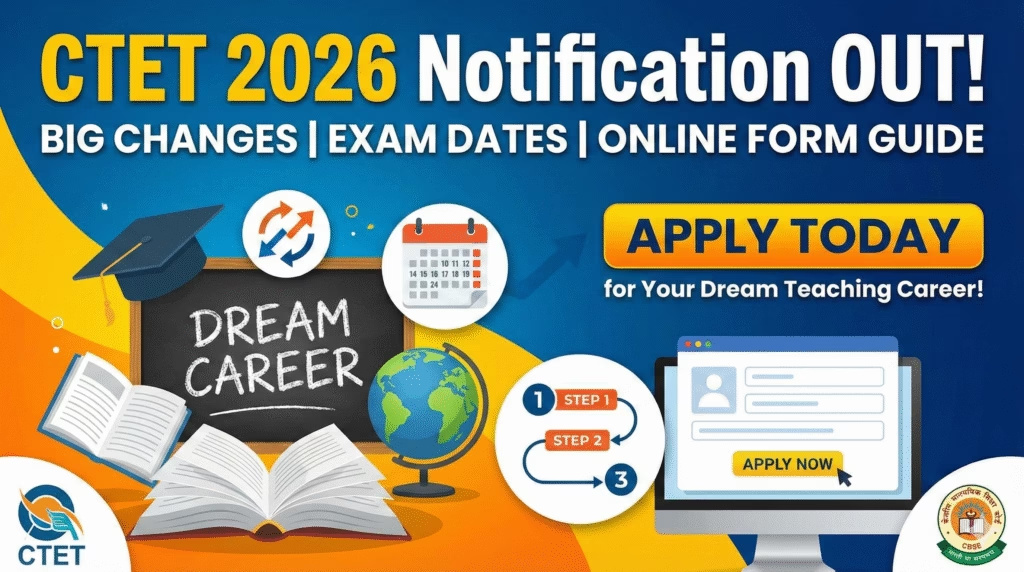
CTET 2026: If you’re dreaming of becoming a teacher in government schools, Kendriya Vidyalayas, Navodaya Vidyalayas, or any CBSE-affiliated school, then the CTET 2026 notification is finally out. This is one of the biggest exams in India for teaching aspirants, and the CTET certificate is now valid for a lifetime, making it even more valuable.
Let’s begin your journey toward becoming a teacher with this definitive CTET 2026 guide.
What is CTET? A Beginner-Friendly Explanation
CTET stands for Central Teacher Eligibility Test, conducted by the Central Board of Secondary Education (CBSE).
It determines your eligibility for teaching:
Primary Classes (Class 1 to 5) – Paper 1
Upper Primary Classes (Class 6 to 8) – Paper 2
Passing CTET does not guarantee a job automatically, but it makes you eligible to apply for thousands of government and private school vacancies across India. Almost every major school trusts CTET because it ensures that teachers have the required knowledge, skill, and teaching aptitude.
CTET is conducted twice every year, and the February 2026 session notification is officially out.
CTET 2026 Exam Highlights
Here is a quick snapshot of the CTET 2026 February exam:
Exam Name: CTET February 2026
Conducting Body: CBSE
Mode of Exam: Offline OMR (Pen-and-Paper)
Exam Date: 8 February 2026
Papers: Paper I and Paper II
Validity: Lifetime
Attempts Allowed: Unlimited
Who Can Apply: Candidates with required educational qualifications for teaching
Application Mode: Online
Official Website: ctet.nic.in
This year, CTET 2026 is expected to have record applications, thanks to lifetime validity and increased teacher vacancies across states.
CTET 2026 Registration Dates
The following dates are crucial if you want to register without any issues:
Notification Release Date: 27 November 2025
Application Start Date: 27 November 2025
Last Date to Apply: 18 December 2025 (till 11:59 PM)
Last Date for Fee Payment: Same day as above
Exam Date: 8 February 2026
Admit Card Release: First week of February 2026
Result Date: March 2026
These dates must be followed strictly. Any delay may lead to missing the exam for the entire year.
CTET 2026 Eligibility Criteria
CTET has separate eligibility criteria for Paper 1 and Paper 2. Make sure your qualifications match the requirements before submitting the form.
Eligibility for Paper 1 (Class 1–5 Teacher)
You are eligible if you meet any of the following:
Senior Secondary (12th) with at least 50% marks + 2-year D.El.Ed
Senior Secondary with 45% marks + D.El.Ed as per NCTE norms
Senior Secondary + 4-year B.El.Ed
Graduation + 2-year D.El.Ed
Graduation + B.Ed (Some conditions apply, check official bulletin)
Eligibility for Paper 2 (Class 6–8 Teacher)
You are eligible if you meet any of the following:
Graduation + 2-year D.El.Ed
Graduation with 50% marks + B.Ed
Graduation with 45% marks + B.Ed as per NCTE norms
Senior Secondary + 4-year B.El.Ed
Senior Secondary + 4-year B.A/B.Sc.Ed or B.A.Ed/B.Sc.Ed
Post-Graduation + B.Ed (special cases)
Age Limit
There is no upper age limit for CTET. Anyone who meets educational qualifications can apply.
CTET 2026 Application Fee
| Category | Paper 1 Only | Both Paper 1 & 2 |
|---|---|---|
| General / OBC (NCL) | ₹1000 | ₹1200 |
| SC / ST / PwD | ₹500 | ₹600 |
Payment must be made online only — via UPI, Net Banking, Debit/Credit Card, Wallets, etc.
CTET 2026 Exam Pattern
The CTET exam has two papers:
PAPER 1 (For Primary Teacher: Class 1–5)
| Subject | Questions | Marks |
|---|---|---|
| Child Development & Pedagogy | 30 | 30 |
| Language I | 30 | 30 |
| Language II | 30 | 30 |
| Mathematics | 30 | 30 |
| Environmental Studies (EVS) | 30 | 30 |
| Total | 150 | 150 |
PAPER 2 (For Upper Primary Teacher: Class 6–8)
| Subject | Questions | Marks |
|---|---|---|
| Child Development & Pedagogy | 30 | 30 |
| Language I | 30 | 30 |
| Language II | 30 | 30 |
| Maths & Science (for Science teachers) | 60 | 60 |
| Social Science/Social Studies (for SST teachers) | 60 | 60 |
| Total | 150 | 150 |
Both exams are MCQ (Multiple Choice Questions) with no negative marking.
CTET 2026 Passing Marks (Cutoff Rules)
To qualify CTET:
General Candidates: 60% (90/150 marks)
OBC/SC/ST/PwD: 55% (82/150 marks, relaxation applicable)
Once qualified, you receive a CTET Certificate with lifetime validity.
CTET 2026 Syllabus
Here is a simple breakdown of the syllabus:
A. Child Development and Pedagogy (Both Papers)
Learning theories
Intelligence theories
Inclusive education
Teaching-learning processes
Child psychology
Classroom challenges
Socialization processes
Concept of development & its relationship with learning
B. Language I & II
Language I focuses on regional language.
Language II focuses on English / Hindi (depending on your choice).
Topics include:
Comprehension passages
Language pedagogy
Grammar
Verbal ability
Communication skills
Mathematics (Paper 1 & Paper 2)
Number system
Geometry
Algebra
Measurement
Ratio & Proportion
Mensuration
Basic math pedagogy
Environmental Studies (Paper 1)
Family & friends
Food, water, shelter
Travel, things we make
Plants, animals
EVS pedagogy
Science (Paper 2)
Food, materials
Natural resources
Life sciences
Chemical reactions
Physics basics
Science pedagogy
Social Studies (Paper 2)
History
Geography
Civics
Social studies pedagogy
How to Apply for CTET 2026 — Step-by-Step Guide
Follow these steps carefully:
Step 1: Visit the official CTET website
Go to ctet.nic.in.
Step 2: Click “Apply for CTET February 2026”
You will find it on the homepage.
Step 3: Register Yourself
Enter your personal details like:
Name
Email ID
Mobile number
DOB
Academic details
Step 4: Fill the Application Form
Choose Paper 1, Paper 2, or both. Fill your qualifications, address, exam center choice, etc.
Step 5: Upload Documents
Upload:
Recent photo
Signature
Eligibility documents if required
All in prescribed size.
Step 6: Pay Application Fee
Choose the payment mode and pay the fee.
Step 7: Download Confirmation Page
This is your proof of successful application. Save it carefully.
CTET 2026 Exam Day Guidelines
Carry your Admit Card + Valid ID
Reach the exam centre at least 45 minutes early
Do not carry electronic gadgets
Use only blue/black ball pen
Check your question booklet code properly
Follow OMR rules carefully
Do not leave blank bubbles unnecessarily
CTET 2026 Preparation Strategy (Exam-Oriented Plan)
Here’s a powerful preparation plan:
1. Understand Syllabus Completely
Focus on child development, pedagogy, language, and subject content.
2. Practice Daily
Solve 30–50 MCQs every day.
3. Previous Year Papers
Solve last 10 years’ question papers.
4. Attempt Mock Tests
Take online/offline full-length mock tests.
5. Strengthen Pedagogy
This section is the highest scoring in both papers.
6. Focus on Reading Comprehension
Language papers contain easy but lengthy comprehension passages.
7. Revision Plan
Revise formulas, theories, and methods every weekend.
CTET 2026 Certificate — Value & Benefits
The CTET certificate is now valid for lifetime, which brings huge advantages:
Eligible for government teacher recruitment
Eligible for private school jobs
Eligible for Army Schools, Central Schools
No need to reappear again
Increases teaching credibility
Increases salary potential
Opens the door for TET-based recruitments in states
Why You Must Not Miss CTET 2026
CTET is the most respected teaching eligibility exam in India.
You should definitely apply if:
You want a stable and respected government teaching job
You want long-term career security
You want eligibility for thousands of vacancies
You want to work in CBSE schools, KVS, NVS, Army schools
You want a lifetime certificate
CTET 2026 is a golden opportunity. Don’t miss it.
Common Mistakes Students Must Avoid
Submitting form on the last day
Uploading wrong-size photos
Selecting the wrong paper
Misunderstanding the syllabus
Ignoring pedagogy
Avoiding mock tests
Arriving late to the exam centre
Avoid these mistakes to improve your performance.
CTET 2026 – FAQs
1. What is the CTET exam and why is it important?
CTET (Central Teacher Eligibility Test) is a national-level eligibility exam conducted by CBSE to ensure teachers possess the right knowledge, teaching skills, and classroom understanding. It is essential because almost all government and CBSE-affiliated schools require CTET qualification as a minimum eligibility to apply for teaching vacancies.
2. Is CTET 2026 notification officially released?
Yes, the CTET 2026 notification for the February session has been officially released. Online registration has started, and candidates can now apply within the given dates mentioned in the notification.
3. When is CTET 2026 exam scheduled?
The CTET 2026 exam is scheduled for 8 February 2026.
It will be conducted in offline OMR mode at designated centers across India.
4. What is the last date to apply for CTET 2026?
The last date to apply for CTET 2026 February session is 18 December 2025, and the application fee must also be paid on or before the same day.
5. Who is eligible for CTET Paper 1?
Candidates who want to teach Class 1 to 5 can apply for Paper 1. Eligibility includes:
12th with 50% marks + D.El.Ed OR
12th with 45% + D.El.Ed (NCTE norms) OR
12th + B.El.Ed OR
Graduation + D.El.Ed OR
Graduation + B.Ed (as per certain conditions)
6. Who is eligible for CTET Paper 2?
Candidates applying for Class 6 to 8 must have:
Graduation + D.El.Ed OR
Graduation (50%) + B.Ed OR
Graduation (45%) + B.Ed (NCTE norms) OR
12th + 4-year B.El.Ed OR
12th + B.A/B.Sc.Ed OR
Post-Graduation + B.Ed
7. What is the age limit for CTET 2026?
There is no upper age limit for CTET.
Anyone who meets the educational qualifications can apply.
8. How many times can I attempt CTET?
You can attempt CTET unlimited times.
There is no restriction on the number of attempts.
9. What is the validity of CTET certificate?
CTET certificate is valid for lifetime.
This means you never have to reappear once you qualify.
10. What is the CTET 2026 application fee?
General / OBC (NCL): ₹1000 for one paper, ₹1200 for both
SC / ST / PwD: ₹500 for one paper, ₹600 for both
11. How can I apply for CTET 2026?
You can apply online by:
Visiting the official CTET portal
Completing registration
Filling the form
Uploading documents
Paying the fee
Downloading the confirmation page
Make sure your photograph and signature meet the required format.
12. Is CTET conducted online or offline?
CTET 2026 will be conducted in offline OMR mode (pen and paper).
Candidates must fill responses using a ball pen.
13. What is the exam pattern for CTET 2026?
Both Papers have 150 questions of 150 marks.
There is no negative marking, which makes scoring easier.
14. Can I apply for both Paper 1 and Paper 2?
Yes. If you meet both eligibility criteria, you can apply for both papers and pay the combined fee.
Candidates applying for both papers get better job opportunities, especially in private schools and central schools.
15. What is the passing marks for CTET 2026?
General: 60% (90 marks)
OBC/SC/ST/PwD: 55% (82 marks)
16. Does CTET guarantee a government job?
No. CTET only makes you eligible to apply for teaching vacancies.
After that, you must clear the recruitment process of the respective school/board.
17. How many questions are asked in CTET?
Each paper contains 150 MCQs, each carrying 1 mark.
Total time: 2 hours 30 minutes.
18. Is CTET tough to crack?
CTET is considered a moderate-level exam.
Most aspirants qualify with dedicated practice, solving previous papers, and focusing on pedagogy.
19. What is the syllabus for CTET 2026?
Syllabus includes:
Child Development & Pedagogy
Language I & II
Environmental Studies (for Paper 1)
Mathematics
Science (Paper 2)
Social Studies (Paper 2)
Teaching methodology
Comprehension & grammar
20. Can B.Ed candidates apply for CTET Paper 1?
Yes, in some conditions B.Ed candidates are also eligible for Paper 1.
This depends on their training and CBSE’s latest eligibility rules.
21. How many languages are available in CTET?
CTET is available in 20+ languages, including Hindi, English, Assamese, Bengali, Gujarati, Tamil, Telugu, Urdu, and more.
22. What type of questions come in CTET?
The exam consists of MCQs with 4 options.
Questions test teaching aptitude, subject knowledge, and classroom understanding.
23. Is there negative marking in CTET?
No.
There is no negative marking, making it easier to attempt all questions.
24. When will CTET 2026 admit card release?
Admit card will be released in February 2026, around a week before the exam.
25. How to download CTET admit card?
Visit the CTET website → Login → Click “Download Admit Card” → Save PDF.
26. How to prepare for CTET 2026 in 2–3 months?
Cover NCERT books (Class 1 to 8)
Read Child Development & Pedagogy twice
Solve mock tests daily
Practice previous year questions
Revise formulas and grammar basics
Take weekly full-length tests
27. Which books are best for CTET 2026 preparation?
Popular books include:
Child Development and Pedagogy by Shalini Punjabi
CTET Success Master – Arihant
Mathematics by NCERT
Environmental Studies NCERT
English grammar books
Previous year CTET solved papers
28. Can I change my exam center after submitting the form?
No. Once the form is submitted, exam center cannot be changed.
Choose wisely while applying.
29. Will CTET 2026 result be available online?
Yes, the result will be released online on the CTET portal in March 2026.
30. How to check CTET result?
Visit CTET website → Enter Roll Number → View your marks → Download scorecard.
31. Can CTET certificate be downloaded online?
Yes. The certificate will be issued through DigiLocker.
Candidates can download it anytime using their mobile number.
32. Is qualifying CTET enough for teaching jobs?
CTET makes you eligible, but you still need to clear the recruitment exams/interviews depending on your chosen school or state.
33. Is CTET valid in all states of India?
Yes. CTET is valid nationwide, and most states accept it for teacher recruitment.
34. Which is easier: CTET Paper 1 or Paper 2?
Generally, Paper 1 is considered easier because the syllabus is simpler.
Paper 2 has more advanced content depending on subject choice.
35. What is the best strategy to score 120+ in CTET?
Perfect command on pedagogy
Strong reading comprehension skills
Practice 3–4 mock tests weekly
Solve previous year questions
Manage time efficiently
Attempt all questions (no negative marking)
36. Can I prepare for CTET at home?
Absolutely yes. With NCERT books, mock tests, YouTube classes, and previous papers, self-study is enough to crack CTET.
37. What happens if I fail CTET?
No problem — you can apply again.
There is no limit on attempts, so you can try every year.
38. Does CTET paper have sectional cutoff?
No.
There is only an overall cutoff based on total marks.
39. Can I appear for CTET while doing my B.Ed or D.El.Ed?
Yes. Candidates who are pursuing final-year B.Ed or D.El.Ed are eligible to apply.
40. What is the difficulty level of CTET math?
Moderate.
Most questions are based on NCERT Class 3–8 concepts, and solving NCERT books is enough.
Final Conclusion (Must Read)
The CTET 2026 Notification is OUT, and the registration window is open. This is the right time to apply and start your preparation seriously.
CTET is not just another exam — it is the gateway to a teaching career, a respected profession, and long-term job stability. The lifetime validity of the certificate makes CTET 2026 even more valuable.
If you are committed to becoming a teacher, then do not delay your application. Fill out the form, start preparation, and aim to clear CTET in your first attempt.
Want more exam updates and premium study resources?
👉 Bookmark and Visit kolee.in and stay ahead of every notification!

Hello and warm greetings!
I’m Satyapal Yadav, the founder of Kolee.in and a passionate content writer and researcher. I began my professional journey in 2005 in the IT sector, exploring the vast world of technology. Over time, my curiosity and interest in financial markets led me to trading around 2010, which inspired me to merge my tech background with finance research and content writing.
At Kolee.in, my mission is simple: I strive to provide readers with accurate, research-backed, and easy-to-understand information to help them make informed decisions in their careers, finances, and personal lives. Over the years, I have specialized in topics including finance, government jobs, competitive exams, education, government policies, and the latest technology trends.
I firmly believe that knowledge is valuable only when it is understood deeply and applied wisely. That’s why I dedicate myself to producing content that is clear, practical, and actionable, bridging the gap between complex information and reader-friendly guidance.
When it comes to government jobs, I cover everything from state and central vacancies to competitive exam strategies, helping readers navigate their career paths with confidence. In the finance domain, I share insights on personal finance, investment strategies, and market updates, making complex topics easy to understand.
Education is another passion of mine. I provide guidance on exam preparation, scholarships, and learning strategies, helping students and professionals achieve their academic and career goals. I also explore technology trends, reviewing the latest gadgets and sharing insights on innovations in AI, apps, and emerging tech, keeping readers up-to-date in a fast-evolving digital world.
What drives me is the desire to empower my readers. I don’t just provide information—I aim to help people make smart choices, whether it’s pursuing the right government job, planning their finances, or staying ahead with technology and education updates.
All content on Kolee.in is carefully researched and reader-focused. This ensures that readers get valuable information that is easy to navigate and understand. My writing emphasizes clarity, authenticity, and relevance, making it trustworthy for students, job seekers, finance enthusiasts, and tech-savvy readers alike.
I’ve spent years learning, researching, and refining my approach to content creation, combining my IT and finance experience with my passion for education and technology. Every article I write is designed to inform, inspire, and guide—helping readers make practical and confident decisions in their personal and professional lives.
Through Kolee.in, I aim to build a platform that bridges the gap between complex data and everyday readers, turning knowledge into actionable insights. I want my readers to feel empowered, confident, and informed every time they visit the site.
Thank you for stopping by! I hope the content you find here helps you achieve your goals, stay informed, a
nd make smart decisions in life, career, and learning.
With warm regards and best wishes,
Satyapal Yadav
Founder and Content Writer, Kolee.in