Bihar’s 68 Lakh Deletions → National Panic → Supreme Court Bench Formation
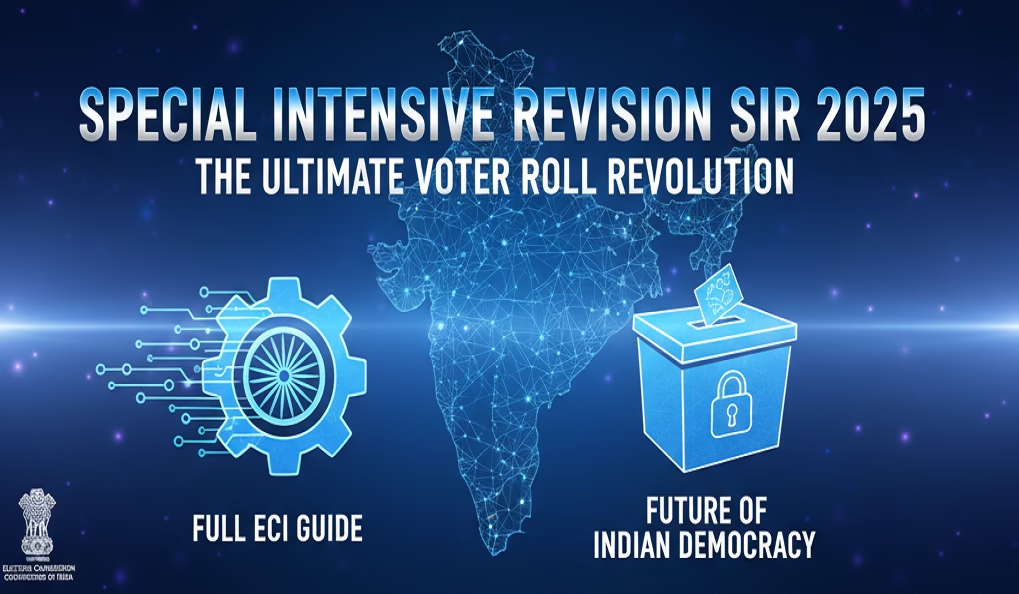
In October 2025, India witnessed a seismic electoral shock: 68 lakh voter deletions in Bihar during the pilot phase of the Special Intensive Revision SIR 2025. What was initially projected as a “routine clean‑up” of outdated records quickly spiraled into a national panic.
Entire families discovered their names missing, migrant workers found themselves erased, and political parties accused each other of orchestrating a silent purge. The uproar was so intense that within weeks, a three‑judge Supreme Court bench was constituted to examine the legality, fairness, and transparency of the exercise.
The Election Commission of India (ECI) insists that the Special Intensive Revision SIR 2025 is a necessary step before the 2026 general elections. With allegations of duplicate voters, ghost entries, and outdated records piling up, the Commission argues that a clean roll is the foundation of free and fair elections. Critics, however, warn that the timing, scale, and opaque methodology could disenfranchise millions.
This section traces the genesis of SIR 2025, exploring how historical voter roll evolution, past scandals, and recent trigger events converged to make this the most controversial electoral exercise in modern India.
Historical Context: Evolution of Voter Rolls
- 1950 – The First Rolls: India’s first general election required registering 17 crore voters manually. Paper rolls, handwritten entries, and booth‑level lists defined the era.
- 2002 – The Base Roll: After decades of incremental updates, the ECI declared 2002 as the “base year” for clean rolls. This became the benchmark against which future revisions were compared.
- 2015 – Digital Leap: With the launch of ERONET (Electoral Roll Network), voter data went digital. While this promised efficiency, it also introduced risks: mismatches, duplication, and technical glitches.
Past Scandals
- UP 2012: Reports of bogus voters in Uttar Pradesh shook confidence in the system.
- Assam NRC 2018: The National Register of Citizens exercise revealed how politically charged voter verification could disenfranchise millions.
These episodes set the stage for Special Intensive Revision SIR 2025, which aims to combine digital technology with manual verification to restore credibility.
Trigger Events Leading to SIR 2025
- October 2025 Supreme Court Order: The SC directed the ECI to “clean rolls before 2026 polls,” citing concerns over electoral integrity.
- PILs from Tamil Nadu, West Bengal, Kerala: Civil society groups and opposition parties filed petitions alleging “pre‑poll rigging.”
- ECI’s Internal Audit: A nationwide audit revealed 12% duplicate entries, amounting to nearly 6 crore questionable records.
These events forced the Commission to launch Special Intensive Revision SIR 2025 as a nationwide exercise, beginning with Bihar and expanding state by state.
ECI’s Official Rationale
- Scale of Democracy: India has 51 crore registered voters, supported by 94 lakh Booth Level Officers (BLOs) and 10.4 lakh polling stations.
- Tech Upgrade: The ECI unveiled ERONET 2.0, an AI‑powered system capable of flagging anomalies such as duplicate EPIC numbers, ghost entries, and deceased voters.
- Efficiency Promise: Officials argue that without Special Intensive Revision SIR 2025, the 2026 polls risk being marred by fraud and inefficiency.
Political Reactions
- BJP’s Stand: “We are cleaning ghost votes. Democracy must be protected.”
- Opposition’s Counter: “This is voter suppression disguised as reform.”
- Civil Society: NGOs warn of disenfranchisement of marginalized groups, especially migrant workers and rural poor.
Why Check the SIR Voter List 2025?
The SIR voter list check 2025 is not just a bureaucratic formality—it’s a safeguard for your democratic rights. With millions of deletions already reported, every citizen must verify their status before the 2026 polls.
- Deletion Risks: Names may be removed due to duplication, migration, or clerical errors.
- New Enrollment: First‑time voters must confirm their inclusion.
- Address Updates: Urban migration and rural shifts often lead to mismatches in constituency rolls.
By performing the SIR voter list check 2025, you ensure your vote is protected and your voice counts.
Method 1: Online Portal
The fastest way to complete your SIR voter list check 2025 is through the official Election Commission portal.
Step‑by‑Step Guide
- Visit voters.eci.gov.in.
- Select Search by EPIC number or Search by details.
- Enter your credentials and solve the CAPTCHA.
- Download the PDF voter slip for confirmation.
Troubleshooting
- “Name not found” error: This often traces back to mismatches with the 2002 base roll.
- Portal glitches: Use a VPN or try during non‑peak hours.
Mobile App Option
- Download the Voter Helpline App (Android/iOS).
- Use the same EPIC search to complete your SIR voter list check 2025 on the go.
Method 2: BLO House Visits
Booth Level Officers (BLOs) are the backbone of the Special Intensive Revision SIR 2025.
What BLOs Ask For
- Form 1A: New enrollment.
- Form 1B: Corrections.
- Form 1C: Deletion objections.
Red Flags
- If marked “Absent,” insist on verification.
- Always demand a receipt copy of submitted forms.
Sample filled forms (visuals to be embedded later) will guide voters through the process.
Method 3: Offline Centers
For those without digital access, the SIR voter list check 2025 can be done at:
- Voter Registration and Education Centers (VRECs)
- Electoral Registration Offices (ERO)
- Helpline 1950 (toll‑free, multilingual support)
SIR form Online – SIR Status Check
ECI Online Form Process (Very Short & Clear)
Visit Official Website
Go to eci.gov.in.Open Voter Services
Click on “Voter Services / Forms”.Choose the Required Form
Form 6 – New Voter ID
Form 8 – Correction/Update
Form 7 – Delete/Objection
Form 6B – Aadhaar Linking
Register / Login
Login with mobile number + OTP on NVSP.Fill Details
Enter personal details, address, and upload required documents.Submit & Track
Submit the form and track status from NVSP Dashboard.
Pro Tips & Hacks
- Use a VPN if the portal is slow or inaccessible.
- Always screenshot your PDF slip and forward it via WhatsApp for family records.
- Cross‑verify with BLO visits to avoid surprises on polling day.
Why 2002 Matters in Special Intensive Revision SIR 2025
The 2002 base roll is often referred to as the “last clean roll” before digitization errors began creeping into the system. For the Special Intensive Revision SIR 2025, the Election Commission of India (ECI) has declared 2002 as the benchmark year against which voter identities are verified.
- Pre‑digitization accuracy: Records were manually verified, reducing duplication.
- Legal benchmark: Courts often cite 2002 rolls in disputes over voter identity.
- Ancestral linkage: Many families rely on pre‑2002 documents to prove lineage and continuity in electoral rolls.
Thus, the Special Intensive Revision SIR 2025 hinges on the authenticity of the 2002 roll, making it crucial for voters to understand how to access and use it.
How to Access the 2002 Roll
Online Access
- Visit the ECI portal and select the “Search in 2002” option.
- Choose your state and assembly segment.
- Download the scanned PDF of the 2002 roll.
Physical Copies
- CEO Offices: State Chief Electoral Officer offices maintain archives.
- Libraries: District libraries often store electoral records.
- Public Notices: BLOs may carry extracts during house visits.
By cross‑checking your details in the 2002 roll, you strengthen your case during the Special Intensive Revision SIR 2025 process.
Ancestral Proofs Accepted
To validate your entry in the Special Intensive Revision SIR 2025, the following ancestral proofs are widely accepted:
- Birth Certificate (issued before 2002)
- School Leaving Certificate (with date of birth and address)
- Ration Card (pre‑2002, showing family linkage)
- Affidavit (sworn before a magistrate, confirming residence and lineage)
Case Studies
- Ramesh Kumar (UP): Used his father’s 1999 ration card to prove continuity.
- Shabana Begum (WB): Submitted a school leaving certificate from 2001 to validate her entry.
- Joseph Mathew (Kerala): Filed an affidavit with supporting church records to confirm lineage.
These examples highlight how ancestral documents play a decisive role in the Special Intensive Revision SIR 2025.
Common Rejections & Appeals
Even with documents, rejections are common during the Special Intensive Revision SIR 2025.
Common Reasons
- “No record found in 2002 roll.”
- “Mismatch in address or spelling.”
- “Document not recognized by BLO.”
Appeal Process
- File Form 7 to object to deletion.
- Attend AERO hearings for clarification.
- Escalate to CEO offices if unresolved.
Persistence is key—many successful appeals have restored voter rights during earlier revisions.
National Timeline of Special Intensive Revision SIR 2025
The Special Intensive Revision SIR 2025 is unfolding in carefully planned phases across India. The Election Commission of India (ECI) has mapped out a national timeline to ensure every state undergoes verification before the 2026 polls.
- Phase 1: Bihar pilot (August–October 2025)
- Phase 2: Southern and eastern states (November 2025–January 2026)
- Phase 3: Northern and western states (February–April 2026)
- Final Consolidation: National roll freeze by May 2026
This phased approach allows the ECI to test reforms, troubleshoot glitches, and refine the SIR voter list check 2025 process before scaling nationwide.
Phase 2 States
Tamil Nadu
The Special Intensive Revision SIR 2025 in Tamil Nadu has become a political battlefield. With 1.8 crore forms filed, the DMK accuses the AIADMK of manipulating BLO visits, while the Supreme Court has temporarily stayed certain deletions. The SIR voter list check 2025 here is critical, as urban migration and student voters form a large bloc.
West Bengal
In West Bengal, the TMC claims the exercise is a “voter purge,” pointing to 2.1 crore verifications. Rural districts have reported mass absentee markings, sparking protests. The SIR voter list check 2025 is being promoted aggressively by NGOs to safeguard marginalized communities.
Kerala
Kerala’s rollout is smoother, with 98% BLO reach achieved. Both LDF and UDF have united in demanding transparency. Citizens are encouraged to complete the SIR voter list check 2025 online, with high adoption of the Voter Helpline app.
Puducherry
In Puducherry, the Congress and NR Congress are sparring over deletions. Though smaller in scale, the Special Intensive Revision SIR 2025 has triggered intense debate about migrant laborers’ rights.
Other States
Eight additional states — including Odisha, Andhra Pradesh, and Telangana — are undergoing rapid verification. Quick stats show deletion rates between 8–12%, reinforcing the urgency of the SIR voter list check 2025 nationwide.
Phase 1 Recap: Bihar Pilot
The Bihar pilot remains the most controversial chapter of the Special Intensive Revision SIR 2025. With 68 lakh deletions (12%), lessons learned include:
- Need for better BLO training.
- Importance of ancestral proofs from the 2002 roll.
- Public awareness campaigns to encourage the SIR voter list check 2025.
ECI’s 11 Approved Documents
The Election Commission of India has released a definitive list of 11 approved documents for the SIR voter list check 2025. These are the backbone of verification during the Special Intensive Revision process.
- Passport
- Driving License
- Aadhaar Card
- Ration Card (pre‑NFSA)
- Voter ID (EPIC)
- Birth Certificate
- School Leaving Certificate
- Bank Passbook with photo
- Electricity Bill (recent)
- Water Bill (recent)
- Affidavit sworn before a magistrate
Carrying at least two of these ensures smoother processing during the SIR voter list check 2025.
Controversial Documents
The SIR voter list check 2025 has reignited debates around certain documents:
- Aadhaar Linking Debate: Critics argue Aadhaar was never meant to be a citizenship proof. Linking it to voter rolls risks exclusion of genuine voters.
- Ration Card Validity Post‑NFSA: With the National Food Security Act (NFSA) reshaping ration distribution, older ration cards are often rejected, leaving families vulnerable.
These controversies underline the importance of carrying multiple proofs during the SIR voter list check 2025.
Digital vs Physical Verification
The SIR voter list check 2025 is unique because it blends digital and physical verification.
- Digital: Integration with DigiLocker allows voters to upload documents directly.
- Physical: Rural voters often lack printers or scanners, forcing reliance on BLO photocopies.
This dual system ensures inclusivity but also creates logistical challenges.
Fraud Prevention Measures
To safeguard the SIR voter list check 2025, the ECI has introduced cutting‑edge fraud prevention:
- AI Face Match: Algorithms compare voter photos with Aadhaar and EPIC databases.
- Fingerprint Scan Pilots: Tested in select constituencies to prevent impersonation.
- Fake Aadhaar Busts: In Uttar Pradesh, several fake Aadhaar entries were flagged and deleted.
These measures aim to restore trust in the Special Intensive Revision SIR 2025 process.
Deletion Statistics in Special Intensive Revision SIR 2025
The Special Intensive Revision SIR 2025 has triggered widespread anxiety due to massive deletion figures.
- Bihar Pilot: 68 lakh deletions, accounting for nearly 12% of the state’s voter roll.
- Projected National Impact: Analysts estimate 8–10 crore deletions nationwide once the exercise is complete.
- Categories of Deletions: Deceased voters, duplicate entries, migrated citizens, and suspected non‑citizens.
These numbers highlight why every citizen must stay vigilant during the Special Intensive Revision SIR 2025.
Who Gets Deleted?
The Special Intensive Revision SIR 2025 targets specific categories:
- Deceased Voters: Identified through municipal death records.
- Duplicate Entries: Flagged by AI algorithms in ERONET 2.0.
- Shifted Residents: Those who moved constituencies without updating records.
- Non‑Citizens: Cases flagged during NRC‑linked audits.
Case Study: Migrant Workers in Mumbai
Thousands of migrant workers discovered their names missing during the Special Intensive Revision SIR 2025. Many had valid EPIC numbers but were marked “absent” due to address mismatches. This underscores the importance of proactive verification.
Myths Busted
The Special Intensive Revision SIR 2025 has been surrounded by misinformation.
- Myth 1: “Only opposition voters are targeted.”
- Reality: Data shows deletions across party lines, driven by duplication and outdated records.
- Myth 2: “Urban voters are safe.”
- Reality: Cities like Delhi and Mumbai have reported high absentee markings.
- Myth 3: “Digital verification is foolproof.”
- Reality: Portal glitches and mismatches with the 2002 roll continue to cause errors.
By busting these myths, citizens can approach the Special Intensive Revision SIR 2025 with clarity.
Legal Recourse for Deleted Voters
If your name is deleted during the Special Intensive Revision SIR 2025, there are clear legal pathways:
- File Form 7: Object to deletion at the BLO level.
- AERO Hearing: Present documents and proofs before the Assistant Electoral Registration Officer.
- CEO Appeal: Escalate unresolved cases to the Chief Electoral Officer.
- High Court & Supreme Court: Landmark judgments have restored voter rights in past cases.
Success Stories
- Case 1: A Delhi High Court ruling reinstated 5,000 migrant workers.
- Case 2: Kerala HC ordered BLOs to accept ration cards as valid proof.
- Case 3: Supreme Court directed ECI to re‑verify deletions flagged as “mass absentee.”
These precedents empower citizens to fight back during the Special Intensive Revision SIR 2025.
November 11, 2025 Hearing: Supreme Court vs Special Intensive Revision SIR 2025
On November 11, 2025, the Supreme Court convened a historic hearing on the Special Intensive Revision SIR 2025. The three‑judge bench listened to hours of arguments from political parties, NGOs, and the Election Commission of India (ECI).
- Transcript Summary: The Court questioned whether mass deletions violated the constitutional right to vote.
- Judicial Concerns: Judges highlighted the lack of transparency in BLO house visits and portal mismatches during the SIR voter list check 2025.
- Immediate Impact: The Court ordered interim safeguards, including mandatory receipts for all voter objections.
This hearing marked the beginning of a prolonged legal battle that could reshape India’s electoral process.
Key Petitions Filed Against Special Intensive Revision SIR 2025
Tamil Nadu (DMK Petition)
- Allegation: “Pre‑poll sabotage” targeting opposition strongholds.
- Demand: Halt deletions until independent audits are completed.
West Bengal (TMC Petition)
- Allegation: “ECI bias” in absentee markings.
- Demand: Judicial monitoring of the SIR voter list check 2025 process.
NGO (ADR Petition)
- Allegation: “Transparency gap” in ERONET 2.0 algorithms.
- Demand: Public dashboards showing deletion statistics.
These petitions underscore the nationwide skepticism surrounding the Special Intensive Revision SIR 2025.
ECI’s Defense of Special Intensive Revision SIR 2025
The Election Commission mounted a strong defense:
- Affidavits: Filed detailed explanations of deletion categories (deceased, duplicates, migrants).
- Data Dashboards: Promised real‑time transparency through ERONET 2.0.
- Legal Position: Asserted that the SIR voter list check 2025 is essential to protect electoral integrity.
The Commission argued that without the Special Intensive Revision SIR 2025, the 2026 polls risk being compromised by ghost voters.
Future Rulings and Their Impact
The Supreme Court’s final ruling could dramatically alter the trajectory of the Special Intensive Revision SIR 2025.
- Possible Stay: A nationwide halt could delay the 2026 elections to 2027.
- Conditional Approval: The Court may allow the process but impose stricter safeguards.
- Long‑Term Impact: Judicial oversight could become a permanent feature of voter roll revisions.
For citizens, this means the SIR voter list check 2025 is not just a bureaucratic step but a constitutional safeguard.
ERONET 2.0 – The Digital Backbone of Special Intensive Revision SIR 2025
The Election Commission of India has rolled out ERONET 2.0, a next‑generation platform powering the Special Intensive Revision SIR 2025.
- Architecture: Built on a centralized database with state‑wise nodes for faster synchronization.
- API Access: Enables integration with municipal records, Aadhaar databases, and DigiLocker.
- Citizen Interface: Directly connects to the SIR voter list check 2025 portal, ensuring real‑time updates.
ERONET 2.0 is designed to eliminate duplication and streamline verification, making it the backbone of the Special Intensive Revision SIR 2025.
AI Flagging & Duplicate Detection
Artificial Intelligence plays a pivotal role in the SIR voter list check 2025.
- Duplicate Detection Algorithm: Flags identical EPIC numbers across constituencies.
- Facial Recognition Pilots: Matches voter photos with Aadhaar and EPIC databases.
- Pattern Analysis: Identifies suspicious clusters of absentee markings.
These AI‑driven tools ensure that the Special Intensive Revision SIR 2025 is not just manual but technologically robust.
Cybersecurity Challenges
With the scale of the SIR voter list check 2025, cybersecurity has become a critical concern.
- Hacking Attempts: Reports of phishing attacks targeting BLOs and voters.
- ECI Response: Deployment of firewalls, two‑factor authentication, and encrypted data channels.
- Citizen Safety: Voters are advised to access the SIR voter list check 2025 only through official portals and apps.
Cybersecurity safeguards are essential to maintain trust in the Special Intensive Revision SIR 2025.
Future of Voting Beyond SIR 2025
The Special Intensive Revision SIR 2025 is not the end—it’s a stepping stone toward futuristic reforms.
- Blockchain Rolls: ECI’s 2030 whitepaper envisions tamper‑proof blockchain‑based electoral rolls.
- Biometric Voting: Fingerprint and iris scans could replace EPIC cards.
- Global Benchmarking: India aims to set a precedent for large‑scale digital democracy.
For citizens, this means the SIR voter list check 2025 is the first step in a long journey toward secure, tech‑driven elections.
30‑Day Action Plan for SIR Voter List Check 2025
To safeguard your vote during the Special Intensive Revision SIR 2025, follow this structured 30‑day plan:
- Day 1: Perform your SIR voter list check 2025 on the ECI portal or Voter Helpline app.
- Day 5: Gather all required documents (birth certificate, ration card, Aadhaar, school leaving certificate).
- Day 10: File Form 6 (new enrollment) or Form 7 (objection to deletion).
- Day 15: Cross‑verify with BLO house visits and demand receipts.
- Day 20: Share your verification status with family and neighbors.
- Day 25: Escalate unresolved issues to the CEO office.
- Day 30: Re‑check your name in the updated roll to confirm inclusion.
This plan ensures you stay ahead of the curve in the Special Intensive Revision SIR 2025.
Impact on the 2026 Polls
The Special Intensive Revision SIR 2025 could reshape electoral margins in at least 50 constituencies.
- Urban Areas: Migrant deletions may shift vote banks.
- Rural Areas: BLO reach ensures higher accuracy but risks absentee markings.
- Overall Impact: Cleaner rolls may reduce fraud but also risk disenfranchisement if unchecked.
This makes the SIR voter list check 2025 a decisive factor in the 2026 elections.
Final Words
The Special Intensive Revision SIR 2025 is not the end—it’s the beginning of a new era of voter vigilance.
- Your Vote = Your Power.
- Your Verification = Your Protection.
- Your Awareness = Your Democracy.
Stay proactive, stay informed, and complete your SIR voter list check 2025 today.
Don’t wait until polling day—secure your vote now! Visit kolee.in to get complete informations on your Special Intensive Revision SIR 2025 voter list check, download the survival kit, and stay protected from deletions. Your vigilance today is your power tomorrow.

Hello and warm greetings!
I’m Satyapal Yadav, the founder of Kolee.in and a passionate content writer and researcher. I began my professional journey in 2005 in the IT sector, exploring the vast world of technology. Over time, my curiosity and interest in financial markets led me to trading around 2010, which inspired me to merge my tech background with finance research and content writing.
At Kolee.in, my mission is simple: I strive to provide readers with accurate, research-backed, and easy-to-understand information to help them make informed decisions in their careers, finances, and personal lives. Over the years, I have specialized in topics including finance, government jobs, competitive exams, education, government policies, and the latest technology trends.
I firmly believe that knowledge is valuable only when it is understood deeply and applied wisely. That’s why I dedicate myself to producing content that is clear, practical, and actionable, bridging the gap between complex information and reader-friendly guidance.
When it comes to government jobs, I cover everything from state and central vacancies to competitive exam strategies, helping readers navigate their career paths with confidence. In the finance domain, I share insights on personal finance, investment strategies, and market updates, making complex topics easy to understand.
Education is another passion of mine. I provide guidance on exam preparation, scholarships, and learning strategies, helping students and professionals achieve their academic and career goals. I also explore technology trends, reviewing the latest gadgets and sharing insights on innovations in AI, apps, and emerging tech, keeping readers up-to-date in a fast-evolving digital world.
What drives me is the desire to empower my readers. I don’t just provide information—I aim to help people make smart choices, whether it’s pursuing the right government job, planning their finances, or staying ahead with technology and education updates.
All content on Kolee.in is carefully researched and reader-focused. This ensures that readers get valuable information that is easy to navigate and understand. My writing emphasizes clarity, authenticity, and relevance, making it trustworthy for students, job seekers, finance enthusiasts, and tech-savvy readers alike.
I’ve spent years learning, researching, and refining my approach to content creation, combining my IT and finance experience with my passion for education and technology. Every article I write is designed to inform, inspire, and guide—helping readers make practical and confident decisions in their personal and professional lives.
Through Kolee.in, I aim to build a platform that bridges the gap between complex data and everyday readers, turning knowledge into actionable insights. I want my readers to feel empowered, confident, and informed every time they visit the site.
Thank you for stopping by! I hope the content you find here helps you achieve your goals, stay informed, a
nd make smart decisions in life, career, and learning.
With warm regards and best wishes,
Satyapal Yadav
Founder and Content Writer, Kolee.in