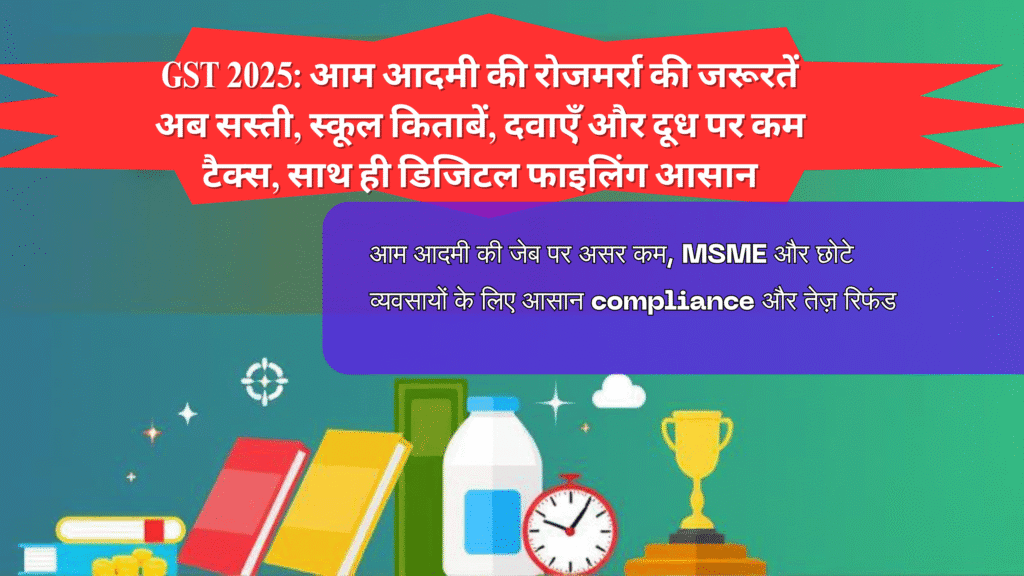
Introduction to GST Reforms 2025
GST (Goods and Services Tax) is India’s biggest indirect tax reform. Implemented on 1 July 2017, it aimed to replace various indirect taxes (such as Central Excise, Service Tax, VAT) across the country into a unified tax system.
Why was GST needed?
Different tax rates in states and center
Multiple taxes make compliance complex
Heavy paperwork for small businesses and MSMEs
Essential goods are expensive for the common man.
GST 2.0 aims to address all these problems and implement a uniform, simple and transparent tax system in India.
Key Objectives of GST Reforms 2025
Simplify Tax Structure
The first five slabs were (0%, 5%, 12%, 18%, 28%).
Now 0–5% GST on essential goods, 28–40% slab on luxury items.
It is beneficial for both the common man and businesses.
Easy Compliance for MSMEs and small businesses
Quarterly GST returns
Auto refund within 30 days
Digital filing is mobile-friendly
Relief on Essential Goods & Services
Milk, Vegetables, Grains, Medicine, School Books – 0–5% GST
Affordable everyday essentials for the common man
Higher Tax on Luxury & Sin Goods
High-end cars, Premium electronics, Alcohol, Tobacco – 28–40% GST
To increase government revenue
Promotion of Digital India and Green Energy
Electric Vehicles (EVs) – 5% slab
Renewable energy products – कम GST
Impact of GST Reforms 2025 on Common Man
Benefits
Daily essentials are affordable
Housing and travel affordable
Lower spending on healthcare and education
Disadvantages
Luxury goods and high-end services are expensive
Higher taxes on premium restaurants and luxury hotels
Case Study
Ramu ji, from a middle-class family, bought an electric scooter.
The tax under the old GST was ₹35,000, but only ₹10,000 under the new GST 2025.
Savings: ₹25,000
Comparison of Old GST and New GST Reforms 2025
GST (Goods and Services Tax) has completely transformed the tax system in India. Implemented in 2017, GST replaced various indirect taxes (such as VAT, Excise, Service Tax) into a unified system. However, the old GST from 2017–2024 had several problems, which were resolved in GST Reforms 2025 .
In this section, we will compare the old GST and the new GST Reforms 2025 sector-wise and slab-wise and understand its impact on the common man.
Difference in GST slabs (tax categories)
| aspect | Old GST (2017–2024) | New GST 2.0 (2025) |
|---|---|---|
| Tax Slabs | 0%, 5%, 12%, 18%, 28% + Cess | 0%, 5%, 12%, 18%, 28%, 40% |
| Essential Goods | Sometimes 12% or 18% | Most 0% or 5% |
| Luxury Goods | 28% + Cess | 28–40% |
| Return Filing | complex, monthly/quarterly | Easy, Auto GST, quarterly option |
| MSME Support | Limited | Fast Refund, Easy Compliance |
| EV & Green Energy | 12% | 5% |
| Transparency | Confusing | Easy and consumer friendly |
Impact on Essential Goods
Old GST:
Milk, Grains, Vegetables – 12% slab
School Books – 12–18%
Medicines – 12%
GST 2.0:
Milk, Grains, Vegetables – 0%
School Books – 0%
Medicines – 0–5%
Impact:
The daily needs of the common man became affordable.
Students and Parents – Education materials became cheaper.
Impact on Luxury Goods and Sin Goods
Old GST:
Luxury Cars – 28% + Cess
Alcohol & Tobacco – 28% + Heavy Cess
Premium Electronics – 28% slab
GST 2.0:
Luxury Cars – 28–40%
Alcohol & Tobacco – 28–40%
High-end Electronics – 28–40%
Impact:
Luxury goods became expensive, leading to a higher tax burden on the high-income group.
Government revenue increased.
Reforms for MSMEs and small businesses
Old GST:
Monthly Returns – Complicated
Refund delays
Difficulty in getting Input Tax Credit
GST 2.0:
Quarterly Returns – Easy
Auto Refund within 30 days
Digital filing – mobile friendly
Special incentives for women entrepreneurs and startups
Impact:
Compliance easier for small traders and MSMEs
Fast refund for exporters
Electric Vehicles and Green Energy
Old GST:
Electric Vehicles – 12% slab
Renewable energy products – 12–18% slab
GST 2.0:
EV – 5% slab
Renewable energy products – 5%
Impact:
Promotion of green energy, electric vehicles are cheap, beneficial for the environment.
GST impact on common man
Benefits:
Daily essentials at bargain prices
Housing, healthcare & education are affordable now
Easier compliance for small businesses and MSMEs
Disadvantages:
Luxury items are expensive
Premium services (restaurants, hotels, imported products) are more expensive now
Case Study:
Seema Devi saved ₹3,500 on Grocery and Medicines in the new GST 2.0 compared to the old GST.
Ramu ji saved ₹25,000 while buying an electric scooter.
New GST rates list 2025
| Goods/Services | GST Rate (%) |
|---|---|
| Milk, curd, cheese, paneer | 0% |
| Ghee, butter, cheese | 5% |
| Namkeen, Bhujia, Snacks | 5% |
| Chocolate (jaggery based), Pasta | 5% |
| Sugary drinks, cold drinks | 40% |
| Bread, Khakhra, Baked Goods | 0% |
| Hair oil, shampoo, toothpaste | 5% |
| Soap, sanitary napkins, diapers | 5% |
| Kitchen utensils, tableware | 5% |
| life saving medicines | 0% |
| Medical equipment, thermometers, oxygen | 5% |
| Life and health insurance | 0% |
| Tractors, agricultural machinery, irrigation equipment | 5% |
| Cement, marble, granite blocks | 18% |
| Hotel stays under ₹7500 | 5% |
| Salon, Yoga, Fitness Services | 5% |
| Public Transport | 0% |
| Renewable Energy Services | 5% |
| Online Gaming, Betting, Casino | 40% |
| Tobacco, gutkha, cigarettes, pan masala | 40% |
| Luxury cars, SUVs, yachts, private jets | 40% |
| weapons, firearms | 40% |
| Pencil, sharpener, crayon, notebook, eraser | 0% |
| Domestic LPG cylinder | 5% |
| Railway Ticket (Sleeper Class) | 5% |
| Clothing and shoes up to ₹2500 | 5% |
| Shoes above ₹2500 | 18% |
| Smart TV (above 32″) | 18% |
| Refrigerator, Washing Machine, Dishwasher | 18% |
| Mobile phone, laptop, headphone, speaker | 18% |
| Motorcycle ≤350cc | 18% |
| Motorcycles >350cc | 40% |
| Electric Vehicles (All Categories) | 5% |
Consolidated Comparison Table of Goods and Services after GST Reforms
| Category | Goods/Services | Old GST rate | New GST Rate | Situation |
|---|---|---|---|---|
| Food ingredient | Milk, curd, cheese, paneer | 5% | 0% | became cheaper |
| Ghee, butter, cheese | 12%–18% | 5% | became cheaper | |
| Namkeen, Bhujia, Snacks | 18% | 5% | became cheaper | |
| Chocolate (jaggery based), Pasta | 18% | 5% | became cheaper | |
| Sugary drinks, cold drinks | 18% | 40% | became expensive | |
| Bread, Khakhra, Baked Goods | 5% | 0% | became cheaper | |
| Spices, malt, starch | 12%–18% | 5% | became cheaper | |
| domestic use | Hair oil, shampoo, toothpaste | 18% | 5% | became cheaper |
| Soap, sanitary napkins | 12% | 5% | became cheaper | |
| Diapers, wipes | 12% | 5% | became cheaper | |
| Kitchen utensils, tableware | 12% | 5% | became cheaper | |
| Health | life saving medicines | 12% | 0% | became cheaper |
| Medical equipment, thermometers, oxygen | 12% | 5% | became cheaper | |
| Life and health insurance | 18% | 0% | became cheaper | |
| Agriculture/Manufacturing | Tractors, agricultural machinery | 12% | 5% | became cheaper |
| Drip irrigation, sprinklers | 12% | 5% | became cheaper | |
| cement | 28% | 18% | became cheaper | |
| Marble, granite blocks | 28% | 18% | became cheaper | |
| Services | Hotel stays under ₹7500 | 18% | 5% | became cheaper |
| Salon, Yoga, Fitness Services | 18% | 5% | became cheaper | |
| Public Transport | 5% | 0% | became cheaper | |
| Renewable Energy Services | 12% | 5% | became cheaper | |
| Online gaming, betting | 18% | 40% | became expensive | |
| luxury goods | Tobacco, gutkha, cigarettes | 28% | 40% | became expensive |
| Pan Masala | 28% | 40% | became expensive | |
| Luxury Cars, SUVs | 45–50% | 40% | became cheaper | |
| This, private jet | 45–50% | 40% | became cheaper | |
| weapons, firearms | 28% | 40% | became expensive | |
| Education/Stationery | Pencils, sharpeners, crayons | 0% | 0% | as it is |
| Exercise books, notebooks | 0% | 0% | as it is | |
| Rubber | 0% | 0% | as it is | |
| other items | Domestic LPG cylinder | 5% | 5% | as it is |
| Railway Ticket (Sleeper Class) | 5% | 5% | as it is | |
| Clothing and shoes up to ₹2500 | 5% | 5% | as it is | |
| Shoes above ₹2500 | 18% | 18% | as it is | |
| Electronics | Smart TV (above 32″) | 28% | 18% | became cheaper |
| Smart refrigerator, washing machine, dishwasher | 28% | 18% | became cheaper | |
| mobile phone | 18% | 18% | as it is | |
| laptop | 18% | 18% | as it is | |
| Headphones, speakers | 18% | 18% | as it is | |
| motor vehicle | Small Cars (≤1200cc Petrol, ≤1500cc Diesel) | 28% + cess | 18% | became cheaper |
| Large Cars, SUVs (>1200cc/1500cc) | 45–50% | 40% | became cheaper | |
| Motorcycle ≤350cc | 28% | 18% | became cheaper | |
| Motorcycles >350cc | 28% | 40% | became expensive | |
| electric vehicles | 5% | 5% | as it is |
Automobile Sector & GST 2.0
The automobile sector in India is a vital part of the economy. The GST slabs, taxes, and incentives applicable to the purchase and sale of vehicles directly impact both the common man and manufacturers. The GST Reforms 2025 have introduced several changes to the sector, promoting affordability and green mobility.
Old GST Scenario
Two Wheelers: 28% + Cess
Small Cars (<4m / Small Cars): 28% + 1% Cess
Mid-size Sedans: 28% + 15% Cess
SUVs (Sports Utility Vehicles): 28% + 22% Cess
Electric Vehicles: 12%
Hybrid Cars: 28% + 15% Cess
Impact:
Two-wheelers and small cars are becoming more expensive for the common man.
EV adoption low
Expensive mobility for Middle-class families
New GST 2.0 Changes
Two Wheelers: 18%
Small Cars: 18%
Mid-size Cars: 22%
SUVs: 40%
Electric Vehicles (EVs): 5%
Hybrid Cars: 18%
Key Highlights:
Affordable two wheelers & small cars
Lesser tax on EV and hybrid vehicles, promoting green mobility
Higher tax on Luxury SUVs and high-end cars
Impact on Common Man
Benefits:
Scooters and hatchbacks are now more affordable for students and middle-class families
Increased EV adoption, will save on electricity/fuel costs
Tax relief on hybrid cars means fuel-efficient options will be promoted
Disadvantages:
Luxury SUVs and premium vehicles are expensive
Higher slabs of 28-40 % on Imported cars
Case Study
Vinod Yadav ji , middle-class family, paid ₹35,000 extra tax in the old GST, whereas in the new GST 2025, only ₹10,000 tax was levied on the EV scooter.
Savings: ₹25,000
Effect: Common man motivated to buy EV, environment friendly mobility increased.
FMCG & Retail Sector & GST 2.0
The FMCG (Fast-Moving Consumer Goods) and retail sectors are a significant part of India’s economy. Everyday necessities like food, personal care products, and packaged goods are part of the average person’s daily consumption.
GST Reforms has introduced several changes in these sectors, which has increased affordability, transparency and consumer convenience.
Old GST Scenario
Food Items: 12–18% slab
Soap, Shampoo, Toothpaste: 18% slab
Packaged & Ready-to-eat Food: Expensive
Luxury FMCG Items: 28% + Cess
Small Retailers: Complicated GST filing and input tax credit
Impact:
Everyday items are expensive for the common man.
Low affordability for rural consumers
Compliance difficult for small retailers and traders
Changes in GST Reforms 2025
Essential Food Items: 0–5% slab
Milk, Grains, Vegetables, Fruits
Packaged Food & FMCG Products: 5–12% slab
Soap, Shampoo, Toothpaste – 12%
Ready-to-eat Foods – 5%
Luxury FMCG Items: 28–40% slab
Premium chocolates, imported beverages
Retailers: Easy quarterly GST returns
Digital Filing: Mobile-friendly, faster auto refunds
Impact on Common Man
Benefits:
Daily Essentials become affordable
Accessible grocery and personal care products for students and families
Packaged foods and dairy products in rural areas at lower taxes
Disadvantages:
Imported luxury FMCG items become expensive
Higher taxes on high-end chocolates, premium drinks, cosmetic products
Impact on Small Retailers & MSMEs
Quarterly GST returns, auto refund system and simplified compliance
Less paperwork for MSME retailers
Digital filing and easy input tax credit
Special incentives to women entrepreneurs and startups
Case Study (Example)
Seema Devi , a middle-class mother, would have saved ₹4,000 on monthly grocery shopping under the new GST 2025 compared to the old GST.
Effect: Daily essentials and packaged foods became affordable
Healthcare Sector & GST Reforms 2025
Healthcare is a critical sector for India. The GST applicable on Medicines, Medical Devices, Hospital Services, and Health Insurance directly impacts the pockets of the common man and patients. The GST Reforms 2025 has introduced several reforms in this sector to make healthcare affordable and accessible.
Old GST Scenario
Essential Medicines: 12% slab
Medical Devices: 12–18% slab
Health Insurance Premium: 18%
Private Hospital Services: Multiple taxes
Impact:
Medical expenses are expensive for the common man and chronic patients
Health insurance expensive
Changes in GST Reforms 2025
Life-saving Medicines: 0% slab
Common Medicines: 5% slab
Medical Devices: 5–12% slab
Health Insurance Premium: 12% slab
Hospital Services: Essential healthcare services – 0% slab
Digital Filing & Fast Refunds: Easy compliance for hospitals and pharmacies
Impact on Common Man
Benefits:
Medicines and health insurance became affordable
Reduced spending on chronic patients and the elderly
Hospital services essential care – tax-free
Faster refund system for hospitals & pharmacies
Disadvantages:
High tax slab 28–40% ON Luxury health services like private premium treatment & imported medical devices
Impact on Small Hospitals & Clinics
Quarterly GST returns & digital filing made easy
Compliance simplified for MSME healthcare providers
Incentives for women entrepreneurs and startup clinics
Case Study
Rajesh Sharma’s daughter will save ₹60,000 annually in cancer treatment under the new GST 2.0 as compared to the old GST.
Effect: Essential healthcare services are now accessible and affordable for middle-class families
Education Sector & GST Reforms
Education is a vital sector for India. GST applicable on school books, uniforms, coaching institutes, higher education, and EdTech platforms directly impacts students, parents, and educational institutions. GST Reforms 2025 has introduced several reforms in this sector to make education affordable, accessible, and transparent.
Old GST Scenario
School Books and Uniforms: 12–18% slab
Coaching / Higher Education: 18% slab
EdTech Platforms: 18% slab
Skill Development Courses: 12% slab
Impact:
Higher costs for students and parents
Private coaching and online platforms are expensive.
Low affordability for rural students
Changes in GST Reforms
School Books & Uniforms: 0% slab
Higher Education: 5% slab
Coaching Institutes: 12% slab
EdTech Platforms: 12% slab
Skill Development Courses: 0% slab
Digital Filing & Easy Refunds: Easy compliance for education providers
Impact on Common Man & Students
Benefits:
School Books and Uniforms became affordable
Coaching and EdTech courses are affordable for students
Skill Development Courses tax-free, accessible to students and youth
Disadvantages:
Higher tax slab 28–40% on Premium foreign education and high-end private universities
Imported educational tools and luxury educational services are more expensive now
Impact on Small Coaching & EdTech
Quarterly GST returns and digital filing made easy
Simplified compliance for MSME and startup education platforms
Women entrepreneurs are given special incentives
Case Study
Aakash ji , a middle-class student, saved ₹12,000 on coaching and EdTech courses under the new GST 2025 compared to the old GST.
Effect: Growth of Affordable education and skill development programs
MSME & Small Businesses & GST Reforms 2025
Micro, Small and Medium Enterprises (MSMEs) are the backbone of India’s economy. GST directly impacts these businesses as they are compliance-heavy sectors. GST Reforms 2025 has introduced several reforms for MSMEs and small businesses to make them easier to operate and increase growth opportunities.
Old GST Scenario
Monthly Returns: Complicated and time-consuming
Input Tax Credit (ITC) claiming: Hard, paperwork heavy
Auto Refund: No, delay usually 60–90 days
MSME Incentives: limited
Impact:
Cash flow problem for small businesses
Compliance costly & time-consuming
Hurdles for women entrepreneurs and startups
Changes in GST Reforms 2025
Quarterly Returns: Easy and flexible
Auto Refund: within 30 days
Input Tax Credit: Simplified and mobile-friendly
Special MSME Schemes: Incentives for women entrepreneurs and startup businesses
GST Slab: 0–18% for essential goods, sector-specific slab for products and services
Impact on Common Man & MSME
Benefits:
Compliance easy and affordable for small businesses
Faster GST refunds, cash flow better
Growth opportunities increased in startups and MSMEs
Disadvantages:
Luxury services and high-end products are under 28–40% slab
Non-compliant businesses can face penalties
Case Study
Amit Bhai’s bakery business was under financial stress due to monthly compliance and delayed refund under the old GST.
The new GST 2.0 will result in annual savings of ₹50,000 and improved cash flow due to quarterly returns and auto refund system .
Agriculture Sector & GST Reforms 2025
Agriculture is the backbone of India’s economy. GST directly impacts farmers and agricultural businesses, impacting their income, product costs, and the rural economy. GST Reforms 2025 has introduced several reforms in the agriculture sector to make essential crops, fertilizers, and agricultural machinery affordable and accessible.
Old GST Scenario
Essential Crops (cereals, vegetables, fruits): 12% slab
Fertilizers: 12–18% slab
Agricultural Machinery: 18–28% slab
Agri Services: Taxable 18%
Impact:
Input cost high for farmers
Rural economy was under pressure
Machinery and fertilizers are expensive
Changes in GST Reforms 2025
Essential Crops & Seeds: 0% slab
Fertilizers: 5% slab
Agricultural Machinery: 12% slab
Agri Services: Essential farm services – 0% slab
Digital Filing & Fast Refunds: Easy compliance for Agri businesses
Impact on Farmers & Common Man
Benefits:
Essential crops and seeds become affordable
Fertilizers and farm machinery are underlow tax slab, reducing cost of cultivation
Increased growth and sustainability in the rural economy
Food prices moderate for the common man
Disadvantages:
Imported machinery & high-end farming tools are in higher tax slab 28–40%
Luxury agricultural services costly
Impact on Small Farmers and Agri MSME
Quarterly GST returns and auto refund system for small agri businesses made easy
Women farmers and small agri startups are to get incentives
Compliance simplified, paperwork reduced
Case Study
Sher Singh , a farmer, used to spend ₹15,000 more on fertilizers and seeds under the old GST.
The new GST 2.0 will save ₹12,000 annually due to 0–5% slab and fast refund.
Effect: Farm profitability increased and crop cost decreased.
Real Estate Sector & GST Reforms 2025
Real estate is known as a major investment and development sector in India. GST applicable on housing, commercial properties, affordable housing projects, and construction services impacts both the common man and investors. GST Reforms 2025 has introduced several reforms in this sector to increase property affordability and transparency.
Old GST Scenario
Residential Flats (<150 sq.m): 5% slab (no ITC)
Luxury Flats (>150 sq.m): 12% slab
Commercial Properties: 12–18% slab
Under-construction Projects: Taxable slab 12–18%
Impact:
Costs were high for home buyers
Difficult for developers to claim input tax credit
Affordable housing growth was slow
Changes in GST Reforms 2025
Affordable Housing Projects: 1% slab (effective from earlier 5%)
Residential Flats (>150 sq.m): 12% slab
Commercial Properties: 18% slab
Construction Services: Input Tax Credit allowed, digital filing easy
Luxury Properties: 28–40% slab
Developer Incentives: Compliance simplified for MSME developers and small builders
Impact on Home Buyers & Common Man
Benefits:
Lower GST on Affordable housing projects, EMI and property cost reduced
Increased accessibility for middle-class families and first-time buyers
Construction services पर ITC allowed, developers pass on benefits to buyers
Disadvantages:
Luxury flats and high-end commercial properties became expensive
Imported construction materials are in higher tax slab 28–40%
Impact on Developers & Small Builders
Quarterly GST returns and digital filing made easy
Simplified compliance for small builders and MSME developers
Women entrepreneurs and startup builders will get incentives
Case Study
Rakesh ji , a middle-class buyer, bought an affordable housing flat.
In the old GST, ₹3,00,000 extra tax was levied due to 5% slab.
₹2,50,000 saving due to 1% slab in new GST 2.0.
Effect: Affordable housing is nowrealistic option for middle-class families
Tourism Sector & GST Reforms 2025
Tourism plays a vital role in India’s economy. The GST applicable on hotels, travel packages, airlines, resorts, and tour operators directly impacts travelers and tourism businesses. The GST Reforms 2025 have promoted affordability, transparency, and growth in this sector.
Old GST Scenario
Hotels (<₹1,000 per night): 12% slab
Hotels (>₹1,000 per night): 18% slab
Luxury Hotels & Resorts: 28% slab
Travel Packages & Tour Operators: 12–18% slab
Airlines Tickets (Domestic): 5–12% slab
Impact:
Stay and travel are expensive for the common man.
Compliance difficult for small tourism operators and startups
Luxury tourism costly
Changes in GST Reforms 2025
Budget Hotels (<₹1,500 per night): 5% slab
Standard Hotels (₹1,500–₹7,500): 12% slab
Luxury Hotels & Resorts: 28–40% slab
Travel Packages & Tour Operators: 12% slab
Airlines Tickets (Domestic): 5% slab
Digital Filing & Auto Refund: Compliance made easy for Tourism businesses
Impact on Common Man & Travelers
Benefits:
Budget and standard hotels become affordable
Domestic tourism promotion – Accessible for middle-class families now
Travel packages and airline tickets are cost-effective now
Disadvantages:
Luxury resorts, cruises and international tour packages are expensive
Imported tourism equipment and luxury services are in high tax slab 28–40%
Impact on Tourism Businesses & MSMEs
Quarterly GST returns and digital filing made easy
Simplified compliance for small travel operators and tour startups
Women entrepreneurs and regional tourism promoters will get incentives
Case Study
Seema Devi and family booked a domestic holiday.
In the old GST, ₹12,000 extra tax was levied on hotel stay.
₹10,000 saving due to 5–12% slab in new GST 2.0.
Effect: Domestic tourism affordable
IT & Startups Sector & GST Reforms 2025
Information Technology (IT) and startups are key drivers of growth and innovation in India’s economy. GST directly affects software services, digital platforms, SaaS products (software as a service), and tech startups. The GST Reforms 2025 have made compliance easy, affordable, and growth-friendly in the IT and startup ecosystem.
Old GST Scenario
Software Services: 18% slab
Digital Platforms / SaaS Products: 18% slab
Startup Services (Tech Startups): 18% slab, Input Tax Credit (ITC) claiming complex
Freelancers / Consultants: GST filing monthly, high compliance cost
Impact:
Financial burden for small startups and freelancers
Compliance and paperworks were heavy
Growth and expansion was slow
Changes in GST Reforms 2025
Software Services & SaaS Products: 12% slab
Tech Startups: 5–12% slab depending on turnover
Freelancers / Consultants: Quarterly GST returns, mobile-friendly filing
Digital Platforms: Auto refund and simplified ITC claim
Special Startup Incentives: Subsidies for women entrepreneurs and MSME startups
Impact on Common Man & IT Sector
Benefits:
Digital services and SaaS products become affordable
Startups get cost-effective growth opportunities
Easy compliance for freelancers and small IT businesses
Innovation and entrepreneurship boost
Disadvantages:
Premium SaaS subscriptions and imported software products are in higher tax slab 28–40%
Luxury IT services (enterprise-level) became expensive
Impact on Startups & MSME Tech Companies
Quarterly GST returns and digital filing made easy
Input Tax Credit (ITC) fast claim, cash flow improve
Special incentives for women entrepreneurs and startups
Digital economy and e-commerce growth increased
Case Study
Ankit Yadav , tech startup founder, faced ₹1,20,000 extra expenditure due to monthly compliance and delayed refund in old GST.
₹1,00,000 saved annually due to quarterly filing and auto refund in new GST 2.0.
Effect: Startup operational cost is low now, growth and innovation promoted
Luxury Goods Sector & GST Reforms 2025
The luxury goods sector includes high-end products such as branded watches, jewelry, imported apparel, premium automobiles, and designer items. This sector is optional for the common man, but is important for high net-worth individuals and investors. The GST Reforms 2025 have balanced the taxation and compliance methods in this sector.
Old GST Scenario
Luxury Watches & Jewelry: 28% + Cess
Imported Designer Apparel: 28% slab
Premium Automobiles & Accessories: 28–40% slab
Luxury Services (Private Clubs, Resorts): 28% slab
Impact:
Higher tax burden on high-end consumers
Imported luxury items are expensive
Domestic luxury brands were facing challenges in global competition
Changes in GST Reforms 2025
Luxury Watches & Jewelry: 28–30% slab (simplified Cess)
Imported Designer Apparel: 28% slab
Premium Automobiles: 28–40% slab, structured slab based on cost
Luxury Services (Clubs & Resorts): 28% slab, ITC allowed for businesses
Digital Filing & Auto Refund: Compliance simplified for Luxury goods retailers
Impact on High-end Consumers & Luxury Brands
Benefits:
Domestic luxury brands got tax structure clarity
Imported items and premium services are in structured slab, predictability increases
Compliance easier for luxury goods retailers
Disadvantages:
Luxury items are expensive – not affordable for the common man
High slab maintained for Imported luxury goods
Impact on Luxury Retailers & Businesses
Quarterly GST returns and easy digital filing
Auto refund and faster ITC claims
For Premium luxury retail chains and online luxury platforms compliance is made easy
Case Study
Sumit ji , a luxury watch buyer, bought an imported watch.
Due to slab 28% + Cess in old GST, ₹1,00,000 additional tax had to be paid.
The new GST 2.0 has increased predictability and transparency due to structured slabs of 28–30% .
Effect: Helped retailers and consumers plan, making compliance easier

Hello and warm greetings!
I’m Satyapal Yadav, the founder of Kolee.in and a passionate content writer and researcher. I began my professional journey in 2005 in the IT sector, exploring the vast world of technology. Over time, my curiosity and interest in financial markets led me to trading around 2010, which inspired me to merge my tech background with finance research and content writing.
At Kolee.in, my mission is simple: I strive to provide readers with accurate, research-backed, and easy-to-understand information to help them make informed decisions in their careers, finances, and personal lives. Over the years, I have specialized in topics including finance, government jobs, competitive exams, education, government policies, and the latest technology trends.
I firmly believe that knowledge is valuable only when it is understood deeply and applied wisely. That’s why I dedicate myself to producing content that is clear, practical, and actionable, bridging the gap between complex information and reader-friendly guidance.
When it comes to government jobs, I cover everything from state and central vacancies to competitive exam strategies, helping readers navigate their career paths with confidence. In the finance domain, I share insights on personal finance, investment strategies, and market updates, making complex topics easy to understand.
Education is another passion of mine. I provide guidance on exam preparation, scholarships, and learning strategies, helping students and professionals achieve their academic and career goals. I also explore technology trends, reviewing the latest gadgets and sharing insights on innovations in AI, apps, and emerging tech, keeping readers up-to-date in a fast-evolving digital world.
What drives me is the desire to empower my readers. I don’t just provide information—I aim to help people make smart choices, whether it’s pursuing the right government job, planning their finances, or staying ahead with technology and education updates.
All content on Kolee.in is carefully researched and reader-focused. This ensures that readers get valuable information that is easy to navigate and understand. My writing emphasizes clarity, authenticity, and relevance, making it trustworthy for students, job seekers, finance enthusiasts, and tech-savvy readers alike.
I’ve spent years learning, researching, and refining my approach to content creation, combining my IT and finance experience with my passion for education and technology. Every article I write is designed to inform, inspire, and guide—helping readers make practical and confident decisions in their personal and professional lives.
Through Kolee.in, I aim to build a platform that bridges the gap between complex data and everyday readers, turning knowledge into actionable insights. I want my readers to feel empowered, confident, and informed every time they visit the site.
Thank you for stopping by! I hope the content you find here helps you achieve your goals, stay informed, a
nd make smart decisions in life, career, and learning.
With warm regards and best wishes,
Satyapal Yadav
Founder and Content Writer, Kolee.in