
Cyber Security 2025: Protecting Your Digital World from Invisible Threats
Introduction
In today’s hyper-connected digital era, your data is your identity. From online banking and cloud storage to social media and smart devices — everything you touch leaves a digital footprint. But what happens when that footprint falls into the wrong hands?
Cyber Security is no longer just a buzzword — it’s the invisible shield guarding your personal and professional life from cybercriminals, hackers, and data thieves who evolve faster than technology itself.
The Digital Dilemma
As we move deeper into 2025, the world is witnessing an unprecedented rise in cyber threats. Every minute, hundreds of phishing emails are sent, ransomware attacks lock down businesses, and millions of personal records are leaked online. From global corporations to local startups, and from government agencies to individuals — no one is truly immune.
But here’s the catch: while digital threats evolve daily, most users and even some businesses are still following outdated protection habits. The result? A growing digital divide between those who understand cyber security and those who fall victim to it.
The Promise
This comprehensive guide — “Cyber Security 2025: The Ultimate Guide to Staying Safe Online” — will empower you to:
Understand what cyber security really means and why it matters more than ever.
Identify common cyber threats that are emerging in 2025.
Learn modern tools, technologies, and best practices to stay protected.
Explore how AI and machine learning are transforming digital defense.
Discover career opportunities, certifications, and future trends in cyber security.
By the end of this article, you’ll have not just the knowledge but also the confidence to secure your personal and professional digital presence — whether you’re an individual user, a small business owner, or part of a large enterprise.
So, buckle up as we dive deep into the fascinating and fast-evolving world of cyber security in 2025 — where every click matters and every precaution counts.
The Evolution and Importance of Cyber Security — From the Early Internet to 2025
A Brief History of Cyber Security
Cyber security didn’t begin as a massive global industry — it started as a simple effort to keep early computer systems safe from misuse.
1970s – The Beginning:
The concept of computer security was born in the 1970s when the first ARPANET (Advanced Research Projects Agency Network) — the foundation of the modern internet — experienced its first known security breach. A researcher named Bob Thomas created a program called “Creeper,” which could move across networks. Another researcher, Ray Tomlinson, developed the first antivirus, named “Reaper,” to chase and delete Creeper.1980s – The Age of Viruses:
As personal computers became common, so did malware and viruses. The infamous “Brain” virus (1986) and “Morris Worm” (1988) marked the dawn of global cyber threats. This era forced tech firms to develop early antivirus software like McAfee and Norton.1990s – Internet Boom, Security Doom:
The internet exploded globally, and with it came new risks — phishing, email scams, and password theft. Businesses began to realize that digital information needed the same level of protection as physical assets. Firewalls, encryption, and secure authentication systems were born.2000s – The Rise of Cybercrime Networks:
As e-commerce and social media flourished, so did organized cybercrime. Hacking groups, ransomware attacks, and large-scale data breaches emerged. Governments started framing cyber laws and data protection acts to combat growing threats.2020s – AI, Cloud, and the Era of Digital Defense:
Fast forward to the 2020s — cyber threats have become more sophisticated, AI-driven, and globalized. The world now faces state-sponsored attacks, AI-powered phishing, and deepfake scams. In 2025, cyber security isn’t optional; it’s a critical digital survival skill.
Why Cyber Security Is More Important Than Ever in 2025
Explosion of Digital Data:
Every individual generates gigabytes of data daily — from online transactions to wearable devices. Protecting this data has become vital for privacy, business reputation, and national security.Rise of Remote Work:
Since 2020, hybrid and remote working models have blurred network boundaries. This has increased vulnerabilities, making endpoint protection and cloud security essential.Growth of Cyber Attacks:
Reports show cybercrime damages are expected to exceed $10 trillion annually by 2025. Attackers are smarter, faster, and often backed by large-scale criminal organizations.Dependence on IoT and Smart Devices:
With billions of connected devices, from smart TVs to industrial sensors, each endpoint is a potential entry point for hackers. The Internet of Things (IoT) is both a marvel and a minefield.Legal and Regulatory Pressure:
Governments are introducing stricter cyber laws, like the Digital Personal Data Protection Act (India, 2023) and GDPR (Europe). Businesses must comply or face hefty fines.AI-Driven Threats:
Cyber criminals now use AI and machine learning to create realistic phishing attacks, voice clones, and even deepfake videos. Traditional security methods are no longer enough.
The Global Impact of Cyber Security
Cyber security is now a shared responsibility across individuals, organizations, and governments.
For individuals: It’s about privacy and identity protection.
For businesses: It’s about brand trust, compliance, and financial stability.
For nations: It’s about defending critical infrastructure like power grids, hospitals, and military systems.
When a cyber attack happens, it’s not just data that’s lost — it’s trust, reputation, and sometimes lives.
Key Insight
“In 2025, cyber security is not just a technology issue — it’s a human, social, and economic priority.”
Major Cyber Threats in 2025 — What You Need to Watch Out For
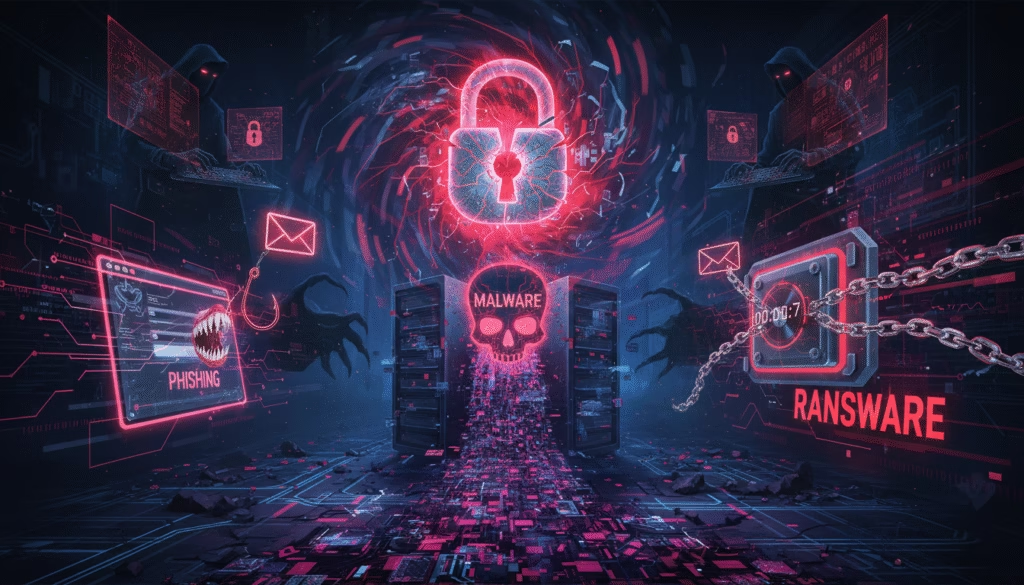
The digital world in 2025 is smarter, faster, and more connected than ever before. Unfortunately, so are cybercriminals.
With the rise of AI tools, cloud systems, and smart devices, cyber threats have become more strategic, automated, and dangerous.
Below are the top cyber threats dominating the 2025 landscape — the ones everyone, from individuals to enterprises, must understand and prepare for.
1. Phishing 2.0 — AI-Driven Deception
Phishing is no longer about a poorly written email claiming you’ve won a lottery.
In 2025, cybercriminals use AI-generated content and deepfake voice messages to impersonate real people — CEOs, friends, or even government officials.
Example:
Attackers use AI voice cloning to call employees and request urgent fund transfers. Since the voice matches the real boss, victims often comply.
How to Stay Safe:
Never click on unknown links or attachments.
Verify requests through alternate channels (phone or in-person).
Use email filters, AI-based anti-phishing tools, and multi-factor authentication (MFA).
2. Ransomware Attacks — Holding Data Hostage
Ransomware remains one of the most destructive cyber threats. Attackers encrypt your system or database and demand payment (often in cryptocurrency) for decryption.
Trend in 2025:
Ransomware-as-a-Service (RaaS) has emerged — meaning anyone can rent ransomware tools from dark web providers without being a tech expert.
Protection Tips:
Regularly back up critical data offline.
Avoid downloading cracked software.
Keep system patches and antivirus definitions up to date.
Train employees to recognize suspicious files.
3. Deepfake and Synthetic Identity Scams
With advanced AI tools, anyone can create realistic fake videos, images, or voices. Deepfakes are now being used for blackmail, misinformation, and financial fraud.
Example:
A deepfake video of a company CEO announcing fake business news caused stock prices to drop before the company confirmed it was a hoax.
Stay Safe:
Double-check sources of videos or news.
Use AI-based verification tools that detect manipulated media.
Educate teams on recognizing deepfake content.
4. Malware and Spyware 2025 — Smarter, Stealthier, Deadlier
Modern malware uses machine learning to hide from traditional antivirus tools. Spyware can silently record keystrokes, screenshots, and even webcam footage.
How to Defend:
Install reputable antivirus and anti-spyware tools.
Avoid suspicious apps, especially from third-party stores.
Use application whitelisting and endpoint protection systems.
5. Cloud Vulnerabilities
As businesses migrate to cloud services, cybercriminals target misconfigured cloud servers.
Common issues include data leakage, weak access controls, and API exploits.
Cloud Security Tips:
Use multi-factor authentication for all cloud accounts.
Enable data encryption in transit and at rest.
Regularly audit permissions and activity logs.
6. AI-Powered Attacks
Cybercriminals now use AI to analyze targets, predict defense patterns, and launch automated attacks faster than humans can react.
Prevention:
Invest in AI-based defensive tools that detect anomalies in real time.
Conduct threat simulation and red team exercises.
Always keep human oversight alongside automation.
7. Internet of Things (IoT) Exploits
Smart devices like cameras, thermostats, and smart TVs often lack strong built-in security.
Hackers can take control of these devices and use them to breach entire networks.
What You Can Do:
Change default passwords immediately after installation.
Disable unnecessary device features.
Keep firmware updated regularly.
8. Supply Chain Attacks
Cyber attackers now target vendors, contractors, or third-party software providers to compromise larger organizations.
⚠️ Example:
A small vendor with weak security became the entry point for a massive data breach at a global corporation in 2024.
Protection Strategy:
Vet all vendors for compliance and cyber hygiene.
Limit third-party access to only what’s necessary.
Monitor data flow across the entire supply chain.
9. Financial Fraud & Identity Theft
From fake banking apps to cloned websites, online financial scams are evolving. Attackers use social engineering and stolen credentials to access accounts.
Prevention:
Never share OTPs or PINs with anyone.
Use official apps only for transactions.
Enable transaction alerts and biometric authentication.
10. Insider Threats
Sometimes, the biggest danger comes from within. Disgruntled employees, contractors, or partners with access can leak or steal sensitive data.
How to Prevent:
Use role-based access control (RBAC).
Monitor user behavior with insider threat detection systems.
Foster a strong cyber awareness culture within teams.
Summary of Threats (2025 Snapshot)
| Threat Type | Primary Target | Motivation | Prevention Strategy |
|---|---|---|---|
| Phishing 2.0 | Individuals & Businesses | Financial gain | Awareness + MFA |
| Ransomware | Businesses | Extortion | Backups + Updates |
| Deepfakes | Public & Media | Manipulation | Verification Tools |
| Malware | Everyone | Theft | Antivirus + Firewalls |
| Cloud Attacks | Enterprises | Data Access | Configuration + Encryption |
| AI-Powered Attacks | Enterprises | Espionage | AI-Defense Tools |
| IoT Exploits | Homes & Industries | Botnets | Firmware Updates |
| Supply Chain | Corporations | Breach Access | Vendor Audits |
| Financial Fraud | Users | Money Theft | Secure Apps + Alerts |
| Insider Threats | Organizations | Revenge/Profit | Behavior Monitoring |
Cyber Security Tools, Technologies & Best Practices for 2025
While knowing about threats is essential, real protection starts with preparation.
In 2025, the most successful individuals and organizations are those that invest not only in advanced tools but also in strong cyber awareness and daily digital discipline.
Let’s explore the top cyber security tools, technologies, and proven best practices that can help safeguard your digital presence.
Top Cyber Security Tools of 2025
Here are some cutting-edge tools trusted by experts worldwide for defending against modern threats:
1. Next-Generation Antivirus (NGAV)
Traditional antivirus tools detect known viruses.
But NGAVs use AI and behavioral analytics to detect suspicious actions in real time — even before malware signatures are known.
Popular NGAV Tools (2025):
CrowdStrike Falcon
Bitdefender GravityZone
SentinelOne Singularity
Sophos Intercept X
2. Endpoint Detection and Response (EDR)
EDR continuously monitors devices (laptops, mobiles, servers) for unusual activities and helps security teams respond immediately.
Recommended EDR Platforms:
Microsoft Defender for Endpoint
VMware Carbon Black
Trend Micro Apex One
3. Security Information and Event Management (SIEM)
SIEM systems collect logs and data from across an organization’s network, analyzing them for possible threats or anomalies.
Leading SIEM Tools:
Splunk Enterprise Security
IBM QRadar
Google Chronicle
4. Identity and Access Management (IAM)
IAM ensures only the right people access the right resources at the right time.
This prevents data breaches caused by stolen or misused credentials.
Trusted IAM Providers:
Okta
Ping Identity
CyberArk
Azure Active Directory
5. Cloud Security Platforms
With the global shift to cloud computing, cloud-native security tools have become indispensable.
Best Cloud Security Solutions:
Palo Alto Prisma Cloud
Check Point CloudGuard
AWS Security Hub
Zscaler Cloud Protection
6. AI-Driven Threat Intelligence Tools
These tools use machine learning to identify attack patterns, predict potential breaches, and adapt faster than human analysts.
Examples:
Darktrace
CrowdStrike Threat Graph
Cisco SecureX
7. Data Encryption & Privacy Tools
Encryption ensures your data remains unreadable even if intercepted.
Use end-to-end encryption for sensitive communications and backups.
Trusted Tools:
VeraCrypt (file encryption)
NordLocker (cloud encryption)
ProtonMail (encrypted email)
HTTPS Everywhere (browser extension)
Essential Cyber Security Technologies in 2025
Zero Trust Architecture (ZTA):
The principle: “Never trust, always verify.”
Every user and device must authenticate, even within a secure network.Blockchain for Security:
Blockchain enhances data integrity by creating tamper-proof ledgers, useful in financial systems and supply chains.Quantum-Resistant Encryption:
As quantum computing advances, traditional encryption can be broken.
Hence, post-quantum cryptography is now being deployed to future-proof systems.AI-Integrated Cyber Defense:
AI continuously learns from global threat databases and responds faster than manual systems.Secure Access Service Edge (SASE):
SASE combines network security and connectivity in the cloud — providing secure, fast access for remote workers.
Cyber Security Best Practices (For Individuals & Businesses)
For Individuals:
Use Strong, Unique Passwords: Avoid reusing passwords; use a password manager like 1Password or Bitwarden.
Enable Multi-Factor Authentication (MFA): Always require at least two forms of verification.
Keep Systems Updated: Regular software updates close security loopholes.
Be Cautious of Public Wi-Fi: Avoid logging into sensitive accounts on open networks.
Check URLs Before Clicking: Phishing websites often mimic real ones.
Use VPNs for Secure Browsing: Tools like NordVPN or ProtonVPN hide your IP and encrypt traffic.
Regularly Back Up Data: Use both cloud and offline backups to ensure redundancy.
For Businesses:
Employee Cyber Awareness Training: 90% of breaches start with human error. Educate your staff regularly.
Incident Response Plan: Define roles, steps, and communication protocols for cyber emergencies.
Network Segmentation: Separate sensitive data networks from general ones to limit damage.
Access Control: Give employees access only to data they need.
Penetration Testing: Regularly simulate attacks to identify weaknesses.
Data Compliance: Stay updated on laws like GDPR, HIPAA, and India’s DPDP Act.
Best Cyber Security Habits for 2025
Think Before You Click
Verify Every Request
Lock Devices When Idle
Keep Backups Offline
Update Passwords Quarterly
Enable Security Alerts on All Accounts
Review Privacy Settings on Apps and Social Media
Expert Insight
“Technology can secure systems, but only awareness can secure people.” — Cyber Security Expert
Cyber security isn’t a one-time action; it’s a continuous lifestyle choice.
In 2025, protection equals awareness — and awareness equals survival.
AI, Cloud & The Future of Cyber Security — What Lies Ahead in 2030
The cyber battlefield is no longer fought only by humans.
By 2025, Artificial Intelligence (AI), Cloud Computing, and Automation have become both the weapons and the shields of digital defense.
As we move toward 2030, these technologies will redefine how we detect, prevent, and respond to threats in real time.
1. The Role of Artificial Intelligence in Cyber Defense
AI has completely transformed the way cyber security operates.
Traditional systems relied on fixed rules and databases, but AI learns continuously — evolving with every new attack it detects.
AI in Action:
Threat Detection: AI models can identify unusual patterns in network traffic, emails, or system logs faster than human analysts.
Behavioral Analysis: Tools use machine learning to understand “normal” behavior, flagging anomalies instantly.
Automated Response: When a breach is detected, AI can isolate the affected system automatically, preventing further spread.
Deepfake Detection: AI can analyze pixel inconsistencies and audio patterns to spot manipulated content.
Popular AI-Based Security Tools (2025):
Darktrace – Autonomous response system based on self-learning AI.
CylancePROTECT – Uses predictive AI to block unknown threats.
CrowdStrike Falcon X – Combines threat intelligence with real-time analytics.
IBM QRadar Advisor with Watson – AI-driven security insights platform.
2. Cloud Security: Protecting the Digital Sky
The move to the cloud has revolutionized business operations — but also introduced new vulnerabilities.
In 2025, Cloud Security has evolved from simple encryption to intelligent, policy-based automation.
Modern Cloud Security Strategies:
Zero Trust Access: Every user, device, and API is verified before granting access.
Data-Centric Security: Protection travels with the data, not the device.
Cloud-Native Firewalls: Deployed directly within cloud environments (AWS, Azure, Google Cloud).
Continuous Compliance: AI systems monitor data flow to ensure compliance with regulations like GDPR, HIPAA, and DPDP 2023 (India).
Top Cloud Security Platforms:
Palo Alto Prisma Cloud
Check Point CloudGuard
Microsoft Defender for Cloud
Google BeyondCorp Enterprise
3. Automation and Orchestration in Cyber Defense
Modern organizations handle thousands of alerts daily — impossible for human analysts to process manually.
That’s where Security Orchestration, Automation, and Response (SOAR) systems come in.
Benefits of SOAR:
Speed: Responds to attacks within seconds.
Consistency: Eliminates human error in repetitive security tasks.
Efficiency: Frees up analysts for critical decision-making.
Scalability: Handles increasing threats as organizations grow.
Leading SOAR Platforms:
Splunk Phantom
Palo Alto Cortex XSOAR
IBM Resilient
Automation ensures 24/7 protection — because cyber attacks don’t wait for business hours.
4. Quantum Computing and Post-Quantum Cryptography
Quantum computing promises unimaginable processing power — but it’s also a potential nightmare for encryption.
Current algorithms like RSA and AES could be broken by powerful quantum machines in seconds.
Future Defense:
Researchers are developing Post-Quantum Cryptography (PQC) — encryption resistant to quantum attacks.
Governments and cybersecurity firms are collaborating to implement PQC standards before 2030.
Hybrid encryption models (classical + quantum-safe) are being tested globally.
Bottom line: The future of cyber security depends on being quantum-ready before the threat becomes real.
5. Global Collaboration and Cyber Governance
Cyber security is no longer a local issue — it’s a global mission.
Nations are increasingly forming international alliances to share intelligence, create cyber treaties, and standardize digital defense frameworks.
Examples:
Global Cybersecurity Alliance (GCA) initiatives promoting unified threat intelligence.
EU’s Cyber Resilience Act (2024) ensuring safer connected devices.
India’s Cyber Surakshit Bharat Mission strengthening critical digital infrastructure.
Future governance will focus on data sovereignty, ethical AI usage, and global threat sharing.
6. The Human Element: Cyber Awareness 2.0
Despite automation and AI, humans remain the weakest — and strongest — link in cyber defense.
Awareness programs are now being gamified and personalized using AI to improve retention.
Human-Centric Security Evolution:
Real-time simulation-based training.
Adaptive learning for different job roles.
Emotional awareness for social engineering detection.
The future of cyber security will blend human intuition with machine precision — not replace one with the other.
7. Predictions for 2030: The Next Frontier
| Trend | Impact on Cyber Security |
|---|---|
| AI-Generated Attacks | Continuous evolution of threat types requiring adaptive AI defenses |
| Quantum Encryption Adoption | New security standards for global communications |
| Digital Identity Systems | Universal biometric verification replacing passwords |
| Autonomous Security Operations Centers (A-SOCs) | Fully automated detection, response, and mitigation |
| Cyber Insurance Boom | Companies buying insurance against cyberattacks |
| IoT Cyber Defense Networks | Shared device protection using collective intelligence |
| Ethical AI Regulations | Global laws to ensure responsible AI use in security |
Expert Quote
“The future of cyber security will belong to those who can make AI work for them, not against them.” — Cyber Future Forum 2025
FAQs — Everything You Need to Know About Cyber Security 2025
1. What are the 5 types of cyber security?
Cyber security can be categorized into five primary types:
Network Security – Protects networks from unauthorized access, malware, and intrusions.
Information Security (InfoSec) – Safeguards data integrity, confidentiality, and availability.
Endpoint Security – Secures devices like laptops, smartphones, and IoT devices.
Application Security – Ensures software is safe from vulnerabilities and attacks.
Operational Security (OpSec) – Focuses on policies, procedures, and risk management.
2. How can I protect myself from cyber attacks?
Use strong, unique passwords and a password manager.
Enable multi-factor authentication (MFA).
Keep all devices and software updated regularly.
Avoid clicking on suspicious emails, links, or attachments.
Back up data offline and in the cloud.
Use a VPN when connecting to public Wi-Fi.
3. What are the top cyber security tools in 2025?
Darktrace – AI-based autonomous threat detection
CrowdStrike Falcon – Endpoint protection and threat intelligence
Palo Alto Prisma Cloud – Cloud-native security
IBM QRadar – SIEM and advanced analytics
Okta / CyberArk – Identity and access management
4. Is cyber security a good career in 2025?
Absolutely! Cyber security is one of the fastest-growing career fields due to increasing global cyber threats.
Roles include ethical hackers, security analysts, cloud security specialists, AI security engineers, and more.
Certifications like CEH, CISSP, CISM, CompTIA Security+, and Certified Cloud Security Professional (CCSP) boost career prospects.
Salaries and demand continue to grow globally, with opportunities in governments, enterprises, and startups.
5. What are the main causes of cyber attacks?
Human error (phishing, weak passwords)
Outdated software or unpatched systems
Malicious insiders
Third-party vulnerabilities (supply chain attacks)
Automated AI-powered attacks by cybercriminals
6. How is AI transforming cyber security?
Threat prediction and detection: AI analyzes patterns to spot attacks faster than humans.
Automated response: Isolates infected systems immediately.
Deepfake and fraud detection: Identifies manipulated media and financial scams.
Behavioral analytics: Learns normal activity and flags anomalies proactively.
7. Which country has the best cyber security system?
Countries with strong cyber defense programs include:
USA – Advanced AI-driven defense, Cyber Command initiatives.
Israel – Globally recognized for cyber defense startups and intelligence.
Estonia – Known for pioneering e-governance and cyber resilience.
Singapore – Combines smart city infrastructure with robust cyber policies.
India – Rapidly improving with missions like Cyber Surakshit Bharat.
8. What is the difference between cyber security and information security?
Cyber Security: Focuses on protecting networks, systems, and online assets from cyber attacks.
Information Security (InfoSec): Broader term protecting all forms of data, whether digital or physical.
In simple terms: All cyber security is info security, but not all info security is cyber security.
9. How can businesses prepare for cyber threats in 2025?
Conduct regular penetration testing and risk assessments.
Train employees on cyber awareness and phishing prevention.
Implement Zero Trust Architecture and strict access controls.
Monitor cloud systems continuously with AI-driven tools.
Have a robust incident response plan ready for emergencies.
10. What are the most common cyber attacks today?
Phishing & Spear Phishing
Ransomware & Malware attacks
DDoS (Distributed Denial of Service)
Man-in-the-Middle (MITM) attacks
Insider Threats
IoT Exploits and Cloud Misconfigurations
Conclusion
Cyber Security 2025 — Key Takeaways
The digital world is evolving faster than ever, and with it, cyber threats are becoming smarter, faster, and more dangerous. In this comprehensive guide, we’ve covered:
The history and evolution of cyber security — from early viruses to AI-driven attacks.
The most common cyber threats in 2025, including phishing 2.0, ransomware, deepfakes, and supply chain attacks.
Essential tools and technologies for protection: NGAVs, EDR, SIEM, IAM, AI-driven solutions, and cloud security platforms.
Best practices for individuals and businesses to stay safe online, including MFA, backups, employee training, and continuous monitoring.
The future of cyber security: AI-powered defense, quantum-resistant encryption, autonomous security operations, and global collaboration.
Answers to frequently asked questions, covering careers, threats, prevention tips, and the difference between cyber security and information security.
The takeaway is clear: Cyber security is not optional — it’s essential for everyone, from individuals to large enterprises. Your digital safety depends on awareness, preparation, and the adoption of modern security tools and practices.
Your Action Plan
Audit Your Digital Presence: Identify vulnerable accounts, devices, and networks.
Adopt Security Tools: Install antivirus, EDR, and AI-driven protection solutions.
Implement Best Practices: Strong passwords, MFA, regular updates, and secure cloud storage.
Stay Informed: Follow cyber security news and updates — the threat landscape changes daily.
Invest in Training: If you’re a business, ensure employees know how to identify and respond to threats.
Final Thought
“In 2025, cyber security is more than technology — it’s a mindset. Protecting your digital world starts with awareness, reinforced by tools, and powered by continuous vigilance.”
Bookmark or Visit Kolee.in for Daily Updates
Stay ahead of cyber threats, explore the latest tech trends, and get actionable insights every day.
👉 Kolee.in – Your Daily Cyber Security & Tech Updates

Hello and warm greetings!
I’m Satyapal Yadav, the founder of Kolee.in and a passionate content writer and researcher. I began my professional journey in 2005 in the IT sector, exploring the vast world of technology. Over time, my curiosity and interest in financial markets led me to trading around 2010, which inspired me to merge my tech background with finance research and content writing.
At Kolee.in, my mission is simple: I strive to provide readers with accurate, research-backed, and easy-to-understand information to help them make informed decisions in their careers, finances, and personal lives. Over the years, I have specialized in topics including finance, government jobs, competitive exams, education, government policies, and the latest technology trends.
I firmly believe that knowledge is valuable only when it is understood deeply and applied wisely. That’s why I dedicate myself to producing content that is clear, practical, and actionable, bridging the gap between complex information and reader-friendly guidance.
When it comes to government jobs, I cover everything from state and central vacancies to competitive exam strategies, helping readers navigate their career paths with confidence. In the finance domain, I share insights on personal finance, investment strategies, and market updates, making complex topics easy to understand.
Education is another passion of mine. I provide guidance on exam preparation, scholarships, and learning strategies, helping students and professionals achieve their academic and career goals. I also explore technology trends, reviewing the latest gadgets and sharing insights on innovations in AI, apps, and emerging tech, keeping readers up-to-date in a fast-evolving digital world.
What drives me is the desire to empower my readers. I don’t just provide information—I aim to help people make smart choices, whether it’s pursuing the right government job, planning their finances, or staying ahead with technology and education updates.
All content on Kolee.in is carefully researched and reader-focused. This ensures that readers get valuable information that is easy to navigate and understand. My writing emphasizes clarity, authenticity, and relevance, making it trustworthy for students, job seekers, finance enthusiasts, and tech-savvy readers alike.
I’ve spent years learning, researching, and refining my approach to content creation, combining my IT and finance experience with my passion for education and technology. Every article I write is designed to inform, inspire, and guide—helping readers make practical and confident decisions in their personal and professional lives.
Through Kolee.in, I aim to build a platform that bridges the gap between complex data and everyday readers, turning knowledge into actionable insights. I want my readers to feel empowered, confident, and informed every time they visit the site.
Thank you for stopping by! I hope the content you find here helps you achieve your goals, stay informed, a
nd make smart decisions in life, career, and learning.
With warm regards and best wishes,
Satyapal Yadav
Founder and Content Writer, Kolee.in